Plumbing Library
Tankless or tank: choosing a water heater for a Houston home
Tankless heaters get a lot of attention, and for some homes they are the right call. For others, a well-sized tank is simpler and does the job. The difference comes down to gas supply, venting, water and habits.
By Greta Wilburn, Plumbing Library EditorUpdated October 2026
Short answer
For a Houston home, a tankless water heater makes sense when the gas line and venting can support it and someone will descale it regularly, because local water is hard. A tank heater is simpler to swap, less work to install in an existing setup, and tolerates scale better. Household size and how many showers run at once decide the rest.
How each type actually heats water
A tank heater keeps 40 or 50 gallons hot all day and night. When you open a hot tap, stored water leaves the top and cold water enters the bottom to be heated. You get a strong burst of hot water right away, then a recovery period once the tank is drawn down. The tradeoff is standby loss: the burner or element cycles to keep that water hot even when nobody is home.
A tankless unit stores almost nothing. When flow passes a sensor, a large burner fires and a heat exchanger warms the water as it moves through. Hot water lasts as long as the gas and flow allow, and there is no standby loss. The limit is flow rate rather than volume: each unit can only raise a certain number of gallons per minute by a certain number of degrees, so two showers plus a dishwasher can outrun a small one.
Gas line and venting: the hidden part of a tankless job
This is where most of the cost and planning goes. A whole-house tankless burner draws far more gas at full fire than a typical 40-gallon tank. Many existing homes have a half-inch line feeding the water heater, sized for the tank it was built with, and that line often cannot carry enough gas for a tankless unit without starving it during heavy use. The fix is usually a larger line from the meter or a nearby trunk.
Venting changes too. Standard tanks often vent through a metal flue that rises by natural draft. Most tankless units are power vented through dedicated pipe, sometimes PVC on condensing models, routed out a wall or roof. Condensing units also need a condensate drain. In the City of Houston, connecting a gas appliance requires a plumbing permit pulled by a master plumber registered with the city, so plan for an inspection as part of the switch.
Hard water, scale and the flush schedule
Hardness in Houston's main system averaged 135.5 ppm in the 2025 water quality report, which the USGS scale puts in the hard range. Both heater types collect scale, but they suffer differently. A tank lets minerals settle to the bottom as sediment, which is slow and fairly forgiving. A tankless heat exchanger has narrow passages where scale bakes onto hot metal, which cuts flow, raises the exchanger temperature and eventually trips error codes.
That is why a tankless unit needs regular descaling: isolation valves are closed, a small pump circulates a descaling solution through the exchanger, and the inlet screen is cleaned. Many homeowners skip it, and that is the most common cause of the tankless repair calls we see. A water softener ahead of the heater cuts scale sharply and stretches the time between flushes, and our hard water guide explains what the city report means for your fixtures.
Rather have a plumber look at it?
Call any hour from anywhere in southeast Houston. We will tell you what we find before any work starts.
The cold-water sandwich and other quirks
Tankless owners sometimes notice a short burst of cold in the middle of a hot shower. It happens when someone shuts the water briefly, then reopens it. Hot water left in the pipe comes out first, then a slug of cold slips through while the burner relights, then hot water returns. It is a few seconds, not a fault, and a small buffer tank or recirculation setup can reduce it.
A few other differences are worth knowing before you choose:
- Minimum flow: a very low trickle may not trigger the burner, so a barely open hot tap can run cold.
- Power outages: tankless units need electricity to run the fan and controls, while many standing pilot tanks keep heating without power.
- Wait time: neither type shortens the time it takes hot water to reach a far bathroom; that depends on pipe length.
- Recovery: a tank that runs empty needs time to reheat, while a tankless unit just keeps going at its rated flow.
Space, placement and the Houston garage
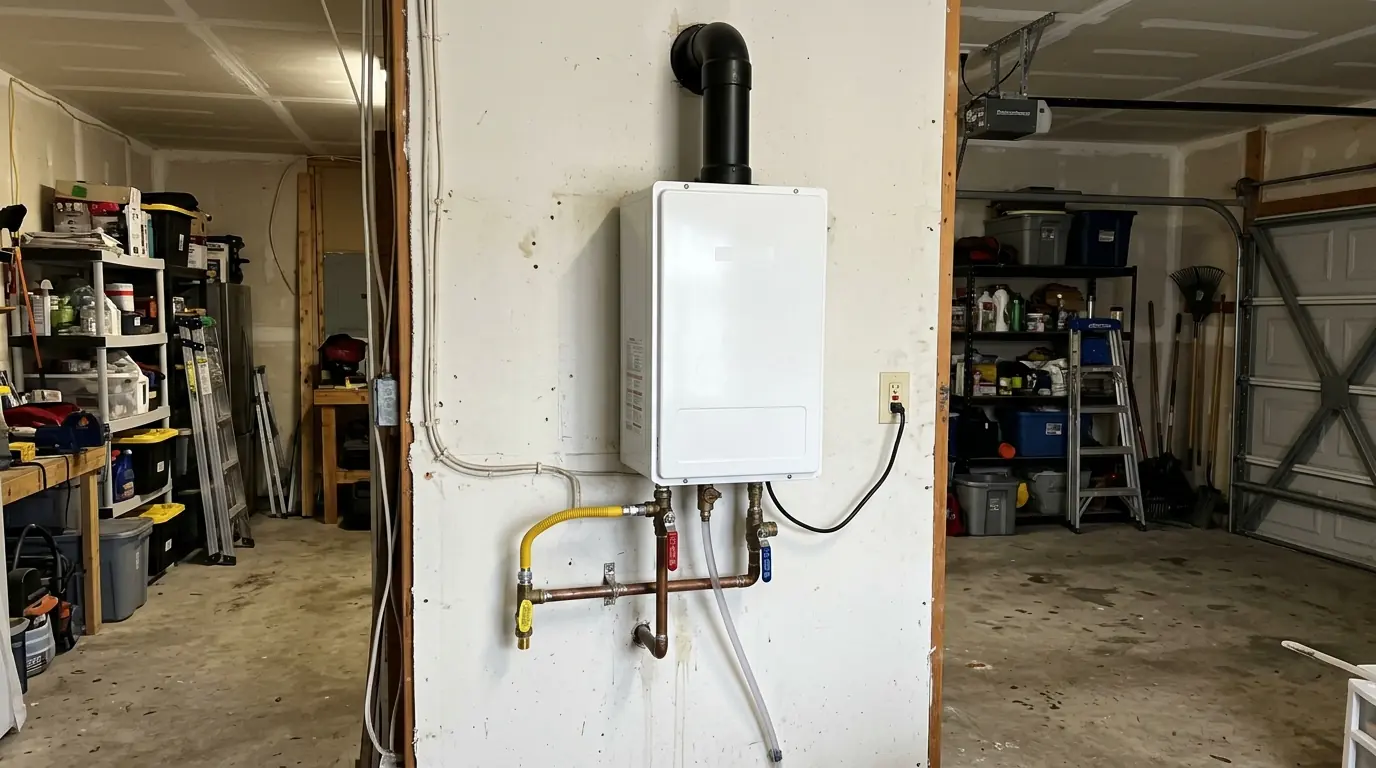
A tankless unit hangs on a wall about the size of a carry-on suitcase, which frees floor space in a closet or garage. That matters in houses where the heater sits in a hallway closet or an attic platform. Taking a heavy tank out of an attic also removes a large volume of water that could come through a ceiling if the tank ever failed.
Tank heaters, on the other hand, fit where the old one stood with few changes. In a typical garage installation, a like-for-like swap uses the same gas connection, the same flue and the same drain pan, which keeps the job short. If the vent route for a tankless unit would have to cross a finished ceiling or a long attic run, that alone can tilt the choice.
Which households fit which heater
There is no single answer, but patterns show up quickly once you look at how a house uses hot water. If you are replacing a failed tank today and are not sure, our guide on repairing or replacing a heater covers the first decision. When the choice is a straight swap, our water heater replacement page explains the work; when the plan is to switch, tankless installation covers gas sizing and venting in detail.
- Tankless tends to fit: larger families who run out of hot water, homes with a big soaking tub, owners planning to stay many years, and anyone willing to keep up with descaling.
- A tank tends to fit: smaller households, homes where upsizing the gas line would be difficult, rentals, and owners who want the simplest maintenance.
- Either can work: average households where the gas line is already sized adequately. Here, venting route and budget usually decide.
- Consider a heat pump tank: all-electric homes with garage space, where lower operating power matters more than recovery speed.
Questions
Follow-up questions readers ask
Often, yes, but the gas line, vent and electrical outlet usually change. The wall has to support the unit and there must be room for the vent run and service valves. A site check before ordering avoids surprises.
Sometimes. The meter and service line need enough capacity for the tankless burner plus the furnace, range and dryer running together. If it falls short, the gas utility may need to upsize the meter.
With hard water and no softener, plan on it at least once a year, and more often for a busy household. A softener can stretch that interval. The unit's error codes and a drop in flow are signs it is overdue.
It removes standby heat loss, so savings depend on how much hot water you use and how efficient your current tank is. Installation costs more, so the payback is longer for small households.
Yes. Larger homes sometimes use two units in parallel or one per wing of the house. That adds flow capacity and gives a backup if one unit is down for service.
When you need the work done
Services this guide covers
- Tankless Water Heater InstallationGas tankless units sized for the house, with the gas line and venting to match.
- Water Heater ReplacementA worn-out tank swapped for a new gas or electric unit, hauled away the same visit.
- Tankless Water Heater RepairError codes, cold-water sandwiches and scaled heat exchangers diagnosed and fixed.
- Water Softener InstallationA softener plumbed with a bypass and drain so hard water stops scaling fixtures.
Keep reading
More from the Plumbing Library
- What a hydrostatic plumbing test tells youFoundation repair estimates and home purchase contracts often call for a hydrostatic test.
- Polybutylene pipe in Houston homes: how to spot itIf your house was built in the late 1970s through the mid-1990s, there is a fair chance some of its water lines are polybutylene.
- Hard water and chloramine in southeast HoustonWhite crust on the shower head, a water heater that pops and rumbles, a faint pool smell from the tap.
Still not sure?
Call and describe what you see. A person answers 24/7.