Plumbing Library
The hydrostatic plumbing test, explained for Houston homeowners
Foundation repair estimates and home purchase contracts often call for a hydrostatic test. It sounds technical, but the idea is simple: fill the drains under the slab with water and see whether they hold it.
By Greta Wilburn, Plumbing Library EditorUpdated October 2026
Short answer
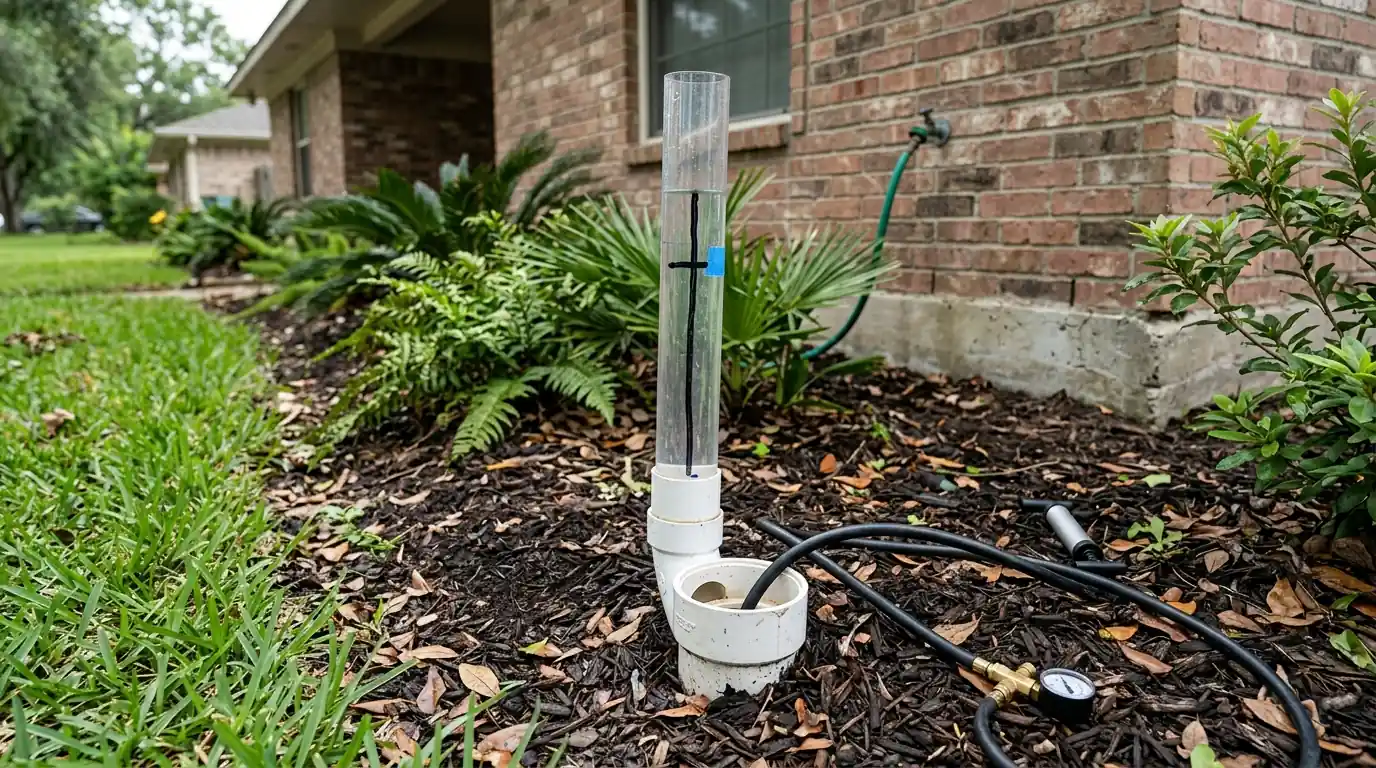
A hydrostatic test checks whether the drain and sewer pipes under a Houston slab hold water. The plumber plugs the main line at the cleanout, fills the system to floor level, and watches whether the water level drops. A drop means a crack, broken joint or separated pipe somewhere under the house, which a camera then helps locate.
What the test checks, and what it does not
Your house has two separate pipe systems under the slab. Supply lines carry pressurized water in. Drain lines carry waste water out by gravity to the sewer. A slab leak on the supply side moves the water meter. A crack in the drain side does not, because drain lines are empty most of the time and only leak when water flows through them. That is why a drain leak can run for years unnoticed while it washes soil out from under the foundation.
A hydrostatic test is aimed at that drain side. It does not test the supply pipes, which are checked with a pressure gauge and leak detection equipment instead. If you suspect a supply leak because of a warm floor or a spinning meter, our guide to slab leak signs is the better starting point.
Why foundation companies and buyers ask for one
Houston houses sit on clay that moves with moisture. The USDA describes the region's Lake Charles clay as cracking up to 2 inches wide and a foot or more deep when it dries, and local reporting has quoted specialists warning that anyone south of Interstate 10 should watch for drought-related foundation movement. A leaking drain under a slab feeds water into that clay, which swells, softens and washes away in places.
Foundation repair contractors know this, so many want the drains tested before they lift a slab. If they level a house and a broken drain keeps soaking the soil, the work can be undone. Lifting a slab can also crack old drain joints, so a test after the repair is common too. Home buyers ask for the test during the option period when the inspection report shows foundation movement or the house has original cast iron drains, which a leak-detection firm notes disappeared from new construction by the mid-1980s.
How the test runs, step by step
A standard test takes a few hours, and the household cannot use any drains while it runs. Here is the usual sequence:
- Access the main line at the exterior cleanout, or install a cleanout if the house does not have one.
- Insert an inflatable test ball past the point where the drain leaves the foundation, sealing the system off from the city sewer.
- Fill the drains with water through the cleanout or a fixture until the level reaches just below the lowest floor drain, usually a shower.
- Hold the water and watch the level in the cleanout riser over a set period, often around 15 to 30 minutes.
- If the level drops, isolate sections by moving the test ball or plugging branches, then test each section again.
- Release the water slowly and remove the plug so the system drains normally.
What a failed result means
A pass means the level stayed put, and the drain system under the slab is holding water at the time of the test. A fail means water is escaping somewhere, and the speed of the drop gives a rough idea of how big the opening is. A slow drop may be a cracked joint or a worn wax ring at a toilet flange. A fast drop points to a broken or separated pipe.
One caution: a failed test tells you that a leak exists in the section tested, not exactly where. Toilets, tub drains and shower pans can lose water too, so a careful plumber rules those out before calling it an under-slab break. The next step is narrowing it down by section, then looking inside the pipe.
Want it checked instead?
Ring us 24/7 and we will get someone out to look.
Camera follow-up: seeing inside the drain
Once a section has failed, a sewer camera inspection shows what is actually wrong. The camera head goes in through the cleanout or a pulled toilet, and the footage shows cracks, offset joints, root intrusion, bellied sections that hold water, or cast iron that has scaled and split along the bottom. A locator picks up the camera head's signal through the floor, so the problem spot can be marked on the slab.
This step changes the size of the repair. Without it, you would be guessing how much pipe to replace. With it, you can see whether you are dealing with one bad joint or a long run of deteriorated cast iron, and you have recorded footage to share with a foundation company, an adjuster or the other side of a home sale.
Repair choices after a failed test
The fix depends on where the damage sits and how much of the system is affected. These are the usual routes for under-slab drain repair:
- Through-slab repair: a small section of concrete is cut over the marked spot, the bad pipe is replaced, and the floor is patched. Suits a single break in open floor.
- Tunneling: a crew digs under the foundation from outside, reaching the drain without opening interior floors. Useful when the damage sits under cabinets, tile or several rooms, or when the run is long.
- Partial or full drain replacement: when the camera shows widespread cast iron decay, replacing the run is often more sensible than patching one spot after another.
- Retest: after any repair, the system is filled again so you have a passing result on record.
Scheduling the test around a sale or foundation work
Timing matters. During a purchase, the option period is short, so book the test early and ask for the camera at the same visit if possible. For foundation work, many contractors want one test before leveling and another after. Tell your plumber which situation you are in so the report covers what the other party needs. If you also want a broader look at the supply side, fixtures and water heater, a whole-house plumbing inspection can run alongside it. We can schedule a hydrostatic plumbing test and camera work together, and you can call us any hour to set it up.
Questions
Follow-up questions readers ask
Someone needs to let the plumber in and make sure no one in the house runs water, flushes or showers while the system is plugged. Using a fixture mid-test can overflow a floor drain or skew the result.
The test only fills drains to floor level, which is the same height they reach during a clog. A pipe that fails under that load was already weak. It does not add pressure beyond what the drains are built to hold.
The test can sometimes run through a pulled toilet, but a cleanout gives better access and makes future camera work and drain cleaning far easier. Many plumbers install one as part of the test.
Ideally both. Before shows whether a leak is feeding the soil, and after confirms that lifting the slab did not crack a joint. Ask your foundation contractor which results they need on paper.
Look for which sections were tested, how long the water was held, how far the level dropped and whether a camera located the cause. A useful report pairs the numbers with photos or video and the marked location.
Yes. That is common, and it is why plumbers isolate the system into sections. It helps keep the repair limited to the line that actually leaks.
When you need the work done
Services this guide covers
- Hydrostatic Plumbing TestUnder-slab drain testing for foundation repair, home sales and suspected drain leaks.
- Under-Slab Drain RepairBroken drains under the foundation reached by tunneling or a targeted floor cut.
- Sewer Camera InspectionA recorded camera run that shows breaks, bellies and roots before anyone digs.
- Plumbing InspectionA full check of supply, drains, gas and the water heater for buyers and owners.
Keep reading
More from the Plumbing Library
- Polybutylene pipe in Houston homes: how to spot itIf your house was built in the late 1970s through the mid-1990s, there is a fair chance some of its water lines are polybutylene.
- Hard water and chloramine in southeast HoustonWhite crust on the shower head, a water heater that pops and rumbles, a faint pool smell from the tap.
- Protecting Houston pipes from a hard freezeMost winters bring a cold night or two and nothing breaks.
Plumbing problem right now?
We answer 24/7. Call and talk to someone who can send a plumber.