Tracking down that sewer odor
Fixing sewer smells and plumbing vents in Houston
The smell comes and goes, usually worse in one room or after rain. Sewer gas almost always has a simple path into the house, and finding that path is most of the work.
- We answer 24/7, nights and weekends included
- Based near Beltway 8 and the Gulf Freeway
- Smoke testing shows exactly where gas escapes
Updated October 2026

Short answer
Sewer smell in a Houston house usually comes from one of three things: a trap that has dried out, a toilet wax ring that no longer seals, or a vent pipe that is cracked or blocked. We check the easy causes first, then use a smoke test to push visible smoke through the drain system and see where it escapes.
The job
Why sewer gas gets into a house and how we find the leak
Every drain in your house has a water seal, the bend of pipe under a sink or built into a toilet, that blocks gas coming up from the sewer. The vent system lets air in and out of the pipes so those seals do not get siphoned dry when water rushes past. If a seal is lost or a vent fails, gas finds its way inside. That is why a sewer smell is a plumbing problem, not a cleaning problem.
We start by running water in rarely used drains, checking toilets for a rocking base that signals a failed wax ring, and looking at the drain side of fixtures for loose slip joints. If the source still is not clear, we seal the roof vents and feed nontoxic smoke into the system. It drifts out of whatever crack, open fitting or bad seal is letting gas in. If gurgling drains point to a partial blockage instead, clearing the drain line may fix both the odor and the slow flow.
Pricing
What drives the cost of fixing a sewer smell
The price depends far more on where the leak is than on the parts. A loose trap under a sink is quick; a cracked stack inside a finished wall is not.
Finding the source
Some smells are obvious in minutes. Others need a full smoke test of the system.
Where the fault sits
Under a sink is easy access. Inside a wall, ceiling or behind a tub needs an opening.
Roof work
Vent repairs from the roof depend on pitch, height and the condition of the flashing.
Pipe material
Replacing a cracked cast iron section means transition couplings and more cutting than PVC.
Toilet reset
A failed wax ring may also need a new flange or closet bolts if the old ones are rusted.
Typical planning range: $500 - $5,000 for plumbing vent pipe replacement, $1,500 on average, per Angi (Upda). That is a published range, not a quote. Your price comes after we look.
The versions we see most
Roof vent stack repairs
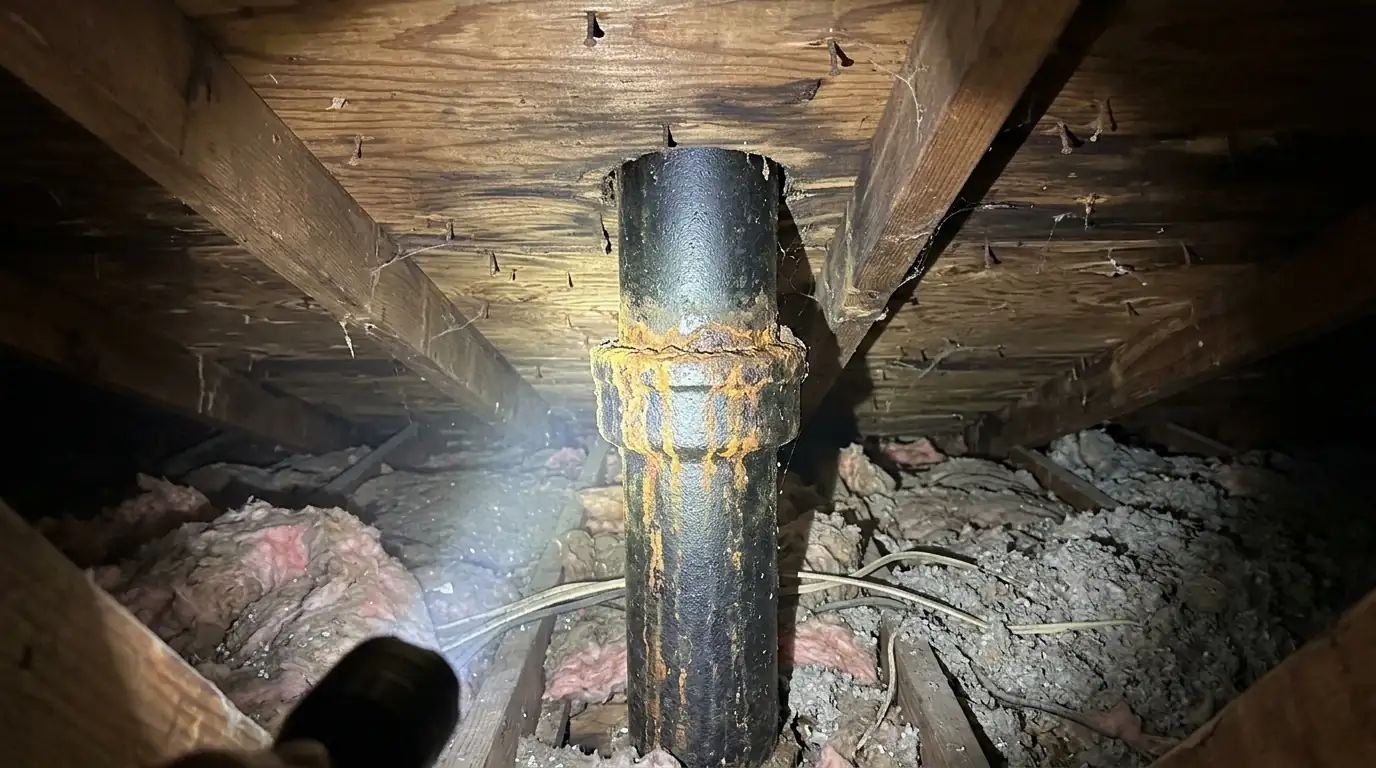
A vent stack runs from the drain lines up through the attic and out the roof. When it fails, the signs are slow, gurgling drains and an odor that seems to come from the attic or the ceiling. Common causes here are a rubber boot that has cracked around the pipe on the roof, a stack knocked loose from its fitting in the attic, or a bird nest or leaves sitting in the open end. We check the run from the attic side, clear any blockage from the roof and replace cracked sections or loose fittings. If the flashing boot is cracked, rain can also leak in around the pipe, so that gets replaced too.
Dry traps and missing P-traps
A guest shower, a floor drain in the laundry room or a sink nobody uses can lose its water seal to evaporation in a few weeks, especially in summer. Pouring water in fixes that. When the smell comes back quickly, the trap may be leaking, cracked or missing. We still find older remodels where a sink was hooked up with a straight pipe or a flexible accordion tube instead of a true P-trap, which leaves no seal at all. We replace the fitting with a proper trap and trap arm at the right slope, and check the trap seal holds after the drain runs hard.
Air admittance valves
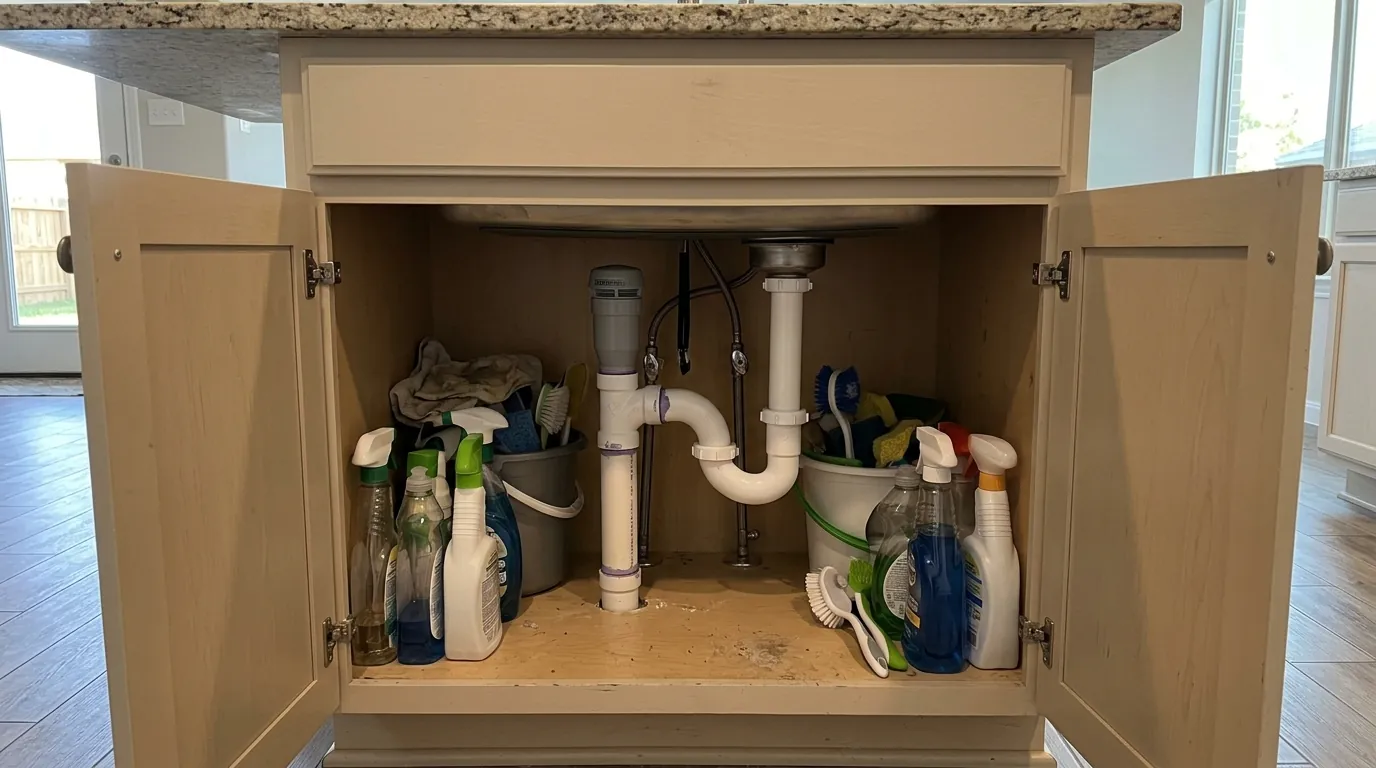
An air admittance valve is a one-way vent that lets air into a drain line without running a pipe through the roof. You find them under island sinks and in some remodels. The spring and seal inside wear out, and a failed valve can stick open and leak gas into the cabinet, or stick shut and let the trap siphon dry. If your smell is strongest under one sink, this is a good place to look. We replace the valve and confirm it sits above the trap arm where it belongs. If the valve was added to dodge a vent that should run through the roof, we will tell you.
Before you call
Quick checks before you call
| Situation | What you can safely do | When to call us |
|---|---|---|
| A guest bath or floor drain smells | Pour a quart of water into each unused drain | If the smell returns within days |
| Odor under a sink cabinet | Hand-tighten the trap slip nuts and look for drips | If there is no P-trap or the valve under the sink hisses |
| Toilet smells or rocks | Stop using it and check for water at the base | Same week, the wax ring has likely failed |
| Strong smell all through the house | Open windows and leave | Call us; if it smells like gas, call the gas company first |
Local to southeast Houston
Older drain and vent pipes around Houston
Many Houston houses still have original cast iron in the drain and vent system. Cast iron disappeared from new home construction by the mid-1980s, and deterioration can begin about 40 years into use, which shows up as cracked hubs and rusted-through sections. In Golfcrest/Bellfort/Reveille, most homes date from suburban development after World War II. A pinhole in an old stack inside a wall can leak gas for months before anyone thinks to check the vent.
Talk to a plumber now
Any hour, any day. Tell us what you see.
Step by step
How a sewer odor call usually goes
Ask and sniff
We ask where and when the smell shows up, then check the rooms you name.
Check the simple causes
Unused drains, toilet seals, trap joints and any air admittance valves come first.
Smoke test if needed
Roof vents are capped and smoke is pushed through the system to show leaks.
Make the fix
We replace the trap, wax ring, valve, boot or cracked pipe section.
Recheck
Drains are run hard and the area is checked again for odor and smoke.
Common questions
Sewer Smell & Vent Repair questions from Houston homeowners
At the low levels found in a house it is mostly an odor problem, but it can cause headaches and nausea, and it should not be ignored. A strong, constant smell means a large opening that needs fixing soon.
Sewer gas smells like rotten eggs mixed with sewage and is strongest near drains. Natural gas has an added rotten egg odor near appliances or the meter. If you suspect natural gas, leave and call the gas company first.
Intermittent odor often follows a pattern: after a nearby toilet flushes, on windy days, or after the room sits unused. Those patterns point us toward a siphoning trap, a vent problem or a dry drain.
No. The smoke is nontoxic and leaves no residue. It may drift out of an open drain or a gap you did not know about, which is exactly what we are looking for.
They do wear out. If a valve under a sink is old and the smell sits in that cabinet, swapping it is usually a quick fix.
Yes, a broken line near the foundation can let gas rise along the pipe. If the inside system tests tight, we look at the main with a camera.
Same system, different job
Related plumbing services
- Drain CleaningKitchen, bathroom and laundry drains cleared with the right cable for the pipe.
- Toilet RepairRunning, rocking, leaking or clogged toilets fixed the same day.
- Sewer Camera InspectionA recorded camera run that shows breaks, bellies and roots before anyone digs.
- Sewer Line RepairOne cracked, offset or root-broken section dug and replaced, not the whole run.
Want a straight answer before you decide?
Call and tell us what you are seeing. We will explain the options and what each one involves.