Gas tankless, sized right
Tankless water heater installation across Houston
You're tired of the tank running out halfway through the second shower, or the old one is failing and you'd rather not buy another. A tankless unit can fix both, if the gas supply and venting are planned for it.
- We answer 24/7, nights and weekends included
- Out of South Belt, near the Gulf Freeway
- Gas supply measured before the unit is chosen
Updated October 2026

Short answer
Tankless water heater installation in Houston depends on gas supply more than anything: a whole-house unit can need several times the gas of a 40 or 50 gallon tank, so we check the meter, line size and run length first. Then we size the unit to the showers and fixtures you use at once, and plan venting and service valves for descaling.
The job
Sizing a tankless unit to your house, not the brochure
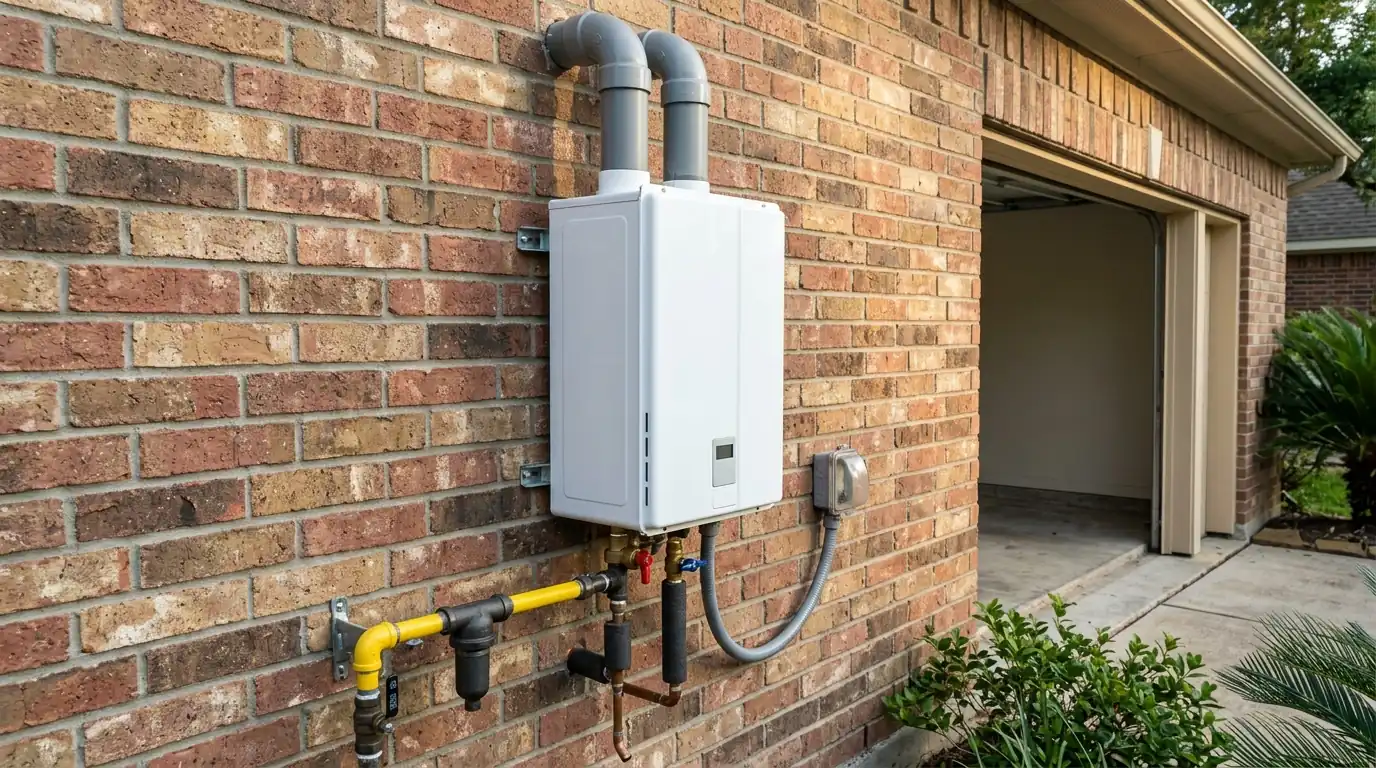
A tankless heater fires a burner only when a tap opens, heating water as it flows through a heat exchanger. The question isn't gallons stored, it's gallons per minute at the temperature rise you need. We count the fixtures that run together in your house, such as two showers and a dishwasher, and match that flow to a unit's rating with room to spare.
The second half of the plan is the house itself. Most tankless units need a larger gas line than the tank they replace, a dedicated vent with the right material, an electrical outlet for the controls, and isolation valves so the heat exchanger can be flushed. Houston water is hard enough that we treat those service valves as standard, not optional, and pairing the unit with a water softener cuts down on scale even more.
Your options
Tankless or a new tank: a side-by-side look
| Compare | Gas tankless | Gas tank |
|---|---|---|
| Hot water supply | Continuous, limited by flow rate | Limited by stored gallons |
| Space used | Wall-mounted, frees floor space | Floor or platform footprint |
| Gas line needs | Often a larger line from the meter | Usually works on the existing line |
| Upkeep in hard water | Heat exchanger descaling on a schedule | Tank flush and anode checks |
| Up-front work | New venting, gas and water piping | Mostly a like-for-like swap |
Tankless makes the most sense when you want continuous hot water or need the floor space and the gas supply can be upgraded. If the budget is tight and the tank simply failed, a new tank is the faster fix.
Pricing
What goes into the price of a tankless install
The unit is one piece of it. Gas line work, venting and where the unit mounts often decide whether an install is simple or involved.
Unit size and type
Higher flow units and condensing models cost more than smaller non-condensing ones.
Gas line upsizing
A longer or larger new gas run from the meter adds material and labor.
Venting route
A short sidewall vent is simpler than a run through the attic and roof.
Indoor or outdoor mount
Outdoor units skip the vent pipe but may need extra protection for the piping.
Electrical and condensate
An outlet near the unit and a condensate drain on condensing models may need adding.
Permit for gas work
Gas connections in Houston need a permit, and we include it in the quote.
Typical planning range: $1,977 - $4,462 for tankless water heater in Houston, TX, per Angi (Upda). Use it for budgeting; the real number depends on what we find on site.
The versions we see most
Tank-to-tankless conversions
Most of our tankless jobs start with a tank heater that's still standing in the garage or closet. Converting means removing the tank and its old flue, mounting the new unit on the wall, and re-piping the hot and cold lines to meet it. The old draft hood vent usually can't be reused, because tankless units need their own sealed vent in PVC, polypropylene or stainless depending on the model. The floor space the tank used is freed up. If you're on the fence between the two, our tankless vs tank guide walks through the tradeoffs, and a same-size tank replacement is still on the table.
Gas line upsizing for tankless
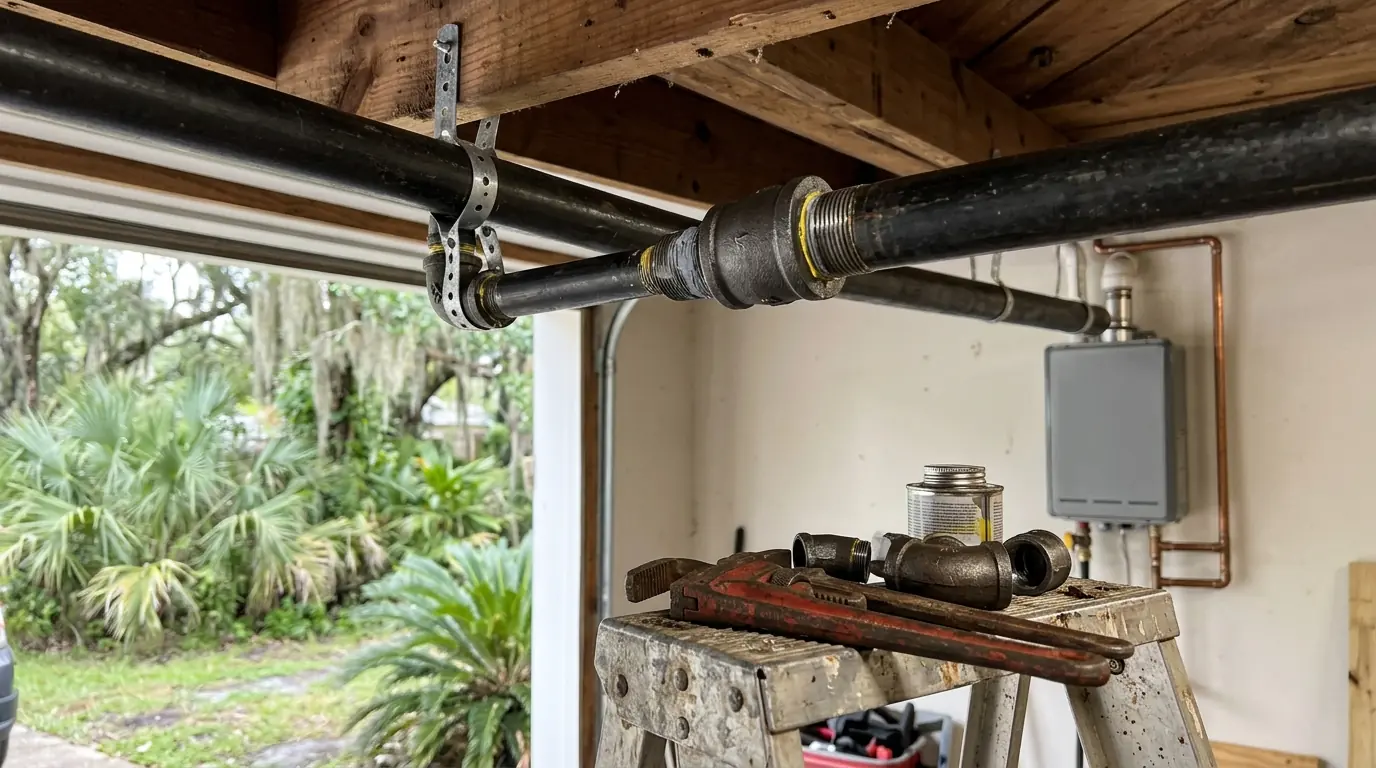
This is the part that gets skipped on bad installs. A tankless burner at full fire can demand far more gas than a tank heater, and a half-inch line that fed the old tank often can't deliver it. The result is a unit that throws ignition errors or sends lukewarm water when two showers run. We measure the run from the meter, add up every gas appliance on the line, and size new pipe to carry the full load. Sometimes that means a new line from the meter, sometimes only upsizing the last section. We pressure test the new piping before the unit is fired, and if the meter itself is too small, we tell you before the job starts.
Indoor and outdoor units
Where the unit goes shapes the whole install. Indoor models in a garage, laundry or closet need a sealed vent through the wall or roof and combustion air, but they're protected from weather and easy to reach. Outdoor models mount on an exterior wall and vent straight out of the cabinet, so there's no vent pipe through the house. On the Gulf Coast the tradeoff is wind, rain and the occasional freeze; outdoor units have freeze protection that only works if the power stays on. We look at where your gas line enters, where hot water is used most, and how far the unit sits from the main bathroom.
Scope of the work
What a tankless installation includes
- Fixture count and flow sizing for your household
- Gas load calculation and new or upsized gas piping
- Removal and haul-away of the old tank heater
- Wall mounting of the indoor or outdoor unit
- Dedicated sealed venting for indoor models
- Isolation valves with flush ports for descaling
- Condensate drain and neutralizer on condensing units
- Gas pressure test and combustion check at full fire
- A walkthrough of the controls and flushing schedule
Talk to a plumber now
Any hour, any day. Tell us what you see.
Local to southeast Houston
Why Houston water hardness shapes a tankless install
Hard water is the main enemy of a tankless heat exchanger. Houston's Main system averaged 135.5 ppm of hardness in the 2025 water quality report, which falls in the USGS hard range of 121 to 180 ppm, and some readings ran as high as 229. When that water is heated in the narrow passages of a heat exchanger, scale forms fast. That's why every tankless unit we install gets isolation valves with flush ports, and why we talk about descaling schedules and softening before the job is done, not after the first error code.
Step by step
How we plan and install a tankless heater
Measure demand and gas
We count fixtures used together and check the meter, line size and run length.
Pick unit and location
You see the recommended size, vent route and mounting spot before ordering.
Run gas, water and vent
New gas piping, water lines with service valves, and a sealed vent go in.
Mount and connect
The unit is hung, piped, wired and the old tank hauled away.
Fire and test
We pressure test the gas, check combustion and run several fixtures at once.
Timing
How long a tankless installation takes
A straightforward conversion with a short vent run and a gas line that only needs upsizing near the heater often takes most of a day. If a new gas line has to run from the meter, or the vent goes up through the attic and roof, plan on one to two days. Hot water is off from when the old tank is drained until the new unit is fired; we keep cold water on through most of the job.
Brands we service and install
We install gas tankless units from Navien, Rinnai and Noritz, sized to your fixtures and gas supply.
- Rheem
- A. O. Smith
- Bradford White
- Navien
- Rinnai
- Noritz
- Kohler
- Moen
- Delta
- American Standard
- Pfister
- InSinkErator
- Uponor
- Watts
Common questions
Tankless Water Heater Installation questions from Houston homeowners
Sometimes, but often not. Tankless units can need far more gas at full fire than a tank. We measure the line size, length and other appliances on it before recommending a unit, so you know if upsizing is part of the job.
It depends on how many fixtures run at once and how much the water needs heating. A home with two showers running together needs a higher flow unit than a one-bath house.
Yes. Hard water builds scale in the heat exchanger, so it should be descaled on a schedule through the service valves. Skipping it leads to error codes and lukewarm water.
Yes, outdoor models mount on an exterior wall and vent through the cabinet. They have freeze protection built in, but it needs power, so the piping below the unit should be insulated too.
No. Tankless heats water continuously, but it still has to travel through the pipes. A recirculation setup is what shortens the wait at far fixtures.
Same system, different job
Related plumbing services
- Tankless Water Heater RepairError codes, cold-water sandwiches and scaled heat exchangers diagnosed and fixed.
- Water Heater ReplacementA worn-out tank swapped for a new gas or electric unit, hauled away the same visit.
- Gas Line InstallationNew gas runs for ranges, dryers, tankless heaters, generators and outdoor kitchens.
- Hot Water Recirculation PumpHot water at the far bathroom in seconds instead of a minute of running tap.
- Water Softener InstallationA softener plumbed with a bypass and drain so hard water stops scaling fixtures.
Ready to talk it through?
Call any hour. We look first, explain the choices, and price them before work starts.