Weak flow or banging pipes
Water pressure repair in Houston, high or low
Pressure trouble cuts both ways. A shower that barely wets you and a washer valve that slams the pipes are both pressure problems, and the fix starts with a gauge on a hose bib, not a guess.
- Answering calls 24/7 for Houston homes
- Out of South Belt, by Ellington
- Static pressure tested before any part is changed
Updated October 2026

Short answer
Water pressure repair in Houston begins with a gauge reading at a hose bib, which tells us in a minute whether the house is over or under a normal 40 to 80 psi range. High readings usually trace to a failed pressure reducing valve. Low readings can come from that same valve, a partly closed main, or old pipe narrowed by scale.
The job
Is it the whole house or one faucet?
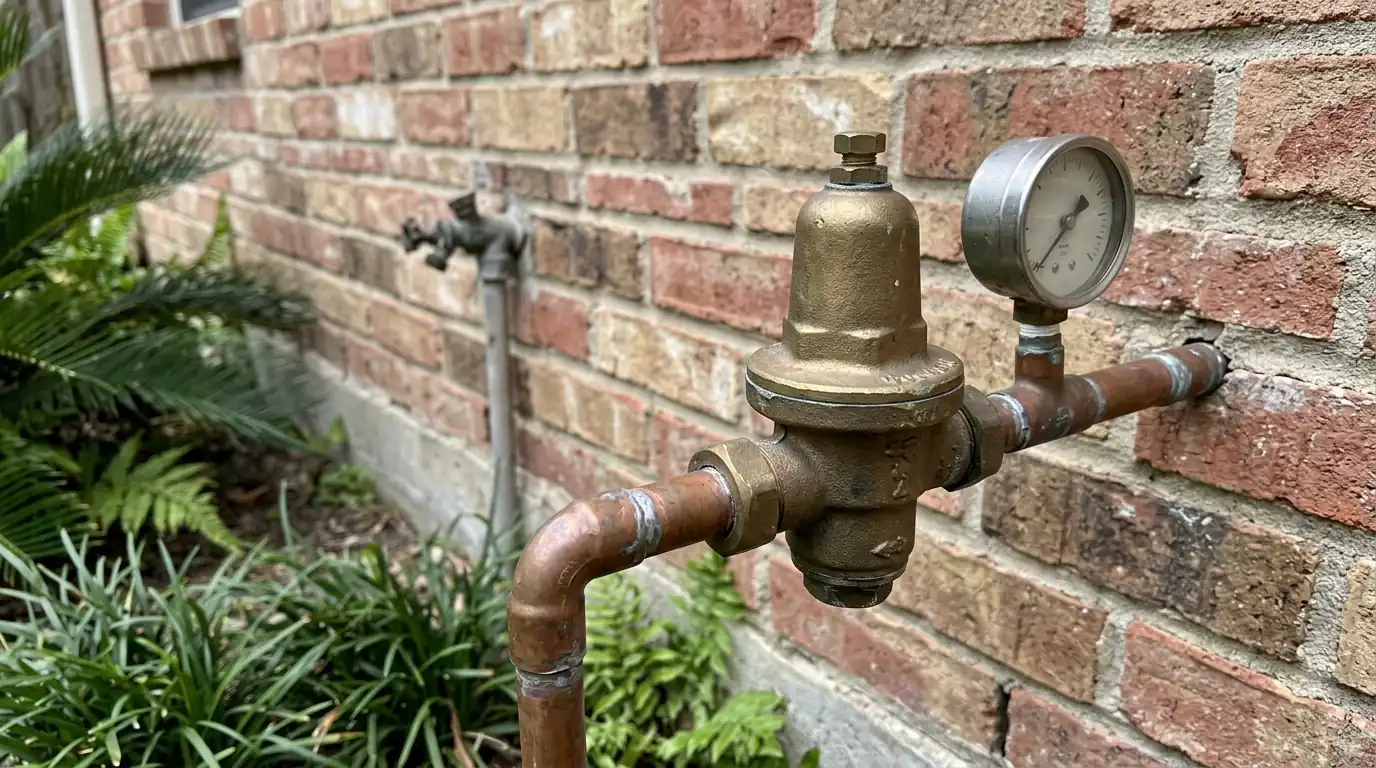
That one question sorts out most pressure calls. If only the kitchen faucet is weak, the culprit is usually a clogged aerator or a worn cartridge at that fixture, and it is a small job. If every tap is weak, or every tap is fine except when two run at once, the problem is upstream: at the regulator, the main valve, the service line or the pipe inside the walls.
We read static pressure with everything off, then watch how far it drops with a couple of fixtures open. A big drop on a normal static reading points to a restriction, such as a half-closed valve, a crushed yard line or scale-choked galvanized. A static reading over 80 psi means the regulator is not doing its job, and that stresses every hose, valve and fitting in the house, from the toilet fill valve to the water heater.
Pricing
What decides the cost of fixing water pressure
Pressure work ranges from a quick valve swap to replacing pipe. The diagnosis tells you which you are facing before anything is bought.
Where the problem is
A single fixture costs far less than the main or the pipe in the walls.
Valve size and location
A PRV in an easy spot swaps faster than one buried in a wall box or yard pit.
Number of arrestors
Each quick-closing valve may need its own arrestor.
Pipe condition
Scale-choked galvanized may mean sections of new pipe, not just a valve.
Access to the main
A main buried in a flower bed or behind siding takes more digging.
Typical planning range: $300 - $650 for water pressure regulator replacement, per HomeGuide (Sept). Treat it as a planning number only. We price your job after we see it.
The versions we see most
Pressure reducing valve replacement
A pressure reducing valve, or PRV, sits on the main line where it enters the house and holds pressure down to a set point. Inside is a spring and diaphragm that wear out, and mineral buildup can jam them open or shut. A failed-open PRV lets street pressure through, so you hear banging, see dripping relief valves and find toilets hissing. A failed-shut one starves the house. We replace the valve, set it to around 55 to 65 psi, and confirm the reading at a hose bib before we leave.
Low pressure diagnosis
Low pressure has more possible causes, so we work through them in order. First the easy ones: the main shut-off fully open, the PRV set right, no clogged whole-house filter. Then the flow test, comparing a hose bib near the meter with one at the far end of the house. If pressure is good at the street side and weak inside, the restriction is in the house pipe, often old galvanized or a leaking branch. If it is weak at the meter too, the service line or the provider's side is the likely suspect.
Water hammer arrestors
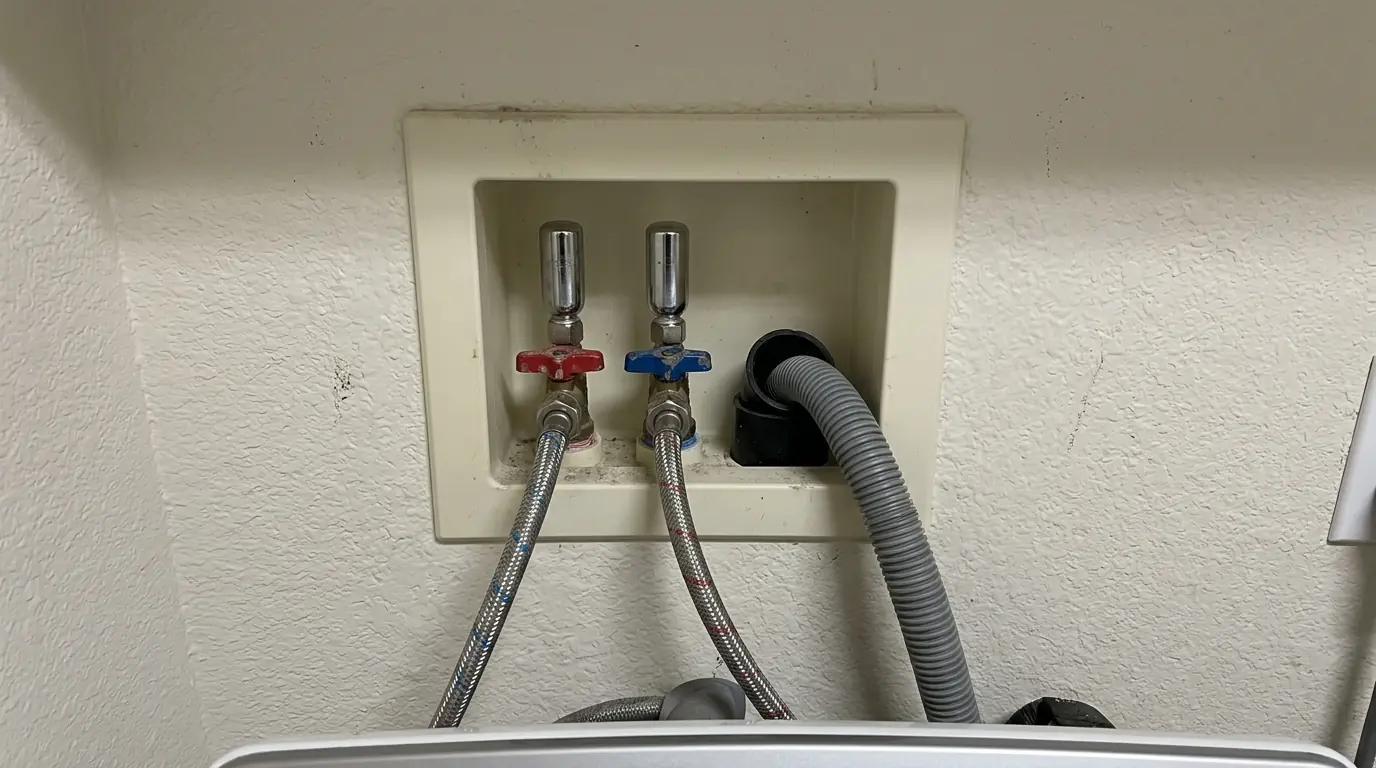
Water hammer is the bang you hear when a washing machine or dishwasher valve snaps shut and the moving water has nowhere to go. Over time that shock loosens straps and fittings. Before adding anything, we check that house pressure is not too high, since an overpressure problem makes hammer much worse. Then we install arrestors at the washer box and other quick-closing valves. These small capped devices hold a cushion of air behind a piston, so the surge has somewhere to go instead of rattling the walls.
Before you call
Pressure checks you can do before calling
| Situation | What you can safely do | When to call us |
|---|---|---|
| One faucet runs weak | Unscrew the aerator and rinse out the grit and scale. | If flow stays weak with the aerator off. |
| Every fixture weak | Make sure the main shut-off is fully open. | If it is open and flow is still low. |
| Pipes bang on shutoff | Note which appliance or faucet sets it off. | If it happens often or straps have loosened. |
| Gauge reads over 80 psi | A hardware store gauge on a hose bib gives you the number. | Any reading over 80, since the PRV needs attention. |
Local to southeast Houston
Hard water and the valves that control your pressure
Houston's Main system averaged 135.5 ppm of hardness in the 2025 water quality report, which lands in the hard range on the USGS scale of 121 to 180 mg/L. That matters for pressure in two ways. Scale settles inside regulators and stop valves, so moving parts stick. And over decades, hard water moving through steel pipe leaves deposits that narrow the opening. A PRV that worked for fifteen years can drift or seize, and galvanized lines slowly lose the flow they once carried.
Talk to a plumber now
Any hour, any day. Tell us what you see.
Step by step
From the first gauge reading to steady pressure
Read static pressure
A gauge on a hose bib with all water off shows the starting point.
Test under flow
We open fixtures and watch how far the reading falls.
Find the cause
Regulator, main valve, service line, house pipe or a single fixture.
Make the fix
Replace the PRV, open or replace a valve, add arrestors or clear the fixture.
Recheck the numbers
Static and flowing pressure are read again so you can see the change.
Brands we service and install
We install and service pressure reducing valves and arrestors from Watts, Uponor fittings on the lines around them, and connections to fixtures from Moen and Delta.
- Rheem
- A. O. Smith
- Bradford White
- Navien
- Rinnai
- Noritz
- Kohler
- Moen
- Delta
- American Standard
- Pfister
- InSinkErator
- Uponor
- Watts
Common questions
Water Pressure Repair questions from Houston homeowners
Most homes run well between 40 and 80 psi, with 50 to 65 a comfortable middle. Above 80, valves and hoses wear faster; below 40, showers feel weak when two fixtures run at once.
Not every one. Many do, usually where the main enters the house or near the meter, but some older homes never had one. We check for it during the first visit.
It can. High pressure pushes the relief valve to drip and adds strain to the tank. A properly set PRV, plus an expansion tank where one is needed, keeps that in check.
A sudden drop at every tap usually means a provider issue, a failed PRV or a new leak on the service line. A sudden drop at one fixture is usually debris lodged in that faucet.
The adjustment bolt is there, and a small turn is fine if you have a gauge to check against. If turning it does nothing, the valve has likely failed inside and needs replacing.
Same system, different job
Related plumbing services
- Water Line RepairLeaking service line between the meter and the house dug, repaired and tested.
- Whole-House RepipingGalvanized, failing copper or patched lines replaced with new PEX or copper.
- Main Shut-Off Valve ReplacementA seized or leaking main valve replaced so the water actually turns off.
- Water Heater RepairNo hot water, pilot trouble or a leaking valve fixed on tank heaters, gas or electric.
Planning the work?
Phone any hour and we will set a time to look at it.