New supply lines, every fixture
Whole-house repiping for older Houston homes
If you have patched the same copper twice this year, or the water runs brown after a faucet sits overnight, spot repairs are only buying time. A repipe replaces every supply line in the house in one planned job.
- Calls answered 24/7, nights and weekends too
- Based in South Belt, off Beltway 8
- Every hot and cold supply line replaced to each fixture
Updated October 2026

Short answer
A whole-house repipe in Houston replaces every hot and cold supply line from the main to each fixture, usually with PEX run through the attic and dropped down inside the walls. Most families stay home during the work, with water back on in the evenings. Drain lines are a separate system and are not part of a standard repipe.
The job
What a repipe replaces, and what it leaves alone
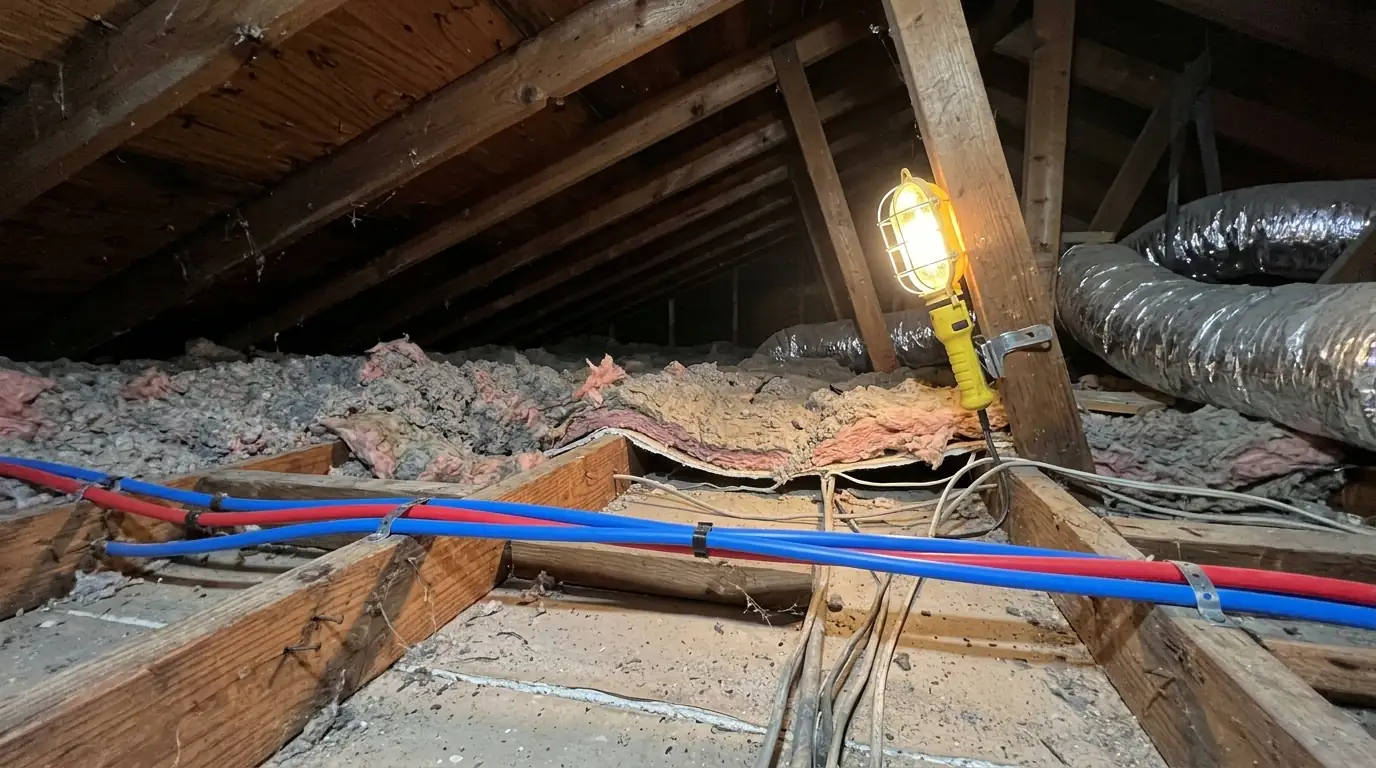
A repipe swaps out the supply side of the house: the line from the main shut-off, the branches to the water heater, and every hot and cold line feeding sinks, tubs, toilets, the washer box and the ice maker. Old pipe is cut and capped, or abandoned in place where it runs under the slab. In most slab homes the new lines go overhead through the attic, so nobody breaks up a floor.
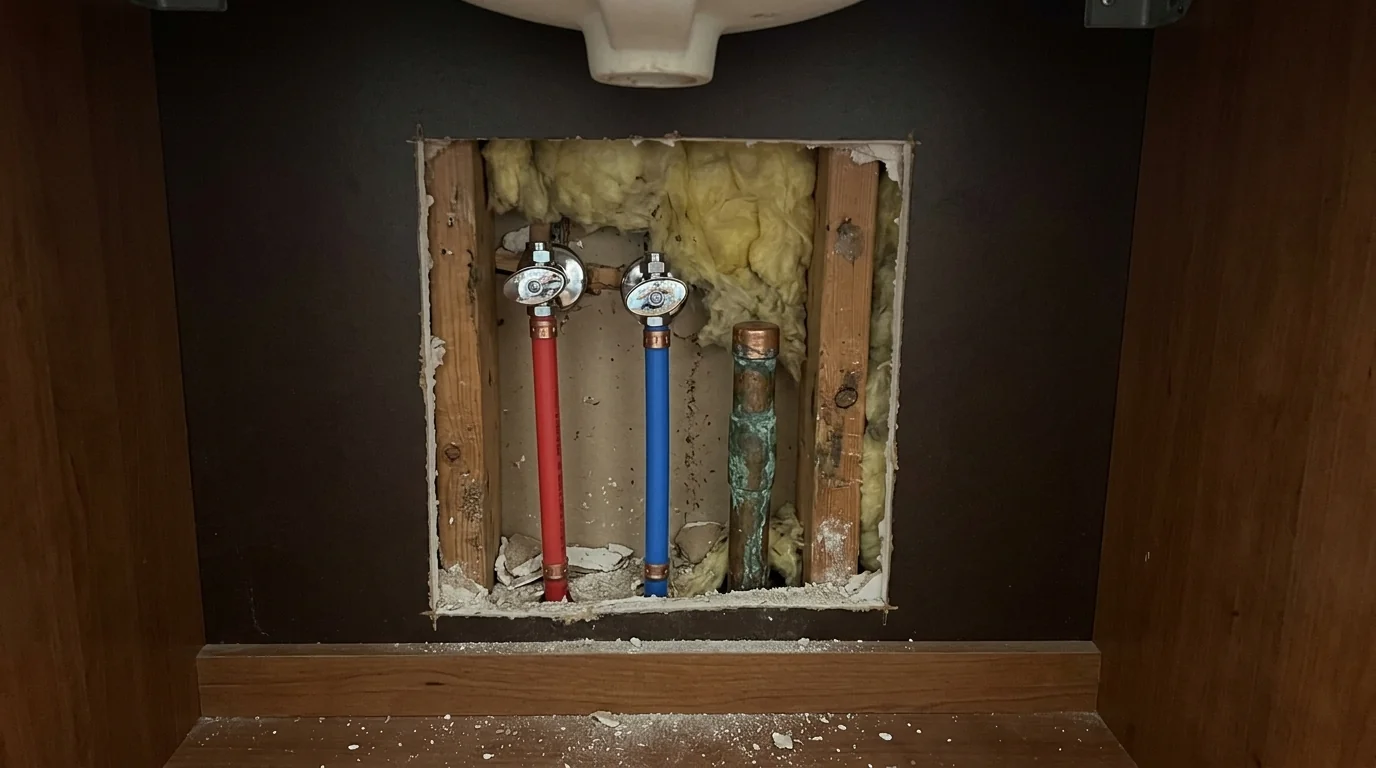
We map the house fixture by fixture first and mark where each new drop will come down. Small square drywall openings let us reach every valve, and the stop valves get replaced while the wall is open. If a leak under the foundation is what sent you here, a repipe moves the supply lines out of the slab for good. If the complaint is weak flow at every tap, we check the pressure regulator first, because a failed PRV can look a lot like pipe trouble.
Your options
PEX or copper for a Houston repipe
| Compare | PEX-A | Type L copper |
|---|---|---|
| Joints in the attic | Few, since the pipe bends around framing | Many, one at every turn |
| Install time | Usually shorter | Usually longer |
| In a hard freeze | Can stretch a little before splitting | More likely to split |
| Sun and heat | Must stay out of direct sun | Handles sun and heat well |
| Water chemistry | Does not pit | Can pinhole with aggressive water |
For most slab houses with an open attic, PEX is the practical choice. Copper makes sense when pipe will be exposed or you simply prefer metal.
Pricing
What moves the price of a repipe
Repipe pricing follows the house more than the pipe. The fixture count, the attic and how much drywall gets opened matter most.
Number of fixtures
Each sink, tub, toilet and appliance line is its own drop and its own valve.
PEX or copper
Copper costs more in material and takes longer to install.
Attic access
A low, tight or floored attic slows the run and can mean more wall openings.
Two stories
Upstairs bathrooms need risers through interior walls or chases.
Drywall patching
Patching and texture are often priced separately from the plumbing.
Typical planning range: $1,479 - $14,790 for repiping a house in Houston, TX, per Angi (Upda). That is a published range, not a quote. Your price comes after we look.
The versions we see most
PEX repiping
PEX is what we install in most repipes. It bends around framing, so the attic run has far fewer fittings, and it does not pinhole the way thin copper can. We use PEX-A with expansion fittings, which stretch the pipe open and let it shrink back over the fitting for a full-bore joint. Lines are red and blue, strapped to the joists, and insulated where they cross hot attic space or exterior walls. The tradeoff: PEX cannot sit in direct sunlight, and it needs a short metal transition at the water heater.
Copper repiping
Some owners want copper, to match a remodel, for resale or simply because they trust metal. We run Type L copper with soldered joints and support it every few feet so it never rubs on framing. Copper takes longer than PEX because every turn is a fitting and every fitting is a joint sweated by hand, and the material costs more. In return you get a rigid, heat-tolerant system that handles sunlight and cramped mechanical closets well. If your old copper pinholed early, we talk through why before choosing copper again.
Galvanized pipe replacement
Galvanized steel turns up in pre-1960s houses and in additions where someone tied into an old run. It rusts from the inside, so the opening narrows year after year. You notice it as brown water after a trip, a shower that never gets strong, or a threaded joint weeping rust. Patching galvanized rarely holds, because the next joint is just as corroded. We cut it out at the main and replace it in full, with dielectric fittings anywhere new pipe meets steel that stays. If galvanized also runs underground from the meter, that line usually needs its own replacement too.
Scope of the work
What comes with a whole-house repipe
- New hot and cold lines from the main to every fixture
- New quarter-turn stop valves at sinks and toilets
- Water heater connections with metal transition fittings
- Washer box and ice maker lines
- Hose bib supply lines on exterior walls
- Insulation on lines in the attic and outside walls
- A full pressure test before drywall closes
- Haul-off of the old pipe we remove
Call before it gets worse
We answer 24/7 from South Belt.
Local to southeast Houston
Why so many South Belt houses are due for new pipe
Age is the main reason. The city's year-built table counts 5,929 homes in South Belt/Ellington built between 1960 and 1979, and another 5,725 built from 1980 to 1999. HAR puts the average build year at 1967 in Sagemont, 1970 in Kirkwood and 1973 in Scarsdale. Pipe in those houses has carried water for five decades or so, and the USGS notes that hard water moving through a pipe for that long can leave scale behind. Older copper, galvanized stubs and earlier patches tend to fail one joint at a time.
Step by step
How a repipe runs from first walk-through to final test
Walk the house
We find every fixture, the main, the water heater and the cleanest attic route.
Protect and open
Floors and furniture are covered, then small openings are cut at each drop.
Run the new lines
PEX or copper goes in through the attic, with new stop valves at each fixture.
Switch over
Fixtures move to the new system and the old supply lines are cut and capped.
Pressure test
The whole system holds test pressure and every connection is checked before walls close.
Timing
How many days a repipe takes, and when you have water
A single-story house with a good attic usually takes two to four days. Two-story homes and copper jobs run longer. We plan the work so water is off during the day and back on most evenings, so you can still shower and cook. Drywall patching can trail the plumbing by a day or two, depending on who handles the finish work.
Common questions
Whole-House Repiping questions from Houston homeowners
Most families stay. Water is off for stretches during the day and usually back on in the evening. Expect some noise and drywall dust in the rooms we are working in, and a few open patches until they are finished.
No. A repipe covers the water supply. Drains and the sewer line are a separate system; if they are old cast iron and failing, we can run a camera through them and price that work separately.
Yes. Repiping one bathroom group or the kitchen side is common when the rest of the pipe is sound. If old pipe is failing everywhere, doing the whole house once usually costs less than doing it in pieces.
It is cut and capped where it leaves the slab and left in place. The new lines run overhead, and since the old pipe no longer carries water, it cannot leak again.
Repeated pinhole leaks, brown water, weak flow at most fixtures, or a house with polybutylene or galvanized pipe are the usual signs. Two or three leaks in a single year is a strong hint the rest is close behind.
Same system, different job
Related plumbing services
- Polybutylene Pipe ReplacementGray plastic supply pipe from the 1980s and early 1990s removed and replaced.
- Water Line ReplacementA new service line from the meter to the house, sized for today's fixtures.
- Slab Leak RepairHot spots in the floor and a meter that never stops, located and repaired.
- Water Pressure RepairLow or banging-high pressure fixed at the regulator, the main or the fixture.
Want a straight answer before you decide?
Call and tell us what you are seeing. We will explain the options and what each one involves.