Split lines and blown fittings
Burst pipe repair across Houston, freeze or no freeze
A stain spreading across the ceiling, a hiss inside a wall after a cold night, or water raining out of a light fixture. Once a pipe splits, every minute with pressure on the line adds to the cleanup.
- We answer 24/7, freeze nights included
- Based in South Belt, close to the Gulf Freeway
- Damaged section cut out, never just taped
Updated October 2026

Short answer
Burst pipe repair in Houston means cutting out the split or blown section and joining new pipe with crimp, press or soldered fittings, then pressure testing before anything is closed up. Shut the main first. Freeze breaks often show up only after thawing, so we check the rest of the exposed run while we're there.
What to watch for
Clues that a pipe has split somewhere you cannot see
No water from one faucet after a cold night
An ice plug, and possibly a split that will leak when it thaws.
Brown ring or sag in a ceiling
Water collecting above the drywall from an attic line.
Hissing inside a wall
Pressurized water escaping through a crack or a blown fitting.
Bubbling paint or swollen baseboard
A slow leak soaking the wall from inside.
Meter moving with everything closed
Water leaving the system somewhere, even if no stain shows yet.
The job
Why a pipe bursts, and why the split is rarely where it froze
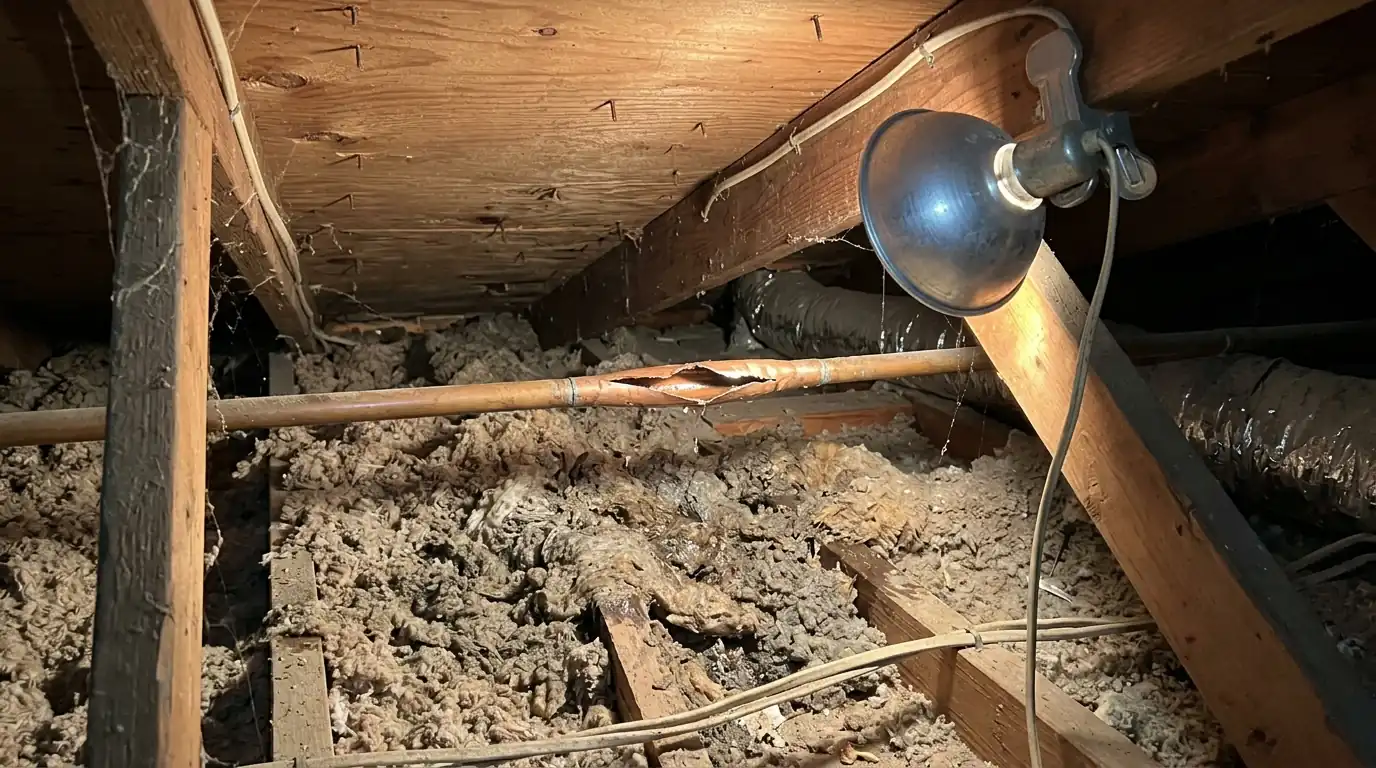
Water expands as it freezes, but the ice plug itself is not usually what breaks the pipe. Pressure builds in the trapped section between the ice and a closed faucet, and the pipe gives at its weakest point, which can be several feet away. Copper splits along its length. PEX usually survives, while its brass or plastic fittings crack or blow off. CPVC tends to shatter at elbows.
That is why we inspect the whole exposed run, not just the wet spot. We cut back to sound pipe on each side, join new material and put the line under pressure before the ceiling or wall is patched. If water has been running into the wall for hours, a moisture meter shows how far it reached. Where the break sits under the floor rather than above it, the job becomes a slab leak repair instead.
The versions we see most
Freeze-damaged pipes
After a hard freeze, the first sign is often silence: a faucet that gives nothing, or one that sputters and stops. Then the line thaws, and water shows up in a ceiling or behind a vanity. Lines in exterior walls, unheated garages and attics are the usual victims, along with the short run feeding each hose bib. We open the area, cut out every split section, replace it, and check nearby fittings that may have cracked without leaking yet. A frost-cracked hose bib is often part of the same job, so we look at the outdoor faucets too.
Attic and wall pipe breaks
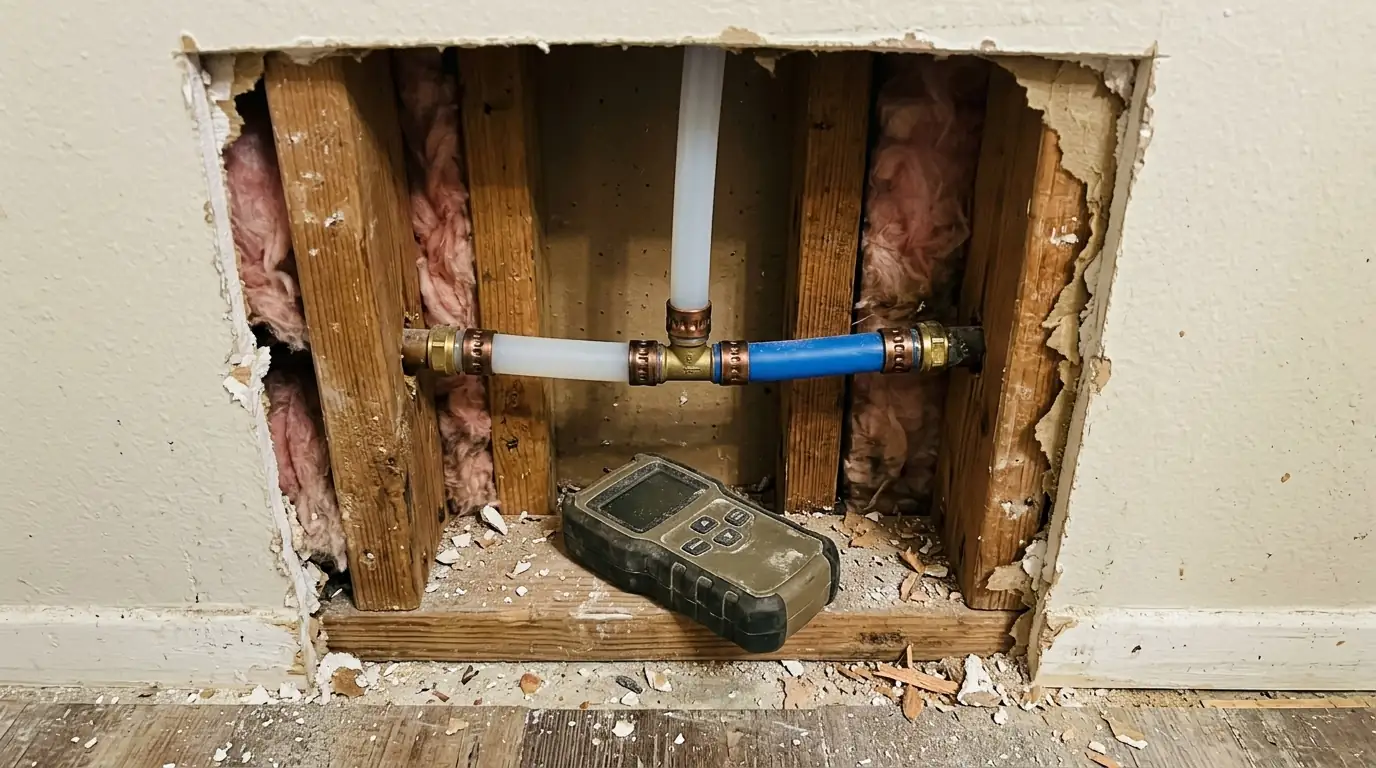
Attics in this climate run hot most of the year, and pipes up there age faster than the ones in conditioned space. A break overhead shows as a sagging, brown-ringed ceiling or water dripping from a light fixture or a supply vent. Inside walls, look for bubbling paint or baseboards that swell. We find the break from below with a moisture meter, cut the smallest opening that gives clean access, and replace the section. When we find brittle CPVC or gray poly pipe in the attic, we tell you, because the next break is often a few feet away.
Pinhole leaks in copper
Not every burst is dramatic. Pinhole leaks start as a tiny spray or a green, crusted spot on copper, and they leave a slow drip that rots drywall for weeks before anyone notices. Pinholes often come in clusters because the pipe wall has thinned from the inside. One pinhole is a short cut-out and a repair coupling. Three or four in different rooms within a year is a different conversation, and repiping the house usually costs less than chasing them one wall at a time.
Timing
How long a burst pipe repair usually takes
A single break in an open area is often repaired in one to two hours, including the pressure test. Breaks inside a finished ceiling or wall take longer because of the access, and a freeze that split the line in several places can fill most of a day.
Water to the house is off while the section is replaced. If the damaged branch can be isolated, we cap it and turn the rest of the house back on while we work. Drywall patching and drying come after the plumbing and are separate from it.
Step by step
From water on the floor to a tested line
Shut and drain
We close the main and open low faucets to take pressure off the system.
Find every split
Moisture readings and a look along the exposed run, not just the wet spot.
Open cleanly
The smallest opening that gives room to work on sound pipe.
Replace the section
Damaged pipe is cut out and new pipe joined with fittings matched to the material.
Pressure test
Water comes back on slowly and every joint is watched before you patch.
Talk to a plumber now
Any hour, any day. Tell us what you see.
Local to southeast Houston
What the February 2021 freeze taught Houston about exposed pipes
Houston does freeze, just not often enough for most homes to be built for it. In February 2021, Bush Intercontinental hit 13 degrees and Hobby 15, the city's 311 line took about 5,000 calls in one week about busted pipes, and water main breaks rose sharply across the system. Records back to 1889 put the average last freeze around February 15, though at Hobby the 30-year average is January 26. Any pipe in an attic, garage or exterior wall is at risk on those nights.
Before you call
Safe first moves when a pipe lets go
| Situation | What you can safely do | When to call us |
|---|---|---|
| Water spraying from a ceiling | Close the main valve, then turn off power to any wet light fixture at the breaker. | Right away, so the line can be repaired. |
| Pipe frozen but not leaking | Open the faucet it feeds and warm the area with a hair dryer, never an open flame. | If no water comes after an hour, or a leak appears. |
| Ceiling bulging with water | Set a bucket under it and poke a small hole at the lowest point to drain it. | Once the water is off, so we can find the break above. |
| Pinhole drip on copper | Wrap a rubber patch and hose clamp over it as a stopgap. | Soon, since more pinholes usually follow. |
Pricing
What decides the cost of a burst pipe repair
The pipe itself is often the smallest part of the bill. Where the break is and how much of the house it soaked matter more.
Location of the break
An exposed line in a garage is quicker than one inside a finished ceiling or behind tile.
Pipe material
Copper, PEX and CPVC each use different fittings and tools to join cleanly.
Number of breaks
A freeze can split a line in more than one spot, and each one is opened and repaired.
Access and patching
Cutting and closing drywall or a ceiling is separate from the plumbing itself.
Time of the call
Night and holiday visits during a freeze cost more than a weekday repair.
Typical planning range: $400 - $2,000 for materials and labor to fix or replace the burst pipe, per HomeGuide (Octo). A guide figure, not our price; your quote follows the inspection.
Common questions
Burst Pipe Repair questions from Houston homeowners
Not until the break is repaired. Turning the main back on sends full pressure into the split, and a crack that only dripped can open wider. Leave it off and use bottled water for a few hours.
PEX pipe stretches and often survives a freeze, but the fittings and valves at the ends of the run can crack. After a hard freeze, check where PEX meets brass or plastic fittings.
Ice can hold a crack shut. When the line thaws and pressure comes back, the split opens and starts leaking. That is why breaks often show up a day or two after the cold.
No. A clamp or patch buys a few hours or days, but the pipe around it is already weakened. The damaged section needs to be cut out and replaced with new pipe.
Let faucets on exterior walls drip, open sink cabinet doors, cover hose bibs, and insulate pipes in the attic and garage. Know where the main valve is before the cold arrives.
Same system, different job
Related plumbing services
- Emergency PlumberBurst lines, sewage backups and no water at 2 a.m. get a call back fast.
- Leak DetectionAcoustic and pressure testing to find a hidden leak before anyone cuts drywall.
- Slab Leak RepairHot spots in the floor and a meter that never stops, located and repaired.
- Outdoor Faucet RepairLeaking hose bibs and frozen spigots repaired or swapped for frost-free valves.
- Whole-House RepipingGalvanized, failing copper or patched lines replaced with new PEX or copper.
Do not wait on a leak
Every hour of running water adds to the repair. Call now, any hour.