Meter to house, all new pipe
Water service line replacement for Houston homes
When the pipe between the meter and your house has been dug up and patched before, or the flow has never kept up with two showers at once, replacing the whole run is usually the cleaner answer.
- We take calls 24/7, every day of the year
- Working from South Belt, near Ellington
- New line from the meter connection to the house valve
Updated October 2026

Short answer
Water line replacement in Houston covers the private pipe from the meter to your house, often somewhere between 30 and 100 feet of buried line. We lay new PEX or copper by open trench or by boring under concrete, connect it at the meter and a new house shut-off, then pressure test it before any soil goes back.
The job
Why replace the whole service line instead of patching it
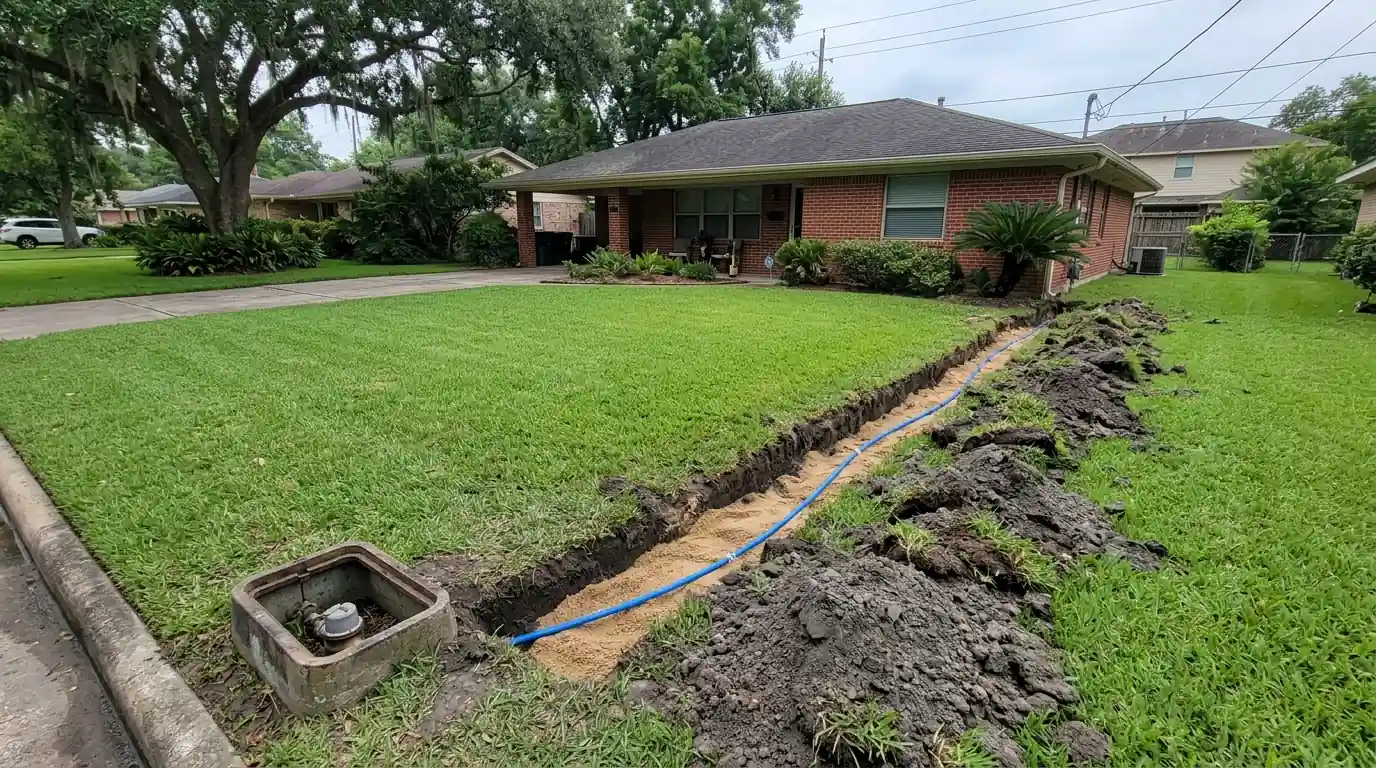
The service line is the one pipe every drop of water in the house passes through. Older lines are galvanized steel, copper or one of several plastics, and once one starts leaking, the same conditions that caused the first break keep working on the rest. A repair fixes one spot. A replacement resets the whole run with new pipe, new fittings at each end and, usually, a better shut-off.
If you have a single fresh leak in an otherwise sound line, a spot repair is often the right call. We suggest full replacement when the line has leaked more than once, when it is undersized for the house, or when it is a material that tends to fail all along its length. It is also a good moment to swap a stuck gate valve for a new main shut-off.
Your options
Open trench or bore: how the new line goes in
| Compare | Open trench | Bore under concrete |
|---|---|---|
| Suited to | Lawn and garden beds | Driveways, walks and patios |
| What gets disturbed | A narrow strip of yard | A small pit at each end |
| Route | Follows bends easily | Straight runs only |
| Restoration | Sod or mulch replaced along the trench | Concrete stays untouched |
| Speed | Usually quicker in soft soil | Slower setup, then moves fast |
Many jobs use both: a trench across the lawn, then a bore under the drive. We walk the route with you and mark where each method fits before anyone digs.
Pricing
What affects the cost of a new water line
Distance is only part of it. What sits between the meter and the house, and how tight the route is, shape most of the price.
Length of the run
A meter at the far curb means more pipe and more digging.
Concrete in the path
Boring under a drive or walk adds equipment and setup time.
Pipe size and material
Upsizing to one inch or choosing copper raises material cost.
Roots and landscaping
Mature trees and beds slow the dig and may need restoring.
Work at the house
A new shut-off, hose bib tee or wall entry adds a little to the job.
Typical planning range: $2,000 - $5,000 for main water line replacement labor and materials; trenched $50 - $200 per linear foot, trenchless $70 - $250 per linear foot, per HomeGuide (Dece). Treat it as a planning number only. We price your job after we see it.
The versions we see most
Meter-to-house replacement
This is the standard job. We find the meter box and the point where the line enters the house, request utility locates, and dig along the most direct path. The old line is disconnected at both ends and left in the ground, or pulled out where it is in the way. New pipe is laid on a sand bed, joined to the customer side of the meter, and brought up at the house to a new shut-off. You see the pressure test holding before any dirt goes back in.
Upsizing for better pressure
Many older homes were fed by a three-quarter-inch line or smaller, sized for one bathroom and a kitchen. Add a second bath, sprinklers and a tankless heater, and the line runs short on volume even when street pressure is fine. You notice it when a toilet refill turns the shower to a trickle. We size the new line to the fixture count, often one inch, so flow holds up with two or three things running. If a regulator turns out to be the bottleneck instead, our pressure repair page covers that fix.
Boring under walks and drives
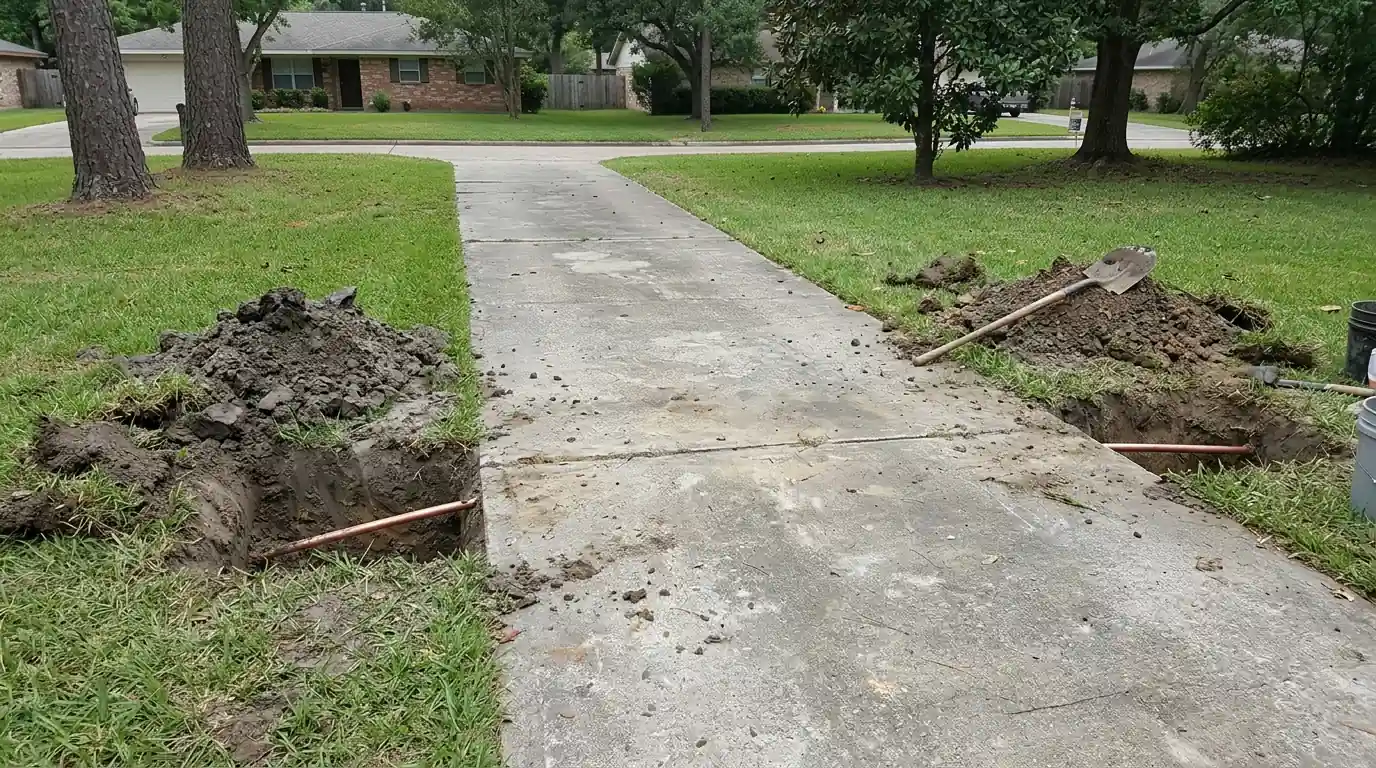
When the shortest path runs under a driveway, a sidewalk or mature landscaping, we bore instead of cutting concrete. A small pit is dug on each side, and a boring tool pushes a path beneath the slab so the new line can be pulled through. It costs more than trenching through soft yard soil but far less than saw-cutting and pouring a new driveway section. The tradeoff is flexibility: bores suit fairly straight runs, so a route with several bends may need a mix of trench and bore.
Scope of the work
What a service line replacement includes
- Utility locate request before digging
- New PEX or copper line sized for the house
- Connection at the customer side of the meter
- New main shut-off valve at the house
- Hose bib tee where the line rises, if wanted
- Pressure test with the trench still open
- Backfill and leveling along the trench
- Old line capped at both ends
Call before it gets worse
We answer 24/7 from South Belt.
Local to southeast Houston
Service lines, the city inventory and Houston clay
The City of Houston says it is inventorying water service lines across its six distribution systems and offers free water testing for qualified homes that may have lead or copper pipe. If you are not sure what the line at your house is made of, opening the ground at the meter answers that fast. The soil matters as well. Southeast Texas clay cracks 1/2 to 2 inches wide when it dries out, and that seasonal movement works on every buried pipe running out to the street.
Step by step
Laying a new line from the meter to your wall
Mark the route
We locate the meter, the house entry and buried utilities, then agree on a path.
Dig or bore
Trench through soil, bore under concrete, keeping the opening narrow.
Lay and connect
New pipe is bedded, joined at the meter and brought up to a new shut-off.
Test before backfill
The line holds pressure with the trench open so the joints are visible.
Close and clean up
Soil goes back, the trench is leveled and the old line is capped.
Common questions
Water Line Replacement questions from Houston homeowners
Usually the water provider is responsible for the meter and the pipe on the street side, and the line from the meter to the house belongs to you. If the leak is on the street side, call your provider; we can help you tell which side it is on.
Deep enough to stay clear of mowers, foot traffic and cold snaps, typically a foot or more. We match the depth to the route and to whatever else is already buried there.
A trench is narrow, about the width of a shovel, and the soil goes back the same day. Grass along the line takes a few weeks to fill back in.
Only during the switchover at the meter and the house, usually a few hours near the end of the job. The old line keeps working while the new one is laid.
Doing both together is efficient, since the new service line and new interior lines get tested as one system. If only one of them is failing, start there.
Same system, different job
Related plumbing services
- Water Line RepairLeaking service line between the meter and the house dug, repaired and tested.
- Whole-House RepipingGalvanized, failing copper or patched lines replaced with new PEX or copper.
- Polybutylene Pipe ReplacementGray plastic supply pipe from the 1980s and early 1990s removed and replaced.
- Main Shut-Off Valve ReplacementA seized or leaking main valve replaced so the water actually turns off.
Planning the work?
Phone any hour and we will set a time to look at it.