Error codes and scale
Tankless water heater repair in Houston
The display is flashing a code, the unit clicks but won't light, or the shower goes hot, cold, then hot again. Tankless heaters fail differently from tanks, and most of those failures trace back to a few causes.
- We answer 24/7, nights and weekends included
- Out of South Belt, off Beltway 8
- Error code history read before parts are ordered
Updated October 2026

Short answer
Tankless water heater repair in Houston most often comes down to scale in the heat exchanger, an ignition or flame sensor fault, or a gas supply that can't keep up. We read the error code and its history, check gas pressure under full fire, and measure flow before replacing any part. Many units recover with a descale and a sensor cleaning.
What to watch for
Signs your tankless heater needs service
A code on the display
The unit has shut down to protect itself and stored the reason.
Clicking but no flame
Ignition, gas pressure or flame sensing is failing.
Water swings hot and cold
Flow sensor, inlet screen or a crossover somewhere in the plumbing.
Takes longer to get hot
Scale is narrowing the heat exchanger.
Shuts off when two taps run
Gas supply or unit size can't keep up with demand.
Whistling or rumbling sounds
Scale or a fan bearing on its way out.
The job
Reading what your tankless unit is telling you
A tankless heater runs a small computer that watches flame, flow, temperature and exhaust. When something is off, it shuts down and stores a code. That code is a starting point, not an answer: an ignition fault can mean a bad igniter, but it can just as easily mean low gas pressure, a blocked vent or a wet flame rod. We pull the code history, then test the likely causes in order.
A good share of tankless calls are scale related. Mineral buildup narrows the heat exchanger, the unit overheats or can't hold temperature, and it throws a code to protect itself. Descaling fixes that. Others come from the install, such as an undersized gas line or a vent run that's too long, and those need gas line work rather than parts. We'll say which one you're dealing with.
The versions we see most
Error codes and ignition faults
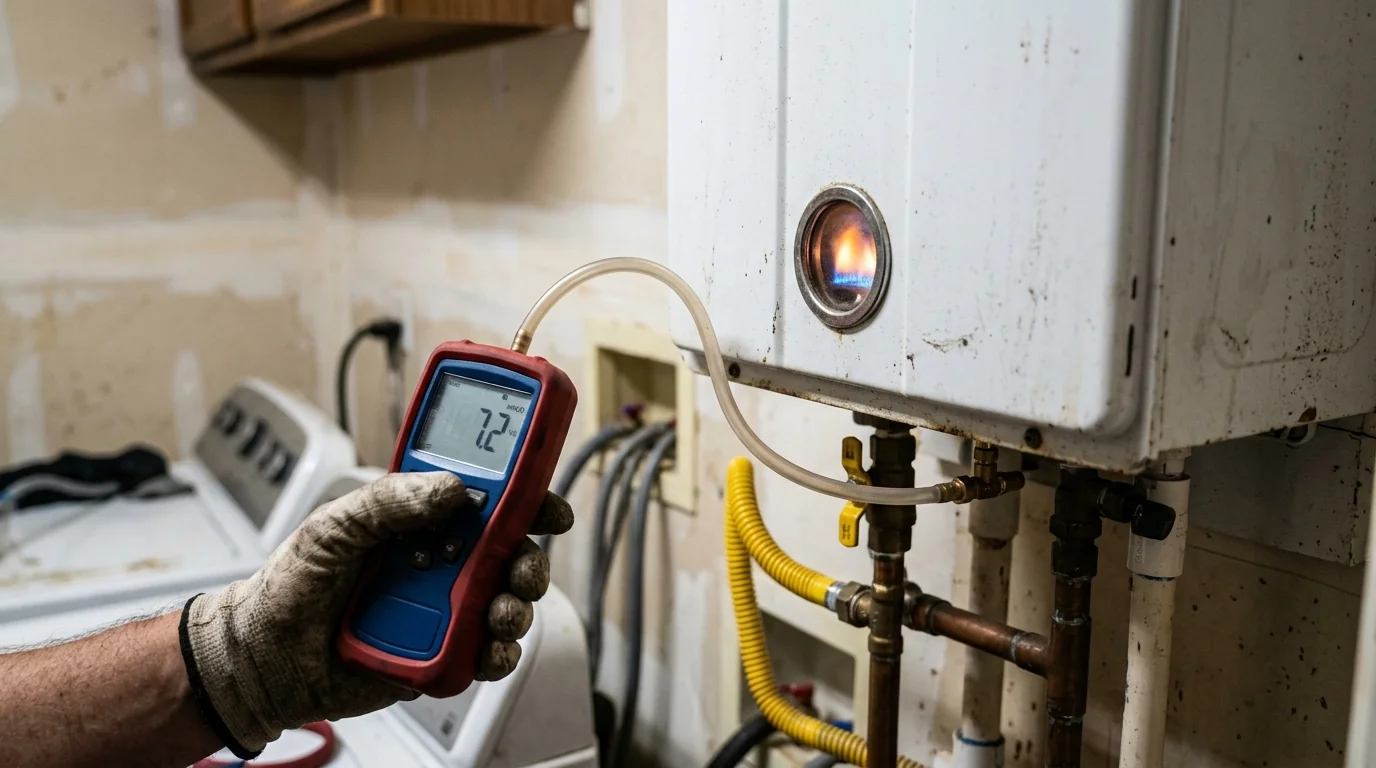
Ignition codes are the most common call. You open a tap, the fan spins, the unit clicks, and then nothing. We check incoming gas pressure with the burner firing, since a line that reads fine at rest can drop too far under load. Next come the igniter, the flame rod and the gas valve. A flame rod coated in oxide gives a weak signal and the board shuts the burner off after a second or two; cleaning or replacing it is quick. Exhaust and intake codes often trace to a wasp nest or debris in the vent termination outside. Board failures happen too, but they're the last thing we blame, not the first.
Descaling and flushing
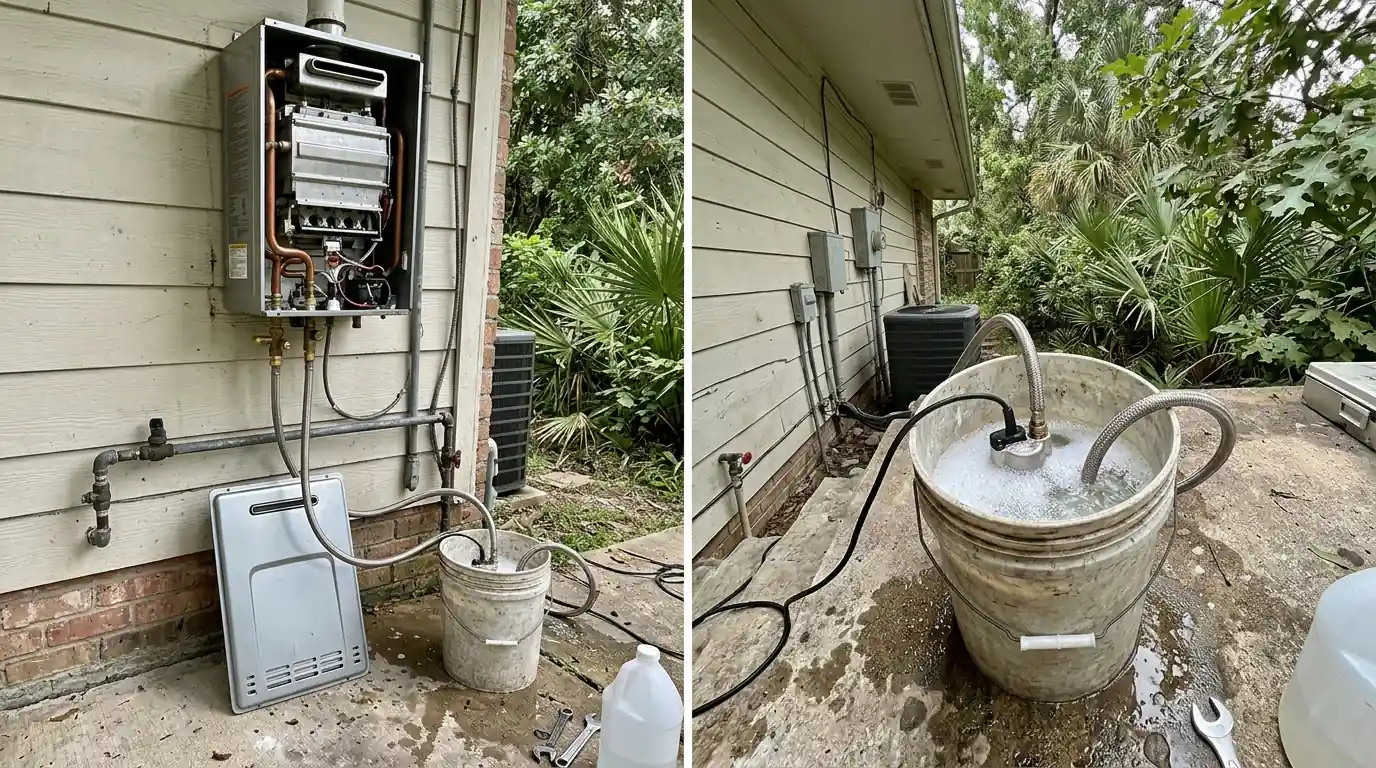
If your unit takes longer to heat, makes a kettle-like rumble or throws overheat codes, scale is the likely cause. We close the isolation valves, connect a small pump and hoses to the service ports, and circulate a descaling solution through the heat exchanger for about an hour. Then we flush it with clean water, clean the inlet filter screen, and bring the unit back online. Units installed without service valves need those valves added first, which we can do the same visit. If the unit needs this every few months, adding a softener ahead of it reduces how fast scale returns.
Lukewarm or fluctuating water
Water that swings hot and cold has a few usual suspects. The cold water sandwich is normal to a point: a short burst of cool water between uses while the burner relights. Long swings are not. A flow sensor clogged with debris can misread demand, a dirty inlet screen chokes flow, and a crossed mixing valve somewhere in the house can feed cold water back into the hot line. We check each one, starting at the unit and working out to the fixtures. Low flow at a single shower may be the shower cartridge, which becomes a shower valve repair rather than a heater problem.
Step by step
How we track down a tankless fault
Read the code history
The stored codes show what the unit has been fighting, not just today's fault.
Test gas and flow
We measure gas pressure under full fire and the flow rate at a fixture.
Inspect burner and sensors
Flame rod, igniter, fan and vent termination get checked and cleaned.
Descale if needed
The heat exchanger is flushed through the service valves and the inlet screen cleaned.
Replace and verify
Any failed part is replaced, then we run several taps to confirm steady temperature.
Local to southeast Houston
Hard water and chloramine inside a Houston tankless unit
The heat exchanger in a tankless unit has narrow passages, and that makes it sensitive to the water it's fed. Houston's Main system averaged 135.5 ppm of hardness in the 2025 report, and the USGS classifies 121 to 180 ppm as hard, noting that long-term flow of hard water causes scale buildup. The same system uses chloramines as its disinfectant, which is gentle on people but can wear rubber seals and gaskets over time. Between the two, scaled exchangers and tired valve seals are routine findings when we open these units.
Talk to a plumber now
Any hour, any day. Tell us what you see.
Before you call
What you can try before calling
| Situation | What you can safely do | When to call us |
|---|---|---|
| Unit shows an error code | Write down the code, then power the unit off and on once at its plug or switch | If the same code returns |
| No hot water at all | Make sure the gas valve to the unit is open and other gas appliances work | If gas is on and the unit still won't fire |
| Low flow at every tap | Close the cold isolation valve and clean the inlet filter screen if you can reach it | If flow stays low or the valves are stuck |
| Smell of gas near the unit | Leave the house and don't operate switches | Call from outside right away |
Pricing
What affects the cost of a tankless repair
The fault, the part and how much scale is inside the unit set the price. Access and whether the unit needs service valves added also play a role.
Type of fault
Cleaning a flame rod is quick; replacing a fan motor, gas valve or control board takes more.
Scale level
A unit badly scaled may need a longer descale or a new heat exchanger.
Service valves present
Units installed without isolation valves need them added before descaling.
Parts availability
Common parts are often on hand; model-specific boards may need to be ordered.
Install problems found
An undersized gas line or venting issue may need correcting for the repair to hold.
Typical planning range: $300 - $1,300 for tankless water heater repairs (routine flush $75 - $350), per HomeGuide (Augu). Treat it as a planning number only. We price your job after we see it.
Brands we service and install
We repair tankless units from Rinnai, Navien, Noritz and Rheem, from ignition faults to scaled heat exchangers.
- Rheem
- A. O. Smith
- Bradford White
- Navien
- Rinnai
- Noritz
- Kohler
- Moen
- Delta
- American Standard
- Pfister
- InSinkErator
- Uponor
- Watts
Common questions
Tankless Water Heater Repair questions from Houston homeowners
Cycling power once is fine, and sometimes a one-off fault clears. If the same code comes back, the unit is pointing to a real problem, and resetting it repeatedly can hide something like low gas pressure.
Many units on Houston water need it about once a year, sooner in homes with heavy use or no softener. If error codes or slow heating start, it's due.
A brief burst of cool water between uses is normal for most tankless units. If the cold spell is long, or water swings back and forth during a shower, something else is wrong.
Either the unit is too small for that demand or the gas supply drops under full fire. We test gas pressure with both running to tell which.
Usually, if the heat exchanger is sound. Sensors, igniters, fans and valves are replaceable. A cracked or leaking heat exchanger on an older unit is often the point where replacement makes more sense.
Same system, different job
Related plumbing services
- Tankless Water Heater InstallationGas tankless units sized for the house, with the gas line and venting to match.
- Water Heater RepairNo hot water, pilot trouble or a leaking valve fixed on tank heaters, gas or electric.
- Water Heater Flush & MaintenanceSediment flushed, anode checked and the relief valve tested before trouble starts.
- Gas Line InstallationNew gas runs for ranges, dryers, tankless heaters, generators and outdoor kitchens.
- Water Softener InstallationA softener plumbed with a bypass and drain so hard water stops scaling fixtures.
Need a plumber tonight?
The phone is answered 24/7. Tell us what you see.