The buried line under your yard
Water line repair from the meter to your Houston home
Part of the yard never dries out, the meter box stays flooded, or every faucet in the house lost pressure at once. The line that feeds the house runs underground, and it is yours to fix from the meter in.
- We answer 24/7, weekends included
- Working from South Belt, off Beltway 8
- Leak located, dug to and pressure tested
Updated October 2026

Short answer
Water line repair in Houston covers the buried service line between the city meter and your house valve, which the homeowner owns. We confirm the leak with a meter test, locate it acoustically, dig a narrow hole over the spot and splice in new pipe. If the line has failed in several places, replacement makes more sense.
What to watch for
Yard and meter clues that the service line is leaking
A green, spongy strip of lawn
Water feeding the grass along the line's route.
Meter box full of water
A leak at the meter connection or just past it.
Meter turning with the house valve closed
The leak is between the meter and the house.
Pressure dropped at every faucet
A large leak or crushed section on the incoming line.
Sinkhole or soft spot near the walkway
Water washing soil away around a buried break.
The job
Who owns the line, and how we fix it without trenching the whole yard
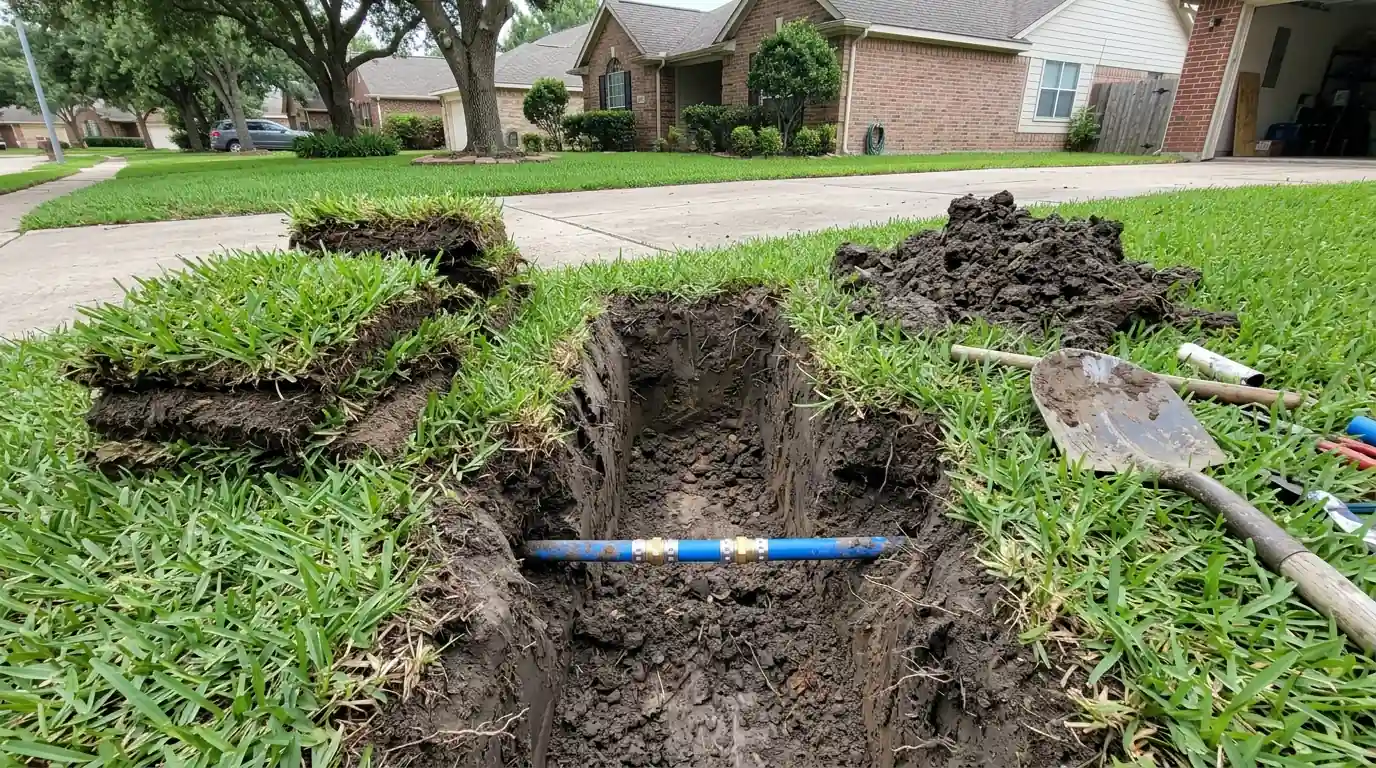
The utility owns the meter and everything on the street side of it. From the meter's outlet to the house, the pipe is the homeowner's responsibility, and it is usually a few dozen feet of copper, PVC, PEX or older poly pipe buried a foot or two down. When it leaks, the utility will not fix it, and the water still runs through your meter.
We confirm the leak sits outside by closing the house valve and watching the meter keep turning. Then an acoustic sensor or a tracer narrows the spot so the dig is a hole, not a trench. We cut out the damaged section, join new pipe with couplings rated for burial, pressure test and backfill. If the line is old poly or has leaked more than once, we'll talk about replacing the whole service line instead.
The versions we see most
Yard leaks and soggy spots
The classic sign is a strip of grass that stays green and soft through a dry week, or a low spot where water seeps up after the sprinklers have been off for days. Sometimes there is no wet ground at all, because the water drains down into cracked clay. We mark the line's route, listen along it, and dig where the sound peaks. Most yard leaks turn out to be a split section, a failed coupling or a spot where a tree root or a fence post bore down on the pipe. Sod is set aside and replaced when the hole is filled.
Meter-side connection leaks
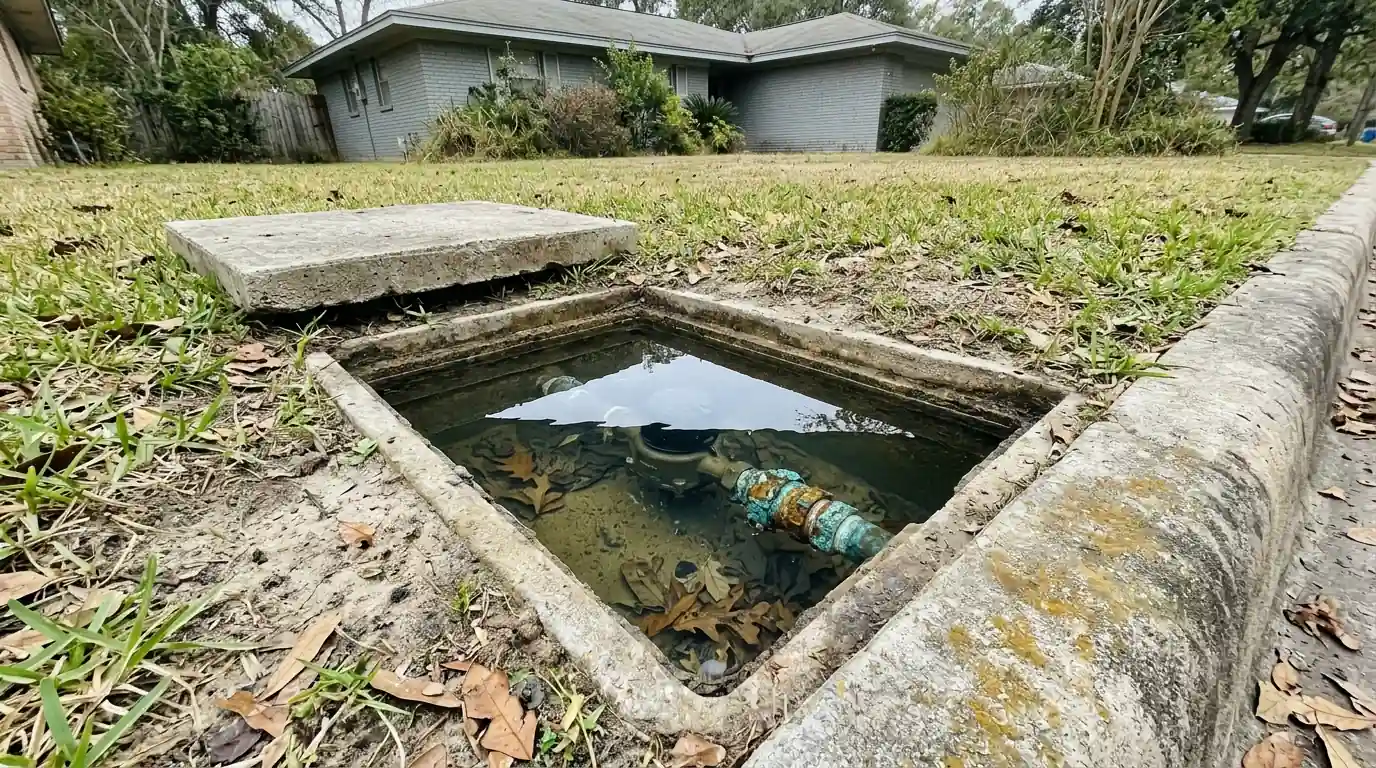
If water pools in the meter box and the box stays wet, the leak may be at the connection on your side of the meter, where the service line meets the meter coupling or a customer-side valve. That joint takes stress every time the ground shifts. We check whether the water is coming from the utility's side, in which case you call them, or from your fitting, which we can repair. Often the fix is a new coupling and a modern ball valve at the meter, which also gives you a shut-off that turns easily.
Low pressure from a damaged line
When pressure drops at every fixture at once, the problem is usually upstream of the house: a crushed section, a large leak, or an old galvanized line nearly closed with scale. We test pressure at the hose bib and compare it to the reading at the meter. A big gap points to the service line. If pressure is fine at the meter and the hose bib but poor inside, the cause is more likely a failing pressure reducing valve or clogged branches, and we look at the pressure problem inside instead.
Step by step
How a yard line repair runs, from test to backfill
Confirm it is outside
House valve closed, meter watched for movement.
Locate the leak
Line traced and listened along to mark one spot to dig.
Dig and expose
Sod set aside and a narrow hole opened down to the pipe.
Repair the section
Damaged pipe cut out and new pipe joined with burial-rated couplings.
Test and backfill
Pressure checked with the hole open, then soil and sod replaced.
Local to southeast Houston
Clay that cracks and freezes that broke mains across Houston
Buried lines here live in ground that moves. Lake Charles clay, common across Southeast Texas, opens surface cracks up to two inches wide that run a foot or more deep when it dries, and that shrinking and swelling puts constant strain on joints in a shallow service line. Cold matters too: during the February 2021 storm the city reported a sharp rise in water main breaks throughout the system, and the shallow private lines that feed each house sit in that same cold ground.
Talk to a plumber now
Any hour, any day. Tell us what you see.
Before you call
What a homeowner can check before calling
| Situation | What you can safely do | When to call us |
|---|---|---|
| Wet spot in the yard | Run the meter test: close the house valve and watch the low-flow dial. | If the dial still moves, the service line is leaking. |
| Water in the meter box | Note whether it is clear and steady or only after rain. | If it stays wet in dry weather. |
| Low pressure everywhere | Check the pressure at a front hose bib with a screw-on gauge. | If it reads well below what it used to. |
| Need to stop the leak tonight | Close the house valve; the curb valve needs a meter key and a careful hand. | Right away, since the meter keeps counting otherwise. |
Pricing
What moves the price of a service line repair
Depth, distance and what sits on top of the pipe drive the cost more than the repair fitting itself.
Where the leak is
Open lawn is a quick dig; under a driveway, walkway or mature landscaping takes more.
Line material
Copper, PVC, PEX and poly each need different couplings and transitions.
Depth of the line
Deeper pipe means a larger hole and more time digging by hand.
Repair or replace
One splice is a short job; a line with repeated failures is better replaced end to end.
Meter-side fittings
Replacing a corroded coupling or valve at the meter adds parts and time.
Typical planning range: $400 - $1,500 for repair of a home's main water service line, per HomeGuide (Dece). A guide figure, not our price; your quote follows the inspection.
Common questions
Water Line Repair questions from Houston homeowners
No. The utility handles the meter and the street side. The pipe from the meter outlet to your house belongs to the homeowner, so its repair is yours to arrange.
Close your house valve and watch the meter. If the low-flow dial keeps turning, the leak is between the meter and the house, which is your line. Water leaking at the street side of the meter goes to the utility.
No. We locate the leak first so the dig is one narrow hole over the spot. Sod is cut and set aside so it goes back in place when we backfill.
We can sometimes repair it from the edge or run a new line around the slab. Cutting concrete is the last option, and we talk it through with you first.
If the line is gray poly pipe, has leaked more than once, or the pipe we expose is brittle or corroded, a full replacement usually costs less than the next two repairs.
Same system, different job
Related plumbing services
- Water Line ReplacementA new service line from the meter to the house, sized for today's fixtures.
- Leak DetectionAcoustic and pressure testing to find a hidden leak before anyone cuts drywall.
- Water Pressure RepairLow or banging-high pressure fixed at the regulator, the main or the fixture.
- Main Shut-Off Valve ReplacementA seized or leaking main valve replaced so the water actually turns off.
Do not wait on a leak
Every hour of running water adds to the repair. Call now, any hour.