Every tap, filtered at the main
Whole-house water filtration for Houston chloramine
If your tap water smells like a pool or tastes flat, a pitcher filter only fixes one glass at a time. A filter at the main treats the water before it reaches the showers, the ice maker and every sink.
- 24/7 phone line, weekends included
- Near Ellington, in South Belt
- Sediment and carbon stages sized to the house flow
Updated October 2026

Short answer
Whole-house water filtration in Houston usually means a catalytic carbon tank on the main line, because the city treats its water with chloramine and ordinary carbon struggles to remove it. A sediment pre-filter ahead of the carbon catches sand and rust. The system is sized to household flow, so pressure at the showers stays where it was.
The job
Why chloramine changes which filter you need
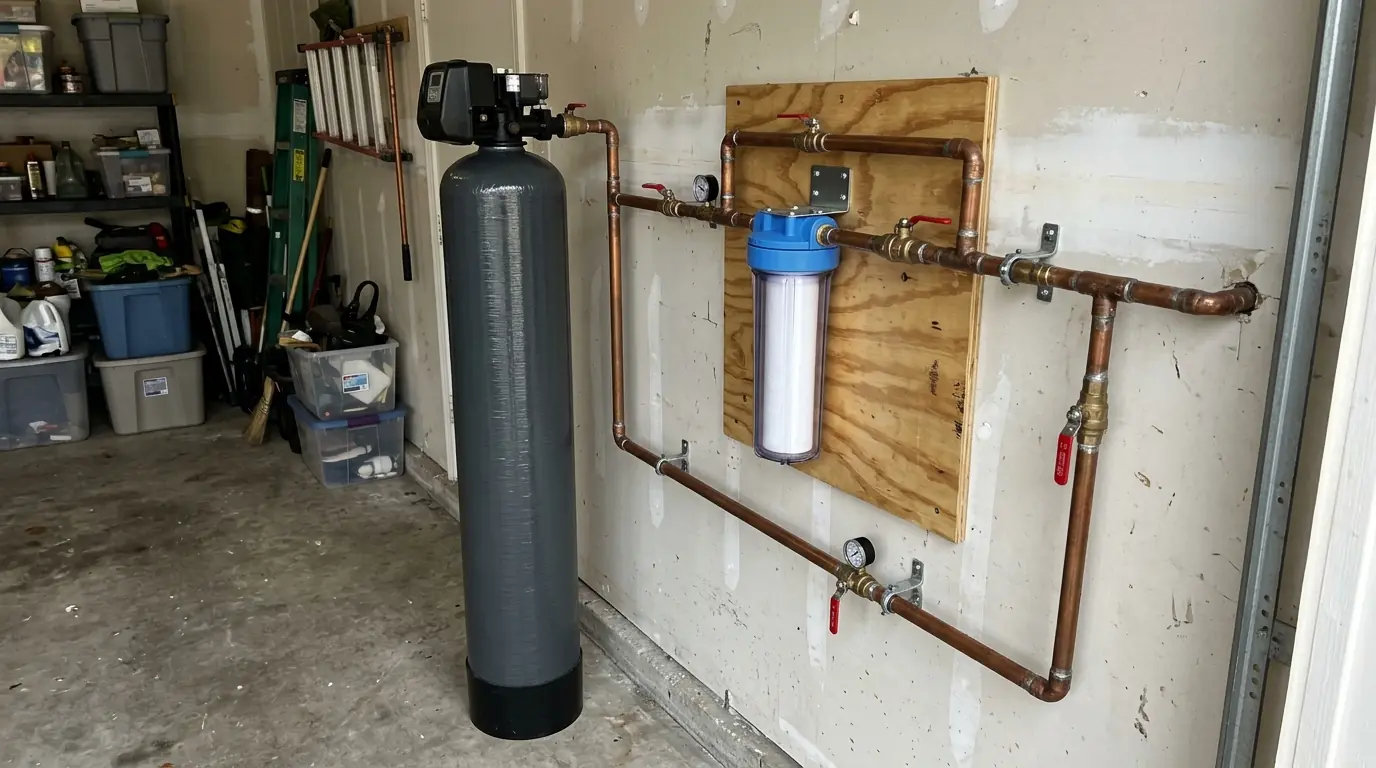
Many cities disinfect with chlorine, which standard carbon removes easily. Houston's water carries chloramine, a more stable compound made of chlorine and ammonia that lasts longer in the pipes. Removing it takes more contact time with the carbon, or a catalytic carbon made for the job. That is why a small cartridge housing that worked fine somewhere else can leave the smell behind here.
We size the tank to the flow your house actually uses, so two showers and a washer running together do not drop pressure. A sediment stage goes first to protect the carbon from grit. If hardness is part of the complaint, the filter goes ahead of a softener, because chloramine can wear on softener resin. For drinking water polished further, an RO unit at the kitchen sink pairs well with whole-house carbon.
Your options
Tank system or cartridge housing for the main
| Compare | Carbon tank system | Large cartridge housing |
|---|---|---|
| Media amount | Large bed, long contact time | Smaller, limited by the cartridge |
| Chloramine removal | Strong with catalytic carbon | Fair, depends on cartridge and flow |
| Change interval | Media lasts for years | Cartridges every few months |
| Space needed | Floor space for a tall tank | Wall mount, compact |
| Up-front cost | Higher | Lower |
For a family house with several bathrooms, a tank system usually does the job better and costs less to run over time. A cartridge housing fits small homes or tight spaces.
Pricing
What sets the cost of a whole-house filter
The biggest choices are the type of system and how much water it has to handle. Installation is fairly similar from house to house.
Tank or cartridge system
Tanks cost more up front and run much longer between media changes.
Household flow
More bathrooms need a larger tank to hold pressure.
Stages included
Sediment, carbon and softener together add tanks and fittings.
Install location
A garage with the main exposed is quicker than an exterior wall or closet.
Drain needs
Backwashing tanks need a drain line; cartridge systems do not.
Typical planning range: $1,382 - $3,225 for whole-house water filtration system in Houston, TX, per Angi (Upda). A guide figure, not our price; your quote follows the inspection.
The versions we see most
Carbon filters for chloramine
The main stage is a tall tank of catalytic carbon or a large cartridge housing, depending on the house and the budget. Tank systems hold far more media and either backwash on a schedule or run on a set flow until replacement. Cartridge systems cost less up front but need changes more often. What you notice afterward: no pool smell in a hot shower, ice that tastes like water, and coffee that tastes like coffee. Carbon does not remove hardness, so white spots on the glass will stay.
Sediment pre-filters
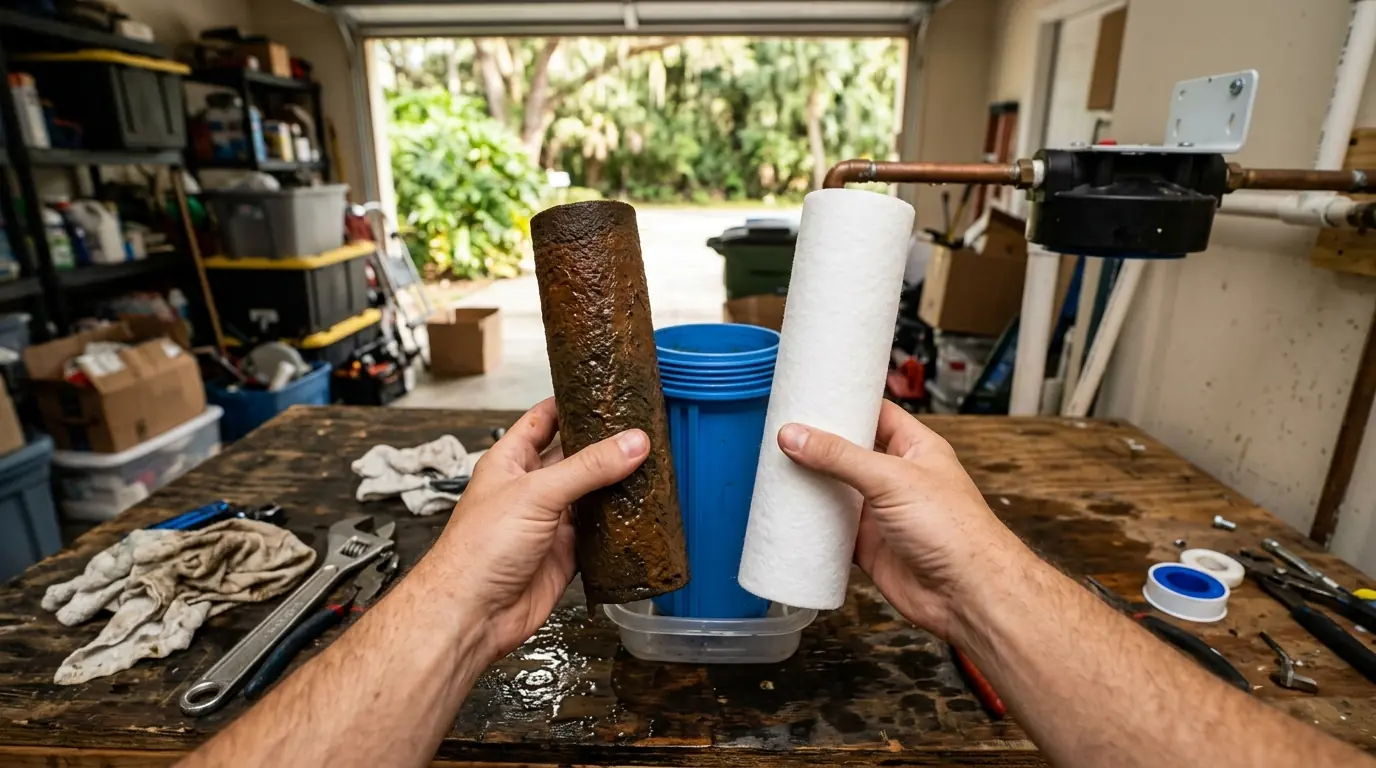
A sediment filter is a clear or opaque housing with a pleated or spun cartridge that catches sand, rust flakes and other particles before they reach the carbon or your fixtures. On its own it is a good fix for grit in aerators or a toilet fill valve that keeps clogging. Paired with carbon, it keeps the carbon from fouling early. We mount it with shut-offs on both sides and room underneath to swap cartridges without a mess, and we show you how a dirty one looks.
Filter and softener combos
When a house has both the chloramine taste and hard-water scale, the usual setup is three stages in a row: sediment, carbon, then the softener. The order matters. Carbon first strips the chloramine so it does not wear on the softener resin, and sediment first keeps both tanks clean. We plumb the loop with a bypass so either unit can be serviced alone. This takes more wall and floor space in the garage, so we measure before choosing tank sizes.
Scope of the work
What comes with a filtration install
- Taste, odor and hardness check at the tap
- Sediment pre-filter housing with shut-offs
- Catalytic carbon tank or cartridge stage
- Bypass valve for service
- New fittings and pipe on the main loop
- Drain line where the system backwashes
- Initial media flush until the water runs clear
- A written change schedule for cartridges or media
Talk to a plumber now
Any hour, any day. Tell us what you see.
Local to southeast Houston
What is in the water coming to southeast Houston homes
The 2025 Houston water quality report lists chloramines as the disinfectant across the Main system, which serves about 2.97 million customers. Most of that water, 90.3 percent, is surface water from the San Jacinto and Trinity rivers, with the rest drawn from deep wells. The Southeast Water Purification Plant near Ellington pulls from the Trinity through the Lynchburg Pumping Station and sends out 200 million gallons a day. Surface water carries more seasonal variation in taste and odor than well water does, and that is often what sends people looking for a filter.
Step by step
Putting a filter on the main line
Check the water and flow
We note taste, smell, hardness and how many fixtures run at once.
Choose the system
Tank or cartridge, with or without a softener, sized to your flow.
Install on the main
The line is cut after the shut-off with a bypass and isolation valves.
Flush the media
New carbon is flushed until the water runs clear.
Walk you through upkeep
You see the bypass, the sediment cartridge and the change schedule.
Brands we service and install
We install and service filter housings, valves and tanks from Watts, A. O. Smith and Rheem, tied in with Uponor PEX on the main loop.
- Rheem
- A. O. Smith
- Bradford White
- Navien
- Rinnai
- Noritz
- Kohler
- Moen
- Delta
- American Standard
- Pfister
- InSinkErator
- Uponor
- Watts
Common questions
Whole-House Water Filtration questions from Houston homeowners
A properly sized system should not cause a drop you notice. Undersized cartridges are the usual cause of pressure loss, which is why we size by flow rather than by price.
No. Carbon targets chloramine, taste and odor. For scale and spots you need a softener, and the two are often installed together.
Sediment cartridges usually every few months, depending on the water. Carbon tanks often last years before the media needs replacing; cartridge carbon stages need changes more often.
A fridge filter treats drinking water and ice only. A whole-house system also covers showers, bath water and every sink, which is where the chloramine smell is most noticeable.
It can, with a cover to shade it from the sun and protect it in a freeze. Inside the garage is simpler when the main comes in there.
Same system, different job
Related plumbing services
- Water Softener InstallationA softener plumbed with a bypass and drain so hard water stops scaling fixtures.
- Reverse Osmosis SystemUnder-sink drinking water filtration with its own faucet and ice maker line.
- Water Pressure RepairLow or banging-high pressure fixed at the regulator, the main or the fixture.
- Appliance Plumbing HookupsDishwashers, ice makers and washing machines connected without a slow leak.
Weighing your options?
Call and ask. A plumber will walk you through the choices before any price is set.