New pipe without the trench
Trenchless sewer repair under Houston driveways and yards
The line needs fixing, but it runs under a driveway, a pool deck or the roots of a big oak. Trenchless methods replace or reline that pipe through a pit at each end and leave the surface above it in place.
- We answer 24/7, nights and weekends included
- South Belt based, just off Beltway 8
- Line cleaned and camera checked before any liner goes in
Updated October 2026

Short answer
Trenchless sewer repair in Houston rebuilds a failing line from the inside or pulls new pipe through it, working from small access points instead of a trench. Cured-in-place lining forms a resin pipe inside the old one; bursting splits the old pipe and drags new HDPE behind it. Neither fixes a deep sag, so the camera decides which method fits.
The job
How a sewer line gets fixed without digging it all up
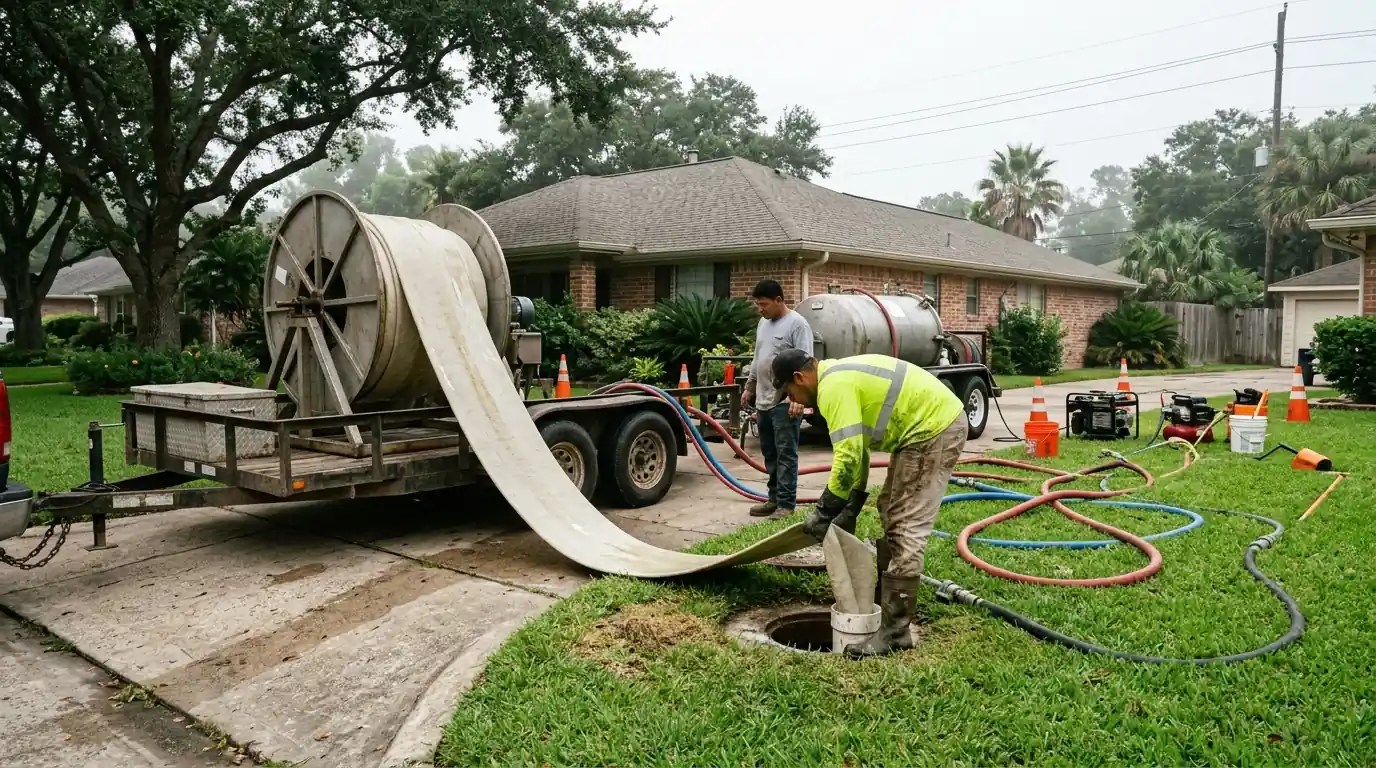
Both trenchless methods need two things: a way in at each end and a clear view of the pipe. We start with jetting to clean the line down to the wall, then run a camera to measure the length, find the lateral connections and check for sags. A liner bonds to whatever shape the old pipe has, so it needs a host pipe that is still roughly round and has a steady fall.
The payoff is what you don't lose. A driveway stays in place. A mature tree keeps its root zone. A finished backyard is disturbed at two pits instead of along a 60 foot trench. The tradeoffs are real too: a liner slightly reduces the inside diameter, and neither method corrects a belly. Where the footage shows a deep sag or a collapsed section, we'll pair a short excavated repair with lining on the rest.
Your options
Pipe lining and pipe bursting side by side
| Compare | Cured-in-place lining | Pipe bursting |
|---|---|---|
| What happens to the old pipe | Stays in place as a shell for the liner | Broken apart and pushed into the soil |
| Condition the old pipe needs | Cracked but still holding its shape | Can be badly broken or partly collapsed |
| Inside diameter afterward | Slightly smaller than before | Same size or slightly larger |
| Access needed | Cleanout plus one end point, sometimes no pit at all | A launch pit and a receiving pit |
| Joints in the finished line | None along the lined section | None, the HDPE is fused into one length |
Lining is the lighter touch when the pipe is cracked but round. Bursting is the stronger choice when the old pipe is too broken to form a liner around.
Pricing
What changes the price of trenchless sewer work
Trenchless jobs are priced on the pipe itself and on how much surface restoration they avoid. These are the main variables.
Lining or bursting
Each method has different equipment and material costs per foot.
Length and diameter of the line
Longer and larger runs take more liner or more HDPE pipe.
Number of branch connections
Each lateral or tie-in that has to be reopened adds time.
Cleaning needed beforehand
Heavy roots or scale must be removed before a liner can bond.
Access pit locations
Pits that land in concrete or near other utilities cost more to dig and restore.
Typical planning range: $1,900 - $6,000 for trenchless sewer pipe line; lining $135 - $150 per linear foot, pipe bursting $150 - $190 per linear foot, per Angi (Upda). Use it for budgeting; the real number depends on what we find on site.
The versions we see most
Cured-in-place pipe lining
Cured-in-place pipe, or CIPP, is a felt or fiberglass tube soaked in resin and pulled or inverted into the cleaned line. An inflated bladder presses it against the old pipe wall, and the resin hardens with hot water, steam or UV light into a jointless pipe inside the old one. Cracks and open joints that let roots in are sealed over. Afterward, any branch connections are reopened from inside with a cutter, and the line is checked on camera. Lining suits clay or cast iron that is cracked and root-prone but still holding its shape.
Pipe bursting
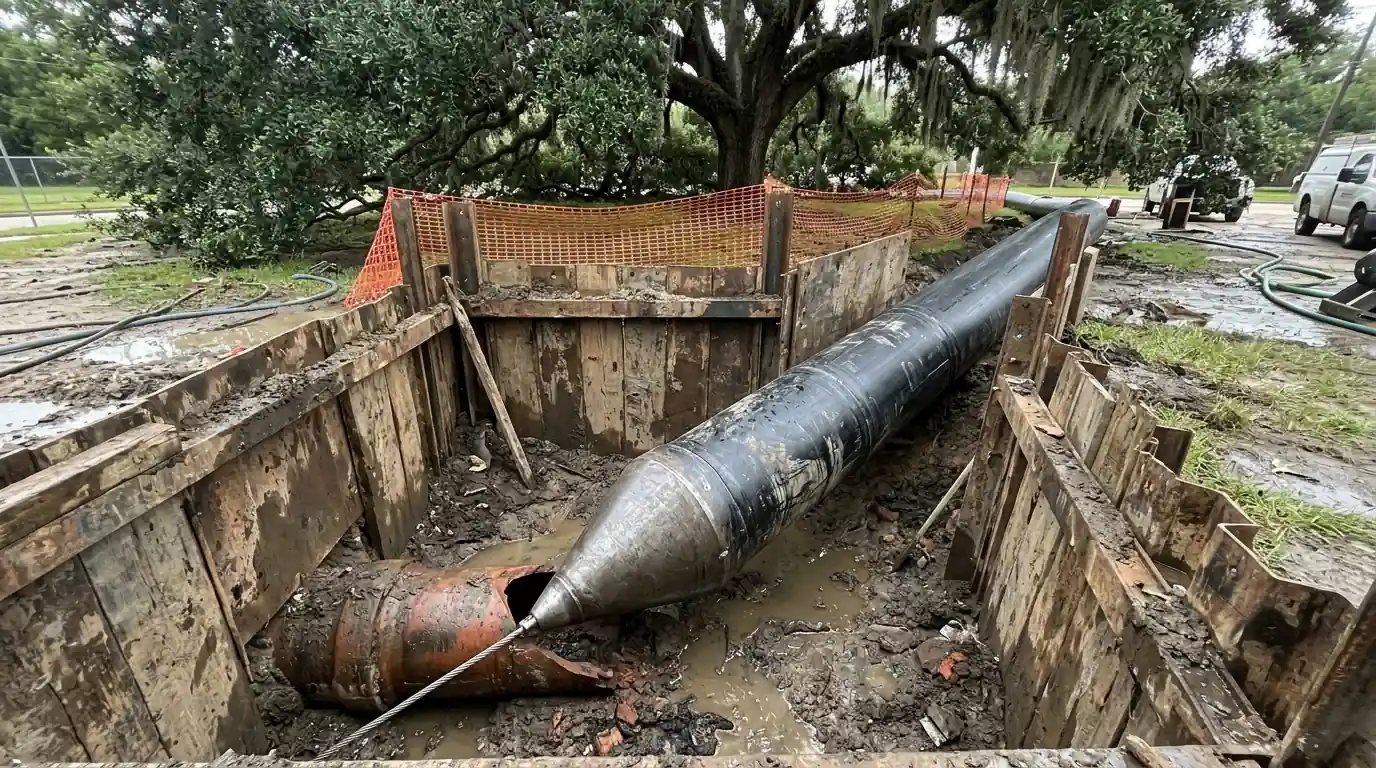
Pipe bursting replaces the line rather than relining it. A cone-shaped bursting head is pulled through the old pipe by a cable winch, fracturing the old clay or cast iron outward into the soil. New HDPE pipe, fused into one continuous length with no joints, follows right behind it. The new pipe can match or slightly exceed the old size. Bursting works well on badly broken pipe that a liner could not form around. It needs launch and receiving pits and some clearance from nearby gas or water lines.
Lining under driveways and trees
The most common reason people ask about trenchless work is a line that runs under a driveway or right through the roots of a large tree. Digging there means breaking and pouring concrete or cutting roots that keep the tree standing. A liner installed from a cleanout near the house and a pit near the street can repair the whole section under both. If the problem is only one spot under the concrete, a short sectional liner, sometimes called a point repair, seals just that joint. A full line replacement by trench stays the fallback for lines that cannot be lined.
Scope of the work
What a trenchless repair includes
- Jetting the line clean down to the pipe wall
- A camera survey measuring length, connections and grade
- A written choice of lining, bursting or a combined approach
- Utility locates before any access pit is dug
- Liner installation and cure, or HDPE pulled in behind a burst head
- Reopening of branch connections from inside the pipe
- A final camera run you can keep
- Backfill of access pits and cleanup of the work area
Talk to a plumber now
Any hour, any day. Tell us what you see.
Local to southeast Houston
Why trenchless work fits so many Houston yards
Much of Houston sits on expansive clay that swells after rain and cracks deep when it dries out; local reporting puts basically anyone south of Interstate 10 on this kind of soil. That seasonal movement opens joints in old clay and cast iron lines, which is exactly the kind of damage a jointless liner seals. It also makes concrete driveways and patios over the line more prone to cracking once they are cut and patched, which is one more reason to avoid breaking them when the pipe can be fixed from inside.
Step by step
From camera footage to a lined or burst sewer line
Clean and camera the line
Jetting clears the wall, and the camera measures length and checks grade.
Choose the method
We show you whether lining, bursting or a mix fits your footage.
Open the access points
A cleanout and one or two small pits give entry at each end.
Install the new pipe
The liner is set and cured, or new HDPE is pulled through behind the burst head.
Reconnect and verify
Branches are reopened, connections made, and the line checked on camera.
Common questions
Trenchless Sewer Repair questions from Houston homeowners
No. The pipe needs to be cleanable, mostly round and without deep sags. Collapsed or badly bellied sections are dug and repaired first or replaced instead.
Liner makers rate their products for decades of service. The resin pipe has no joints for roots to enter and does not corrode the way cast iron does.
It reduces the inside size slightly, but the smooth surface usually carries flow better than the rough, cracked pipe it replaced.
Usually a small pit at one end, sometimes at both. With a good outdoor cleanout, some lining jobs need very little digging.
We cut and jet them out before lining. Once the liner covers the joints, roots have no gap left to grow back through.
Same system, different job
Related plumbing services
- Sewer Line ReplacementA failed house-to-tap sewer line replaced with new PVC and a proper cleanout.
- Sewer Line RepairOne cracked, offset or root-broken section dug and replaced, not the whole run.
- Sewer Camera InspectionA recorded camera run that shows breaks, bellies and roots before anyone digs.
- Hydro JettingHigh-pressure water scours grease, scale and roots off the pipe wall.
Ready to talk it through?
Call any hour. We look first, explain the choices, and price them before work starts.