Gas and electric tank repairs
Water heater repair for Houston tank heaters
The shower ran cold this morning, or there's a puddle by the tank in the garage. Before you price a new heater, know that many tank failures come down to one part we can swap.
- We answer 24/7, nights and weekends included
- Out of South Belt, near Beltway 8 and the Gulf Freeway
- Each part tested before anything gets replaced
Updated October 2026

Short answer
Water heater repair in Houston usually means one failed part, not a failed tank: a thermocouple or flame sensor on gas units, a burned element or thermostat on electric ones, or a relief valve that drips. We test before replacing anything. If water is coming from the tank body itself, repair is off the table and we tell you so.
What to watch for
Clues your tank heater needs a repair
Pilot light keeps going out
Often a thermocouple, a dirty pilot or a clogged combustion air screen.
Hot water runs out quickly
On electric tanks, usually a failed lower element or thermostat.
Popping or rumbling while heating
Water trapped under a layer of sediment on the tank bottom.
Water dripping from the side pipe
The T&P valve is worn or tank pressure is running too high.
Rusty or smelly hot water
A spent anode rod or corrosion starting inside the tank.
Reset button keeps tripping
An electric element or thermostat is shorting out.
The job
What we check first when your tank heater quits
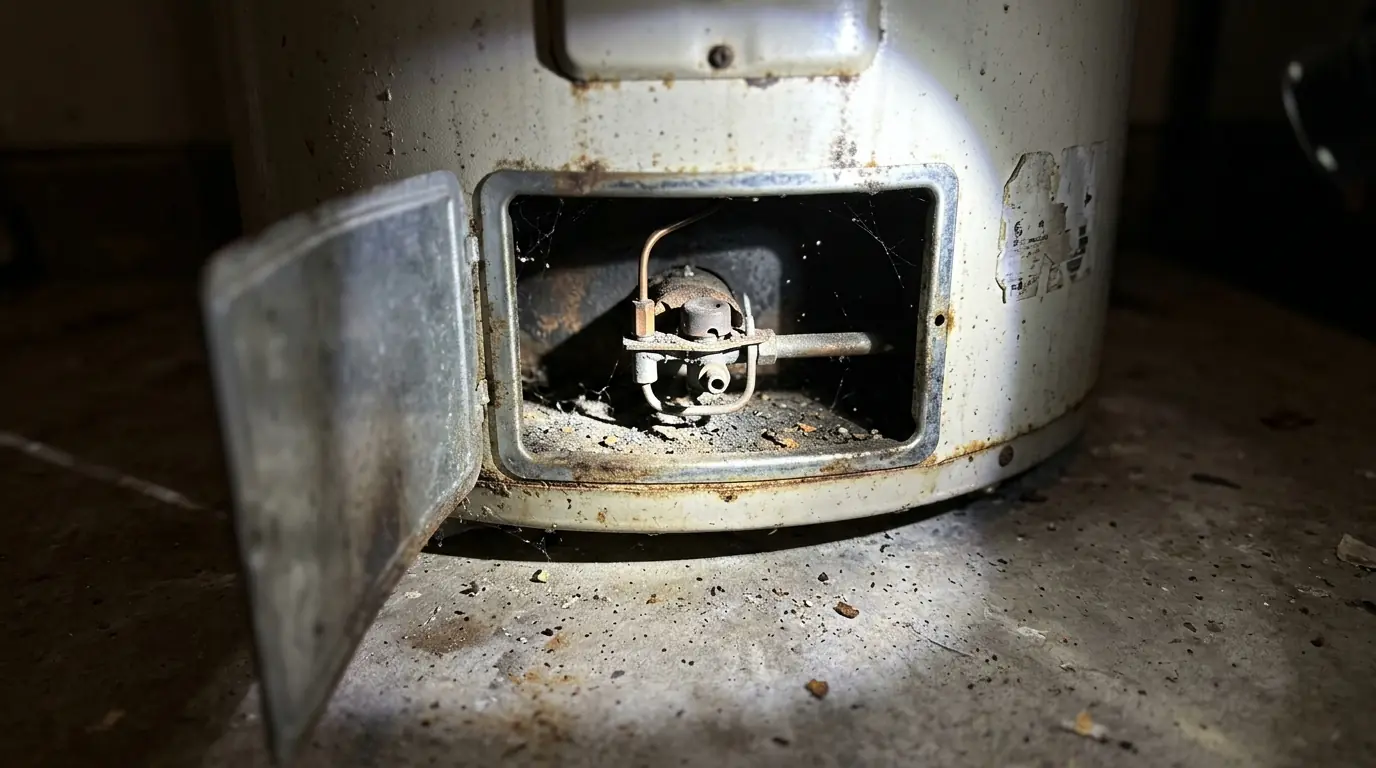
A tank water heater has only a handful of parts that fail, and each one leaves its own clue. A gas unit with a dark burner window points to the pilot assembly, thermocouple or gas control valve. An electric unit that gives a few minutes of warm water and then runs cold usually has one dead element. We read those clues, then confirm with a meter or a flame check instead of guessing.
The other half of the visit is deciding whether repair makes sense at all. Rust at the base or water seeping from the jacket seam changes the math. In those cases we'll show you why and price a replacement tank next to the repair, so the choice is yours. If the unit is sound but full of sediment, a flush and anode check often cures rumbling and slow recovery.
The versions we see most
Gas pilot and burner problems
The pilot goes out, relights, then goes out again. Or the burner lights with a lazy yellow flame and the water never gets truly hot. On most gas tanks the cause is a worn thermocouple, a dirty pilot orifice, or a burner fouled by rust flakes falling from the flue. Newer units with a sealed combustion chamber have an intake screen at the base, and when garage lint clogs it the burner starves for air and the unit locks out. We clean or replace the failed piece, check the draft at the vent hood and confirm the gas valve opens and closes cleanly. If you smell gas at the heater, leave the house and call; that becomes a gas leak repair first.
Electric element and thermostat repair
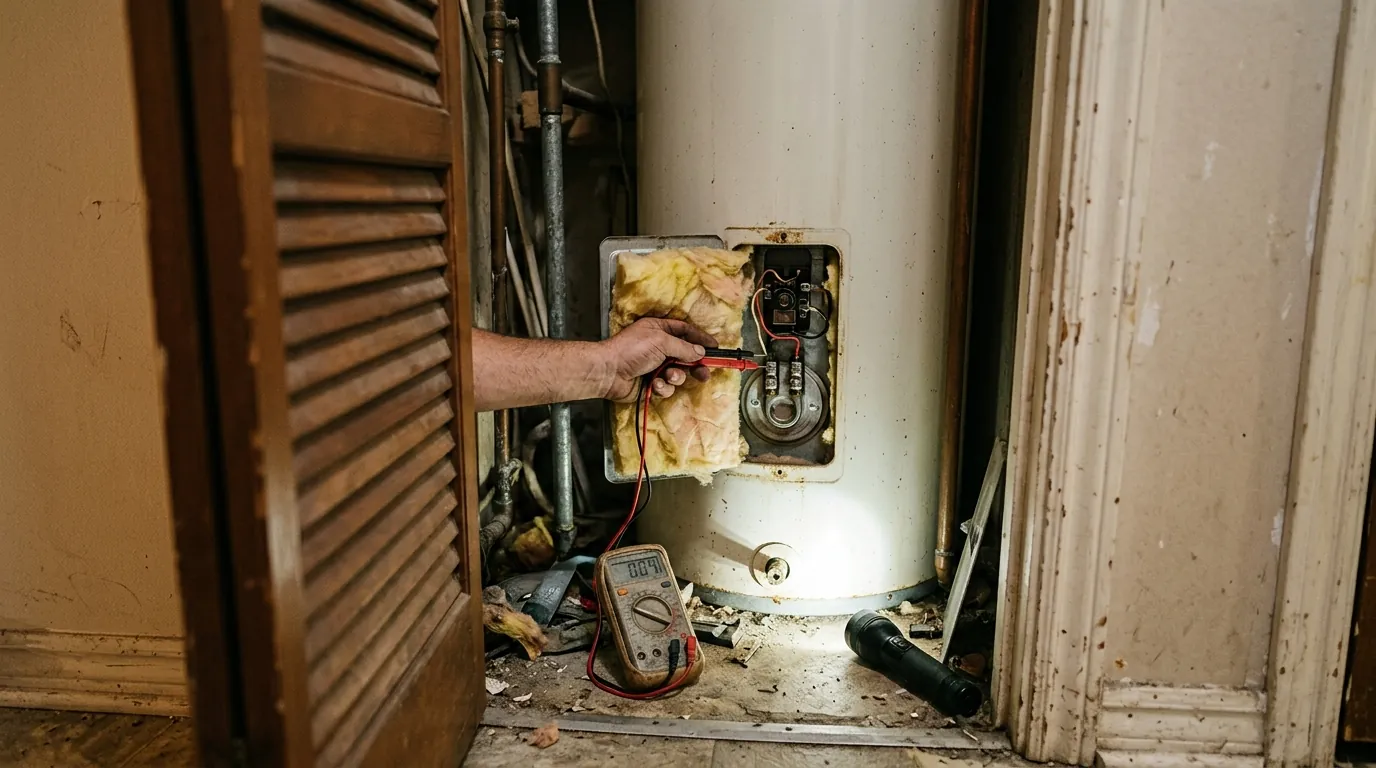
Electric tanks have two heating elements, each run by its own thermostat. When the upper one fails you get no hot water at all; when the lower one goes, you get a short burst of hot water and then lukewarm. A tripped reset button above the upper thermostat is another common call, and it trips for a reason, such as a shorted element or a thermostat stuck closed. We cut power at the breaker, test each element for resistance and each thermostat for continuity, and replace only what reads bad. Hard water coats lower elements with scale, so an element that keeps burning out often signals a tank full of sediment.
Leaking temperature and pressure relief valves
The T&P valve is the brass fitting near the top with a pipe running down the side or out through the wall. If that pipe drips, the valve is either worn or doing its job because pressure inside the tank is too high. Replacing the valve fixes the first case. The second points to high street pressure or a missing or waterlogged expansion tank, and swapping the valve without fixing the cause just means another drip in a few weeks. We test incoming pressure at a hose bib before choosing the repair, and correct high water pressure at the PRV when that's the source.
Step by step
From a cold shower back to a hot tap
Make it safe
We shut the gas or cut the breaker and look for leaks or scorch marks.
Find the failed part
Flame checks, meter readings and a pressure test narrow it to one component.
Repair or replace
You get the repair price, plus a replacement price if the tank is near its end.
Swap the part
We fit the new thermocouple, element, thermostat or relief valve and reseal fittings.
Run a full cycle
We relight or restore power and watch the heater bring the tank up to temperature.
Local to southeast Houston
How Houston water wears down a tank heater
Houston's Main system averaged 135.5 ppm of hardness in the 2025 water quality report, and the USGS calls anything from 121 to 180 ppm hard. Heat pulls that hardness out of solution, so the bottom of a tank collects mineral sediment that insulates the burner or buries the lower element. The same report lists chloramines as the disinfectant, and treated water slowly eats the anode rod that protects the steel. Put together, that's why so many of our repair calls involve a scaled element or a burner fighting a sediment crust.
Talk to a plumber now
Any hour, any day. Tell us what you see.
Before you call
What you can check before we arrive
| Situation | What you can safely do | When to call us |
|---|---|---|
| Gas heater, no flame | Follow the relight steps on the label; if it won't stay lit, turn the gas control to off | If it goes out again or you smell gas |
| Electric heater, no hot water | Check the breaker and reset it once if tripped | If it trips again, there is a short inside |
| Puddle around the base | Close the cold supply valve above the tank and turn off gas or power | Right away, so we can find the source |
| T&P pipe dripping | Set a bucket under it; never cap or plug the pipe | The same day, since the cause may be pressure |
Your options
Repair the heater or replace the tank?
| Compare | Repair it | Replace it |
|---|---|---|
| Tank body | Dry, no rust at the seams | Leaking or rusted through |
| Failed parts | One part, like a thermocouple, element or valve | Several parts failing at once |
| Hot water quality | Clean once the part is fixed | Rusty water from inside the tank |
| Sediment | Light, clears with a flush | Hardened enough to scale the burner or bury elements |
| Recent history | First problem in years | Repeat calls on the same heater |
A dry tank with one bad part is almost always worth repairing. A leak from the steel tank itself can't be repaired, so replacement is the only fix.
Pricing
What decides the cost of a water heater repair
Most repairs come down to which part failed and how easy the heater is to reach. The condition of the tank matters too, because it decides whether a repair is worth doing.
The part that failed
A thermocouple or T&P valve is a short job; a gas control valve or a pair of elements takes longer.
Where the heater sits
Attic installs and tight closets take more time than a garage platform with open access.
Sediment in the tank
Heavy buildup may need flushing before a new element or burner will work properly.
Related problems
High street pressure, a failed expansion tank or a corroded vent can add to the visit.
Time of the call
Nights and weekends may be priced differently from a weekday visit.
Typical planning range: $150 - $700 for tank water heater repair, per HomeGuide (Augu). A guide figure, not our price; your quote follows the inspection.
Brands we service and install
We repair tank heaters from Rheem, A. O. Smith, Bradford White and the other brands common in Houston garages and attics.
- Rheem
- A. O. Smith
- Bradford White
- Navien
- Rinnai
- Noritz
- Kohler
- Moen
- Delta
- American Standard
- Pfister
- InSinkErator
- Uponor
- Watts
Common questions
Water Heater Repair questions from Houston homeowners
The usual causes are a worn thermocouple, a dirty pilot tube or a combustion air screen clogged with lint. Drafts in a garage can play a part too. If it keeps happening after a relight, the part needs testing, not repeated relighting.
For a short time, yes, as long as the discharge pipe is open and not capped. The drip means the valve is releasing pressure or failing. Either way it should be checked soon, since a valve that sticks shut is the real danger.
It depends where the water comes from. A drain valve or a fitting can be replaced. Water seeping from under the jacket usually means the steel tank has rusted through, and that can't be repaired.
Yes. Attic units take more care because a leak there damages ceilings, so we also check the drain pan and its line while we're up there.
That smell usually comes from a reaction between the anode rod and bacteria in the tank. Flushing the tank and swapping the anode, sometimes for an aluminum-zinc rod, usually clears it.
A surge or a shorted element can trip the high-limit reset above the upper thermostat. Pressing it once is fine; if it trips again, an element or thermostat has failed and needs testing.
Same system, different job
Related plumbing services
- Water Heater ReplacementA worn-out tank swapped for a new gas or electric unit, hauled away the same visit.
- Water Heater Flush & MaintenanceSediment flushed, anode checked and the relief valve tested before trouble starts.
- Tankless Water Heater RepairError codes, cold-water sandwiches and scaled heat exchangers diagnosed and fixed.
- Gas Leak RepairGas smell, hissing fittings or a red-tagged meter handled the right way.
- Water Pressure RepairLow or banging-high pressure fixed at the regulator, the main or the fixture.
Do not wait on a leak
Every hour of running water adds to the repair. Call now, any hour.