Find it before you open it
Hidden leak detection in Houston homes
You know water is going somewhere. The bill says so, or the meter does, or a patch of drywall keeps going soft. What you don't want is a plumber cutting holes until something turns up wet.
- We answer 24/7, any day of the year
- Starting out of South Belt, by Ellington
- Leak narrowed to a spot before any wall is cut
Updated October 2026

Short answer
Leak detection in Houston homes starts at the water meter: with every fixture off, a moving dial proves a leak exists. From there we split the system into sections, pressure test each one and use acoustic and thermal tools to mark the spot. Nothing gets opened until the readings agree on one location.
What to watch for
Things around the house that point to a hidden leak
Meter dial turning with all taps off
Confirms water is escaping somewhere in the system.
Soft or stained drywall
Usually a supply or drain line inside that wall or ceiling.
Musty smell in one room
Moisture trapped behind a cabinet or baseboard.
Toilet tank refilling on its own
The flapper is letting water seep into the bowl.
Water heater running more often
A hot side leak keeps the tank reheating.
Patch of yard greener than the rest
A buried service line leaking under the grass.
The job
How we narrow a hidden leak down to a few square feet
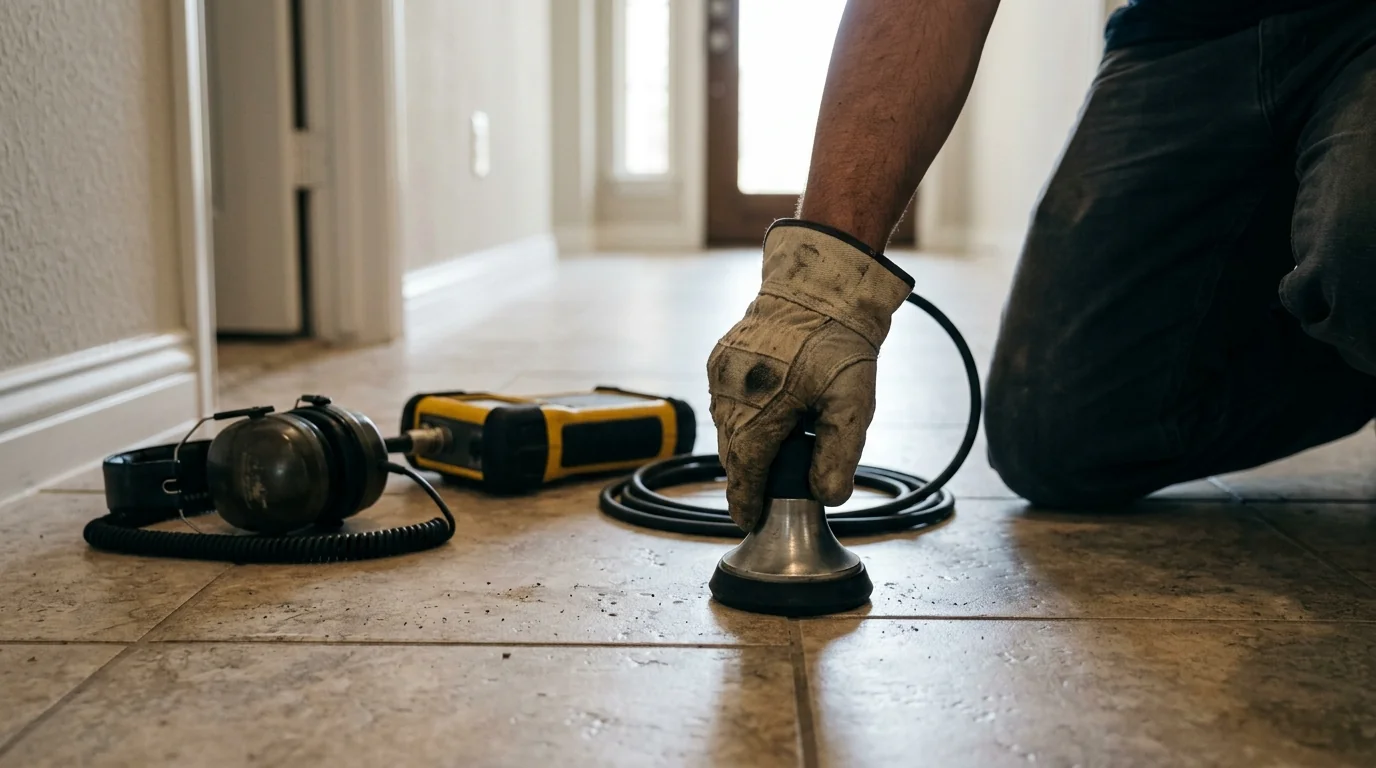
A hidden leak is detective work in a fixed order. First we confirm there is a leak at all by reading the meter and its low-flow indicator with everything shut off, including the ice maker and irrigation. Then we rule out the easy suspects: a toilet flapper seeping into the bowl, a water heater relief valve dripping into its drain line, a hose bib left cracked open.
If those check out, we isolate sections of the house. Closing the supply at the water heater separates hot from cold. Capping branches lets us pressure test each run with a gauge and watch which one drops. Only then do the acoustic sensor and thermal camera come out, because they work far better when we already know which line we're listening to. If the leak sits under the concrete, we move on to repairing it under the slab; if it's in the yard, the job becomes a service line repair.
The versions we see most
Wall and ceiling leaks
A stain on a ceiling below a bathroom could be a supply line, a drain, a shower pan or a failed caulk line at the tub, and each one is fixed differently. We start by running each fixture above the stain one at a time while watching with the thermal camera. A drain leak only shows when water flows; a supply leak shows all the time. Moisture readings across the drywall map how far the water traveled. When we do cut, it is a small square access hole over the marked spot, easy to patch.
Running water meter with no visible leak
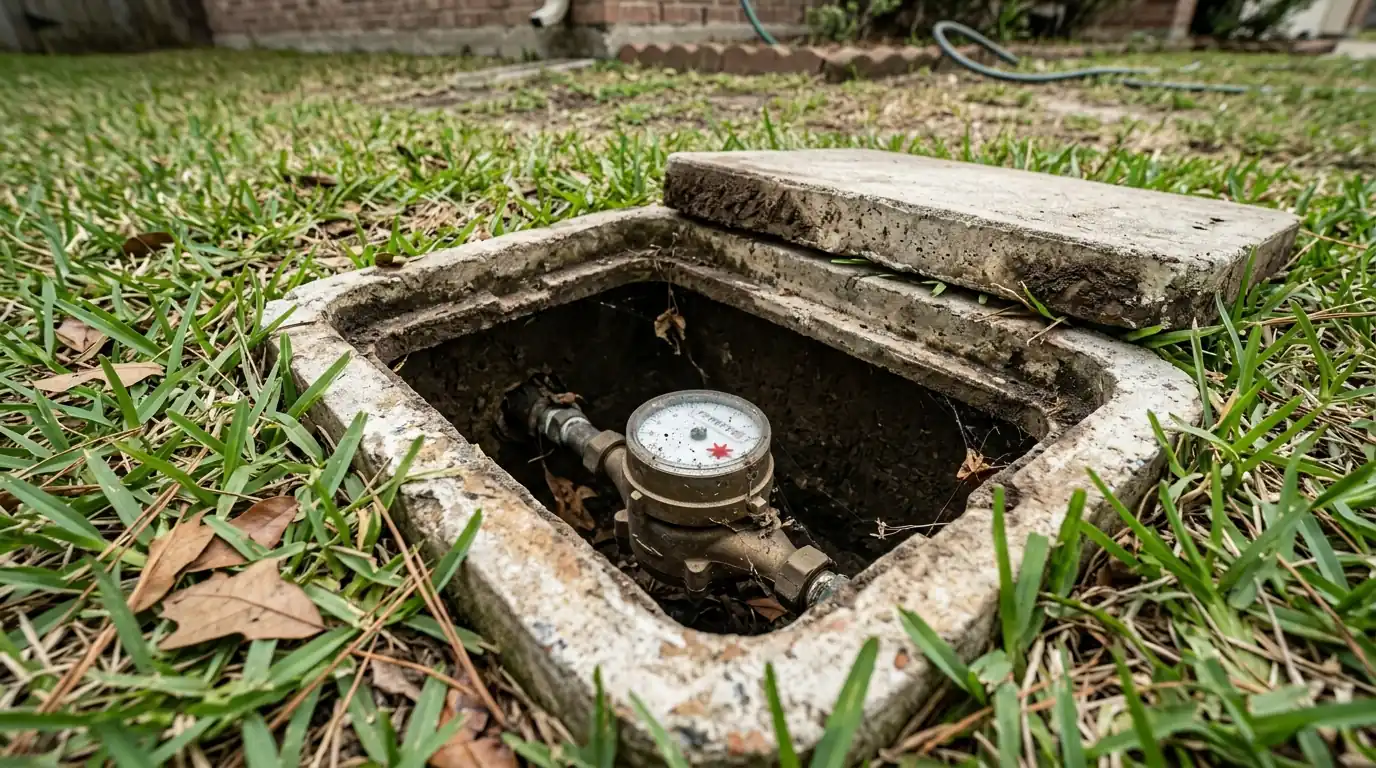
The low-flow triangle or dial on your meter is the most reliable test you have. If it turns with everything off, water is leaving the pipes somewhere, and we work outward from that fact. A leak between the meter and the house keeps the meter moving when the house-side main valve is closed. A leak inside the house stops when that valve closes. That one check decides whether we search the yard, the walls or the slab, and it saves hours of guessing in the wrong place.
High water bill investigation
A bill that jumps without a change in habits is worth a look, even when you can't see water anywhere. Toilets are the most common culprit: a flapper that leaks silently wastes a surprising amount over a billing cycle, and a dye tablet in the tank tells you in fifteen minutes. Irrigation is next, especially a cracked head or a zone valve that never fully closes. After those we check the water heater, any softener drain and the main line. If the meter holds and the bill is still off, we tell you so you can ask the utility to recheck the meter.
Step by step
The order we test in, so nothing gets cut on a guess
Read the meter
Everything off, and the low-flow dial watched for movement.
Rule out fixtures
Toilets, the relief valve, hose bibs and irrigation are checked first.
Split the system
Hot and cold are isolated and branches pressure tested on a gauge.
Pinpoint
Acoustic listening and thermal imaging mark the spot on the wall, floor or yard.
Show you the readings
You see what we found and the repair options before anything is opened.
Local to southeast Houston
Hard water, clay and quiet leaks around Houston
Two local conditions make leaks harder to spot. Houston's Main system averaged 135.5 ppm hardness in the 2025 city report, which falls in the USGS hard range, and scale builds up inside pipes and valves over time. And the expansive clay under most of the area, basically anywhere south of Interstate 10, opens cracks when it dries, so water from a buried leak can drain away instead of surfacing as a puddle. A leak can run for weeks with no wet spot to show for it.
Call before it gets worse
We answer 24/7 from South Belt.
Your options
Acoustic listening or thermal imaging: which tool finds what
| Compare | Acoustic listening | Thermal imaging |
|---|---|---|
| How it works | Picks up the sound of pressurized water escaping a crack | Shows temperature differences on a surface |
| Strongest on | Supply lines under pressure, in slabs and yards | Hot water leaks and wet drywall behind paint |
| Struggles with | Noisy rooms, running appliances, very slow seeps | Cold side leaks that match room temperature |
| Drain leaks | Rarely useful, since drains are not under pressure | Useful once water has been run down the drain |
| What you see | A marked spot and the signal strength we heard | A picture of the warm or cool pattern on the wall |
We usually use both. Acoustic finds pressurized leaks; thermal confirms where water has spread and catches hot side leaks quickly.
Pricing
What changes the cost of finding a leak
Finding a leak is priced on time and tools. A leak that shows itself in ten minutes costs less than one that takes isolating every branch.
How many lines are involved
A single bathroom group tests quickly; a whole house with hot, cold and irrigation takes longer.
Where the leak hides
Walls and ceilings are easier to scan than lines buried in the yard or under the slab.
Valve condition
A main or branch valve that will not close fully has to be dealt with before testing is reliable.
Access openings
If a small cut is needed to confirm the spot, patching it is separate from the detection.
Repair on the same visit
Many leaks are repaired right after they're found, which adds parts and labor.
Typical planning range: $75 - $500 for professional leak detection for most homes (slab leak detection $125 - $400), per Benjamin Franklin Plumbing Fort Worth (Janu). A guide figure, not our price; your quote follows the inspection.
Common questions
Leak Detection questions from Houston homeowners
Turn off every faucet, the ice maker and irrigation, then watch the small triangle or dial on your water meter. If it moves over fifteen minutes, there is a leak somewhere between the meter and your fixtures.
Often only a small access hole once the spot is confirmed, and sometimes none at all if the leak is at a fixture or in the yard. Nothing gets opened until the readings point to one place.
Yes, but differently. Drains are not pressurized, so we run water through them and use thermal imaging or a sewer camera. A drain leak under the slab may need a separate test.
If the meter holds still and the fixtures check out, we tell you that plainly. A bill that is still high may come down to a meter reading the utility should recheck.
Yes. Most leaks we find are repaired on the same visit, from a supply connector to a short section of pipe. Bigger jobs, like a reroute, are scheduled with you.
Same system, different job
Related plumbing services
- Slab Leak RepairHot spots in the floor and a meter that never stops, located and repaired.
- Water Line RepairLeaking service line between the meter and the house dug, repaired and tested.
- Burst Pipe RepairSplit copper, blown PEX fittings and freeze-cracked lines cut out and replaced.
- Emergency PlumberBurst lines, sewage backups and no water at 2 a.m. get a call back fast.
Do not wait on a leak
Every hour of running water adds to the repair. Call now, any hour.