New tank, same visit
Water heater replacement in Houston, gas or electric
Water is seeping from under the jacket, the hot water comes out rusty, or the heater has needed one repair after another. When the tank itself is done, the job is a clean swap with connections brought up to date.
- We answer 24/7, nights and weekends included
- Out of South Belt, off Beltway 8
- Old tank drained, removed and hauled off
Updated October 2026

Short answer
Water heater replacement in Houston is usually a one-day job: we drain and remove the old tank, set a new gas or electric unit of the right size, and redo the connections that wear out with it. That means new supply lines, a new relief valve and discharge, and an expansion tank where the plumbing is a closed system.
The job
When a new tank is the right call
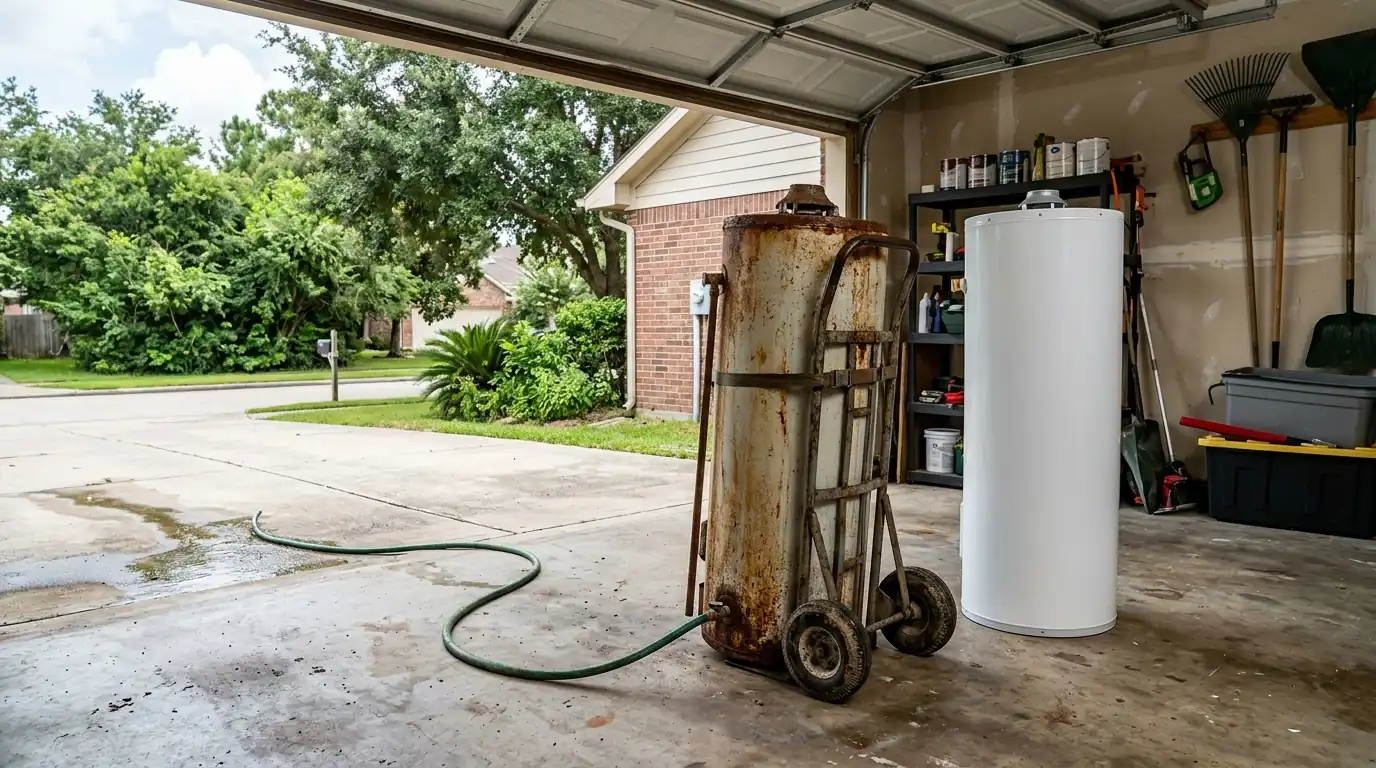
Replacement starts with a simple question: is the steel tank leaking or not? A dripping valve, a dead element or a bad thermocouple can be fixed, and if that's all it is we'll point you to a repair instead. Water coming from the tank body, rust in the hot water only, or a burner chamber eaten by corrosion all mean the tank has reached the end.
From there you choose what goes in. Most homeowners stay with the same fuel and capacity because the gas line, venting and wiring already fit. Some take the chance to move up a size for a bigger family, or to step away from tanks entirely with a tankless unit. We'll talk through first-hour rating, the footprint you have, and what each option asks of the house before anything is ordered.
Your options
Gas tank or electric tank: how they compare
| Compare | Gas tank | Electric tank |
|---|---|---|
| Recovery after a long shower | Faster, since the burner heats more quickly | Slower, the elements take longer to reheat |
| What the house needs | A gas line and a flue or power vent | A dedicated circuit at the right amperage |
| During a power outage | Standing pilot models keep heating | No hot water until power returns |
| Install location | Needs clearance and venting to the outside | Fits closets and spaces with no flue |
| Common parts that fail | Thermocouple, gas valve, burner | Elements and thermostats |
Staying with the fuel the house already has is usually the simplest swap. Switching fuels means running gas or upgrading wiring, so it makes sense mainly when you are remodeling.
Pricing
What sets the price of a new water heater
The tank itself is only part of the bill. Location, fuel type and how much of the old connection work has to be redone shape the total.
Fuel and capacity
A larger tank or a high-efficiency gas model costs more than a standard same-size swap.
Install location
Attic and closet units take more labor and need a drain pan and line.
Venting condition
Rusted or undersized flue pipe on gas units has to be replaced to vent safely.
Expansion tank and valves
Adding an expansion tank, new shutoffs or a sediment trap adds parts and time.
Permit for gas work
Gas connections in Houston need a permit, which is included in the price we quote.
Typical planning range: $600 - $3,100 for standard tank water heater with installation, per HomeGuide (Janu). Use it for budgeting; the real number depends on what we find on site.
The versions we see most
Gas tank water heaters
Gas tanks are the most common heater we replace in Houston garages, and the swap involves more than the tank. We shut off gas and water, drain the old unit, disconnect the flex connector and lift the vent pipe off the draft hood. The new heater goes on the platform with a fresh gas connector, a sediment trap ahead of the gas control, and a vent run checked for proper rise and clearance. Venting is where old installs most often fall short, with sagging single-wall pipe or a loose hood. After lighting, we watch the draft with the burner running to make sure exhaust goes up the flue and not into the garage.
Electric tank water heaters
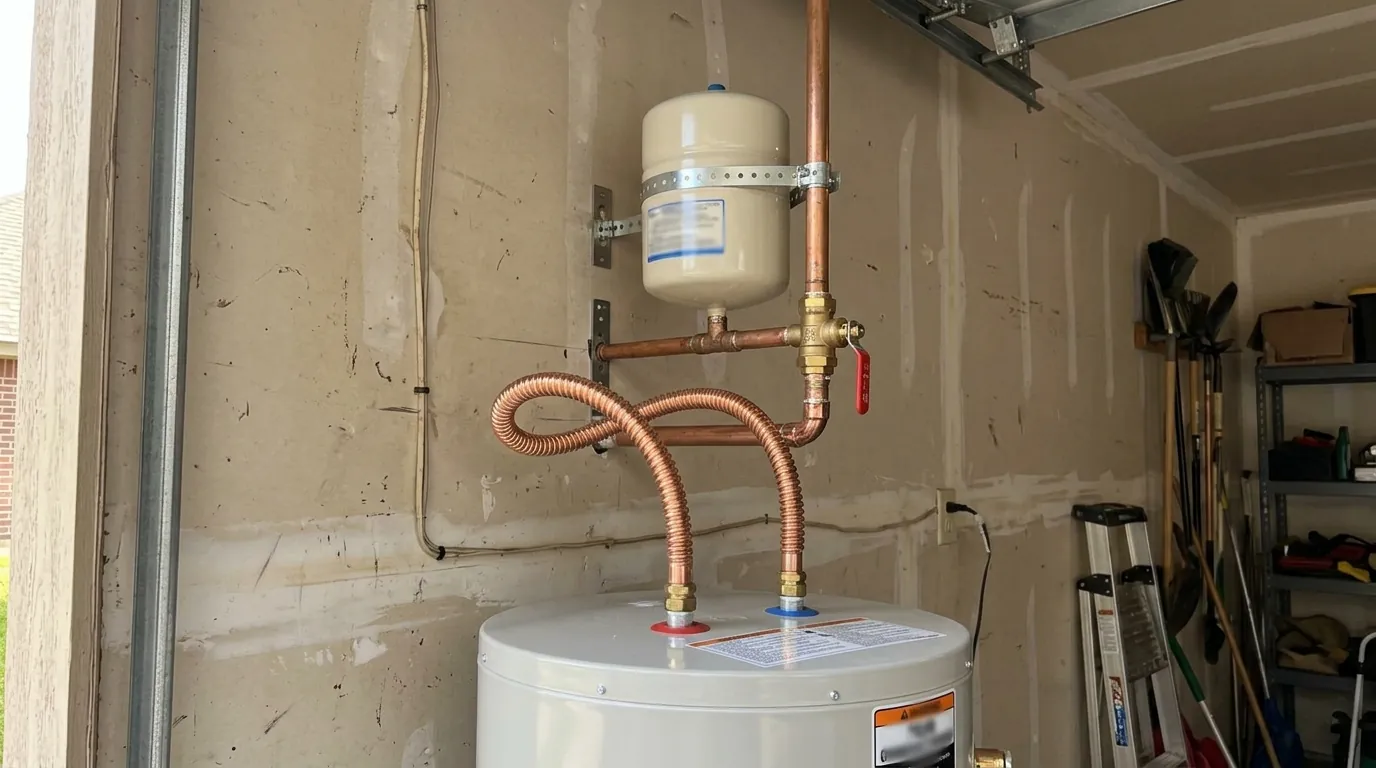
Electric tanks are simpler to swap because there's no flue or gas line, but the wiring and the breaker have to match the new unit's elements. We kill the breaker, confirm the circuit is dead, drain the tank, and disconnect the supply lines and the wiring at the junction box. The new tank is set level, filled completely before power goes back on, and checked so both elements cycle properly. Filling first matters: an element energized in an empty tank burns out in seconds. If you're replacing an electric tank anyway, it's worth asking whether a heat pump model fits the space, since it uses the same kind of circuit.
Expansion tanks and code updates
A lot of older Houston installs were done before anyone thought about thermal expansion. When water heats it expands, and if a check valve or PRV keeps it from backing into the city main, pressure spikes every time the burner runs. That shows up as a dripping relief valve and stress on every fitting in the house. A small expansion tank on the cold line absorbs it. We also replace the T&P valve and route its discharge pipe correctly, fit a drain pan with a drain line on attic and upstairs units, and replace corroded nipples and shutoffs at the top of the tank so the new heater doesn't inherit old leaks.
Scope of the work
What comes with a water heater replacement
- Draining, disconnecting and removing the old tank
- A new gas or electric tank sized to your household
- New water supply connectors and shutoff where needed
- New temperature and pressure relief valve with a proper discharge line
- New gas connector and sediment trap on gas units
- Vent pipe checked and replaced if rusted or loose
- Expansion tank on closed systems
- Drain pan and drain line for attic or interior installs
- Haul-away of the old heater
Call before it gets worse
We answer 24/7 from South Belt.
Local to southeast Houston
Gas heater swaps and Houston permit rules
When the heater burns gas, a rule comes with the swap. The Houston Permitting Center says a plumbing permit is required for the connection to a fuel gas appliance, pulled by a master plumber registered with the city, so we pull it as part of a gas swap. Plenty of homes here are on their second or third tank: in South Belt/Ellington alone, 5,929 housing units were built between 1960 and 1979 and another 5,725 between 1980 and 1999, so older vent runs and gas connectors are common.
Step by step
How a tank swap goes on the day
Size the new heater
We check household demand, the old unit and the space before recommending a tank.
Shut down and drain
Gas or power off, water off, and the old tank emptied through a hose to a drain.
Set the new tank
New connectors, valves, venting and pan as the install calls for.
Fill, light and test
The tank fills fully, then we light or power it and check draft and pressure.
Haul the old tank away
The old heater leaves with us and the area is cleaned up.
Timing
How long a water heater replacement takes
A same-size swap on a garage platform usually takes two to four hours from shutoff to hot water at the tap. Attic installs, vent repairs or adding an expansion tank can stretch it toward a full day. Cold water stays on for most of the job; you're only without hot water while the new tank fills and heats, which takes roughly another hour after it's lit or powered.
Brands we service and install
We install gas and electric tanks from Bradford White, Rheem and A. O. Smith, matched to the space and the fuel your home already has.
- Rheem
- A. O. Smith
- Bradford White
- Navien
- Rinnai
- Noritz
- Kohler
- Moen
- Delta
- American Standard
- Pfister
- InSinkErator
- Uponor
- Watts
Common questions
Water Heater Replacement questions from Houston homeowners
Usually, unless your household has changed. If you run out of hot water often now, moving up one size or looking at a tankless unit may make sense. We check the first-hour rating against how many showers run back to back.
If your home has a PRV or a check valve at the meter, the system is closed and thermal expansion has nowhere to go. An expansion tank protects the new heater and the relief valve from constant pressure spikes.
Sometimes. Moving it to a garage or closet means rerouting water lines, and on gas units, the gas line and venting. It costs more up front but removes the risk of a leak over the ceiling.
We drain it, take it out and haul it away the same visit, so it doesn't sit in your garage or on the curb.
Water leaking from the steel tank or through the jacket seam is the clear sign. Valves and parts can be swapped, but a corroded tank wall can't be patched.
Same system, different job
Related plumbing services
- Water Heater RepairNo hot water, pilot trouble or a leaking valve fixed on tank heaters, gas or electric.
- Tankless Water Heater InstallationGas tankless units sized for the house, with the gas line and venting to match.
- Heat Pump Water Heater InstallationHybrid electric units that pull heat from the air, installed with a proper drain.
- Water Heater Flush & MaintenanceSediment flushed, anode checked and the relief valve tested before trouble starts.
- Gas Line InstallationNew gas runs for ranges, dryers, tankless heaters, generators and outdoor kitchens.
Ready to talk it through?
Call any hour. We look first, explain the choices, and price them before work starts.