Running, rocking or clogged
Toilet repair for running, leaking and clogged toilets in Houston
The tank keeps refilling on its own, water shows up around the base, or the bowl rises every time someone flushes. A toilet that misbehaves is almost always fixable, and usually in one visit.
- We answer 24/7, nights and weekends included
- Based in South Belt, close to Beltway 8
- Tank parts, wax seal or clog, fixed on the toilet you have
Updated October 2026

Short answer
Toilet repair in Houston most often means replacing a fill valve or flapper that scale has worn out, resetting a toilet that rocks on a failed wax ring, or clearing a clog the plunger can't move. Most of these are finished in one visit, and we only suggest a new toilet when the bowl or tank itself is cracked.
What to watch for
Signs your toilet needs a repair, not a plunger
The tank refills by itself
Water is leaking past the flapper or the fill valve isn't shutting off.
Water around the base
The wax seal or the flange under the toilet has failed.
The toilet rocks
Loose closet bolts or a broken flange, and the seal is likely next.
Weak or double flushes
Chain slack, a low water line or scale in the rim holes.
Hissing from the tank
The fill valve is sticking or the float is set too high.
Sewer smell near the toilet
The seal at the floor isn't holding gas back anymore.
The job
What is actually wrong when a toilet acts up
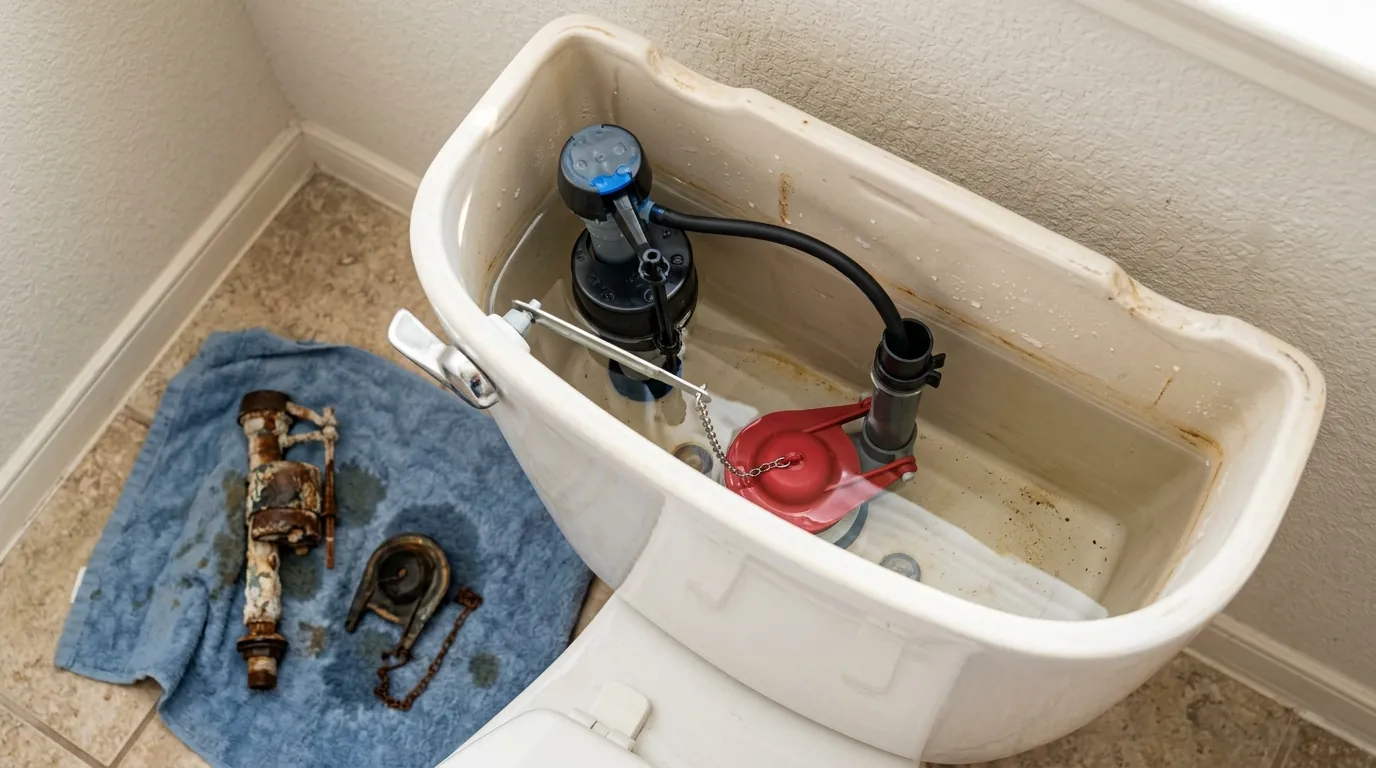
A toilet has only a handful of moving parts, so the symptom points to the culprit. Water trickling into the bowl means the flapper isn't sealing. A tank that hisses and refills means the fill valve or float is off. A flush that stops halfway means the chain, handle or flush valve. Water on the floor means a supply line, tank bolts or the seal under the toilet.
We test each of those before replacing anything, and we use parts that fit your toilet's flush valve size, since 2 inch and 3 inch openings take different flappers. If the bowl is chipped through, or the tank has a hairline crack that weeps, a repair won't hold and we'll talk about a new toilet instead. If several drains are slow at once, the toilet isn't the problem and we look at the drain line further down.
The versions we see most
Running toilets
A running toilet can waste a surprising amount of water without a sound you notice from the next room. The two usual causes are a flapper that has warped or picked up scale, so water leaks past it into the bowl, and a fill valve that no longer shuts off at the right level. A quick test: put a few drops of food coloring in the tank and wait. Color in the bowl without flushing means the flapper. Water spilling into the overflow tube means the fill valve. We replace the worn part, set the water line to the mark on the tank, and adjust the chain so the flapper closes fully every time.
Leaks at the base
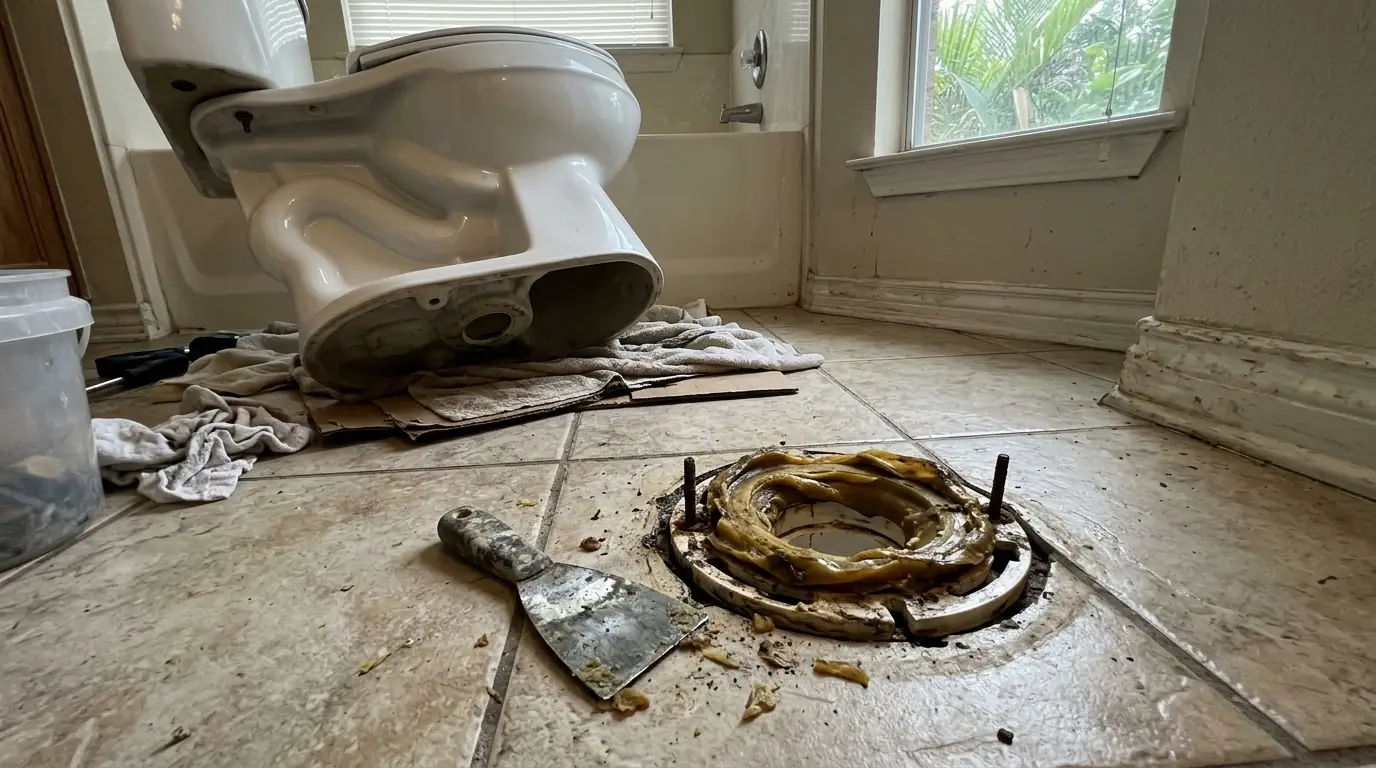
Water around the base after a flush, a toilet that rocks when you sit, or a sewer smell in the bathroom all point to the seal between the toilet and the floor flange. Wax rings fail when a toilet has been loose for a while or the floor has moved. We pull the toilet, scrape the old wax, check the flange and the closet bolts, and reset it on a new seal with shims where the floor isn't flat. If the flange is broken or the subfloor is soft, that repair is done first so the new seal has something solid under it.
Stubborn toilet clogs
A clog that a flange plunger won't clear usually sits in the trapway of the bowl or just past it. Wipes, toys, dental floss and paper towels are the common finds. We start with a closet auger, which reaches through the trap without scratching the porcelain. If the auger brings back roots or grease, or other fixtures gurgle when the toilet flushes, the blockage is further down the line. At that point the toilet is just the symptom, and the fix moves to the main sewer line through the cleanout.
Step by step
How a toilet repair visit runs
Watch it fail
We flush, listen and dye-test the tank to see which part is at fault.
Shut off the supply
The stop is closed, the tank drained, and the angle stop checked for leaks.
Repair or reset
Tank parts are replaced, or the toilet is pulled and reset on a new seal.
Flush test
Several full flushes to confirm the fill level, the seal and a dry floor.
Local to southeast Houston
Hard water and the parts inside a Houston toilet tank
Every flush refills the tank with city water, and in Houston that water averages about 135 ppm of hardness, with readings up to 229 ppm in the latest city report. By USGS standards, that range runs from hard to very hard, and hard water leaves scale on whatever it passes through. In a toilet tank, that means crusty fill valve seals, stiff floats and flappers that no longer seat flat. A running toilet here is more often a scale problem than a broken part.
Talk to a plumber now
Any hour, any day. Tell us what you see.
Before you call
What you can try first, and when to stop
| Situation | What you can safely do | When to call us |
|---|---|---|
| Toilet keeps running | Lift the tank lid and check that the chain isn't caught under the flapper | A new flapper or adjusted float doesn't stop the refill |
| Bowl is rising after a flush | Close the stop valve behind the toilet right away | A flange plunger won't clear it in a few tries |
| Small leak at the supply line | Close the stop and snug the coupling a quarter turn by hand | The line is cracked or the stop keeps weeping |
| Toilet rocks slightly | Leave the bolts alone; overtightening cracks porcelain | Any rocking, since the wax seal is already under strain |
Pricing
What decides the cost of a toilet repair
Most toilet repairs are small jobs. The bill grows when the toilet has to come off the floor or the problem turns out to be past the toilet.
Tank part or floor seal
Swapping a flapper or fill valve is quick; pulling and resetting the toilet takes longer.
Flange condition
A cracked or rusted flange adds a repair before the toilet goes back down.
Toilet design
Skirted, wall-hung and one-piece toilets are heavier and slower to remove and reset.
Where the clog sits
A bowl clog is cleared with an auger; a main line clog needs a cable from the cleanout.
Subfloor damage
Long-term leaks can soften the floor under the toilet and need repair before resetting.
Typical planning range: $100 - $300 for toilet repair, per HomeGuide (June). Treat it as a planning number only. We price your job after we see it.
Brands we service and install
We stock repair parts for toilets from Kohler, American Standard, Delta and other common makers, and match flappers to the flush valve size.
- Rheem
- A. O. Smith
- Bradford White
- Navien
- Rinnai
- Noritz
- Kohler
- Moen
- Delta
- American Standard
- Pfister
- InSinkErator
- Uponor
- Watts
Common questions
Toilet Repair questions from Houston homeowners
Not usually, but it keeps wasting water until you fix it. Close the stop valve behind the toilet between flushes if it won't stop, and call when it's convenient. If water is reaching the floor, call right away.
Low-flow bowls from the 1990s, a partial blockage in the line, or a vent that doesn't let air in can all cause repeat clogs. If more than one fixture is slow, the cause is usually further down the drain.
No patch on porcelain holds pressure for long. A cracked tank can sometimes be replaced alone if the model is still made; otherwise the whole toilet is replaced.
Often the flange sits below the finished floor, so the wax ring never compresses. An extension ring or a thicker seal fixes it once the toilet is pulled.
Tank part repairs usually take under an hour. Pulling and resetting a toilet on a new seal often takes one to two hours, more if the flange needs work.
Same system, different job
Related plumbing services
- Toilet InstallationNew toilets set on a fresh flange with a new supply line and a level seal.
- Drain CleaningKitchen, bathroom and laundry drains cleared with the right cable for the pipe.
- Main Sewer Line CleaningBackups in more than one fixture cleared at the cleanout, roots included.
- Faucet Repair & InstallationDrips, low flow and loose handles repaired, or a new faucet set and sealed.
Need a plumber tonight?
The phone is answered 24/7. Tell us what you see.