Broken drains under the floor
Under-slab drain repair for Houston foundations
A hydrostatic test failed during a home sale, or the camera shows a cast iron drain cracked open under the kitchen. The pipe sits inside or below the slab, and getting to it is most of the job.
- We answer 24/7, nights and weekends included
- Out of South Belt, near Beltway 8 and Ellington
- Drain break located on camera before the floor or yard is opened
Updated October 2026

Short answer
Under-slab drain repair in Houston fixes broken waste lines that run beneath the foundation, reached either by tunneling in from outside or by cutting the floor right over the break. Cast iron drains under older slabs are the usual repair. These are drain lines, not water supply lines, so the leak shows up on a camera or a hydrostatic test rather than on the meter.
The job
Drain lines under the slab, and why they fail quietly
Every sink, tub and toilet on a slab house drains into pipes that were set in the ground before the concrete was poured. When one of those drains cracks, sewage seeps into the soil under the foundation instead of flowing to the street. Unlike a broken water line, nothing is under pressure, so the meter stays still. What you see instead are slow drains, a sewer smell inside, or a failed test.
A drain break is a different problem from a pressurized slab leak in a water line. We find it with a camera run through the drains and, when needed, a hydrostatic test that fills the drain system and watches for the water level to drop. The camera's locator marks the break on the floor. That tells us whether to tunnel in from outside or cut a small section of the slab directly above it.
Your options
Tunnel under the house or cut through the floor
| Compare | Tunneling from outside | Cutting the slab |
|---|---|---|
| Inside disruption | None, the floor stays in place | Flooring and concrete over the break are removed |
| Right choice when | The break is under cabinets, tile or rooms in daily use | The break is close to an open, easy floor area |
| Outside disruption | A pit and a soil pile beside the foundation | Little or none |
| Time on site | Usually longer because of digging and backfill | Usually shorter for a single break |
| After the repair | Tunnel backfilled and compacted under the slab | Concrete patched and flooring replaced |
If the break is a few feet from an outside wall or under a finished kitchen, tunneling usually wins. If it sits under a closet or bare concrete near the center, a floor cut is often simpler.
Pricing
What drives the cost of an under-slab drain repair
Getting to the pipe is usually the larger part of the bill. Where the break sits under the house matters more than the size of the break.
Tunnel or floor cut
A tunnel moves more soil but avoids interior flooring. A floor cut is shorter but needs concrete and flooring work.
Distance from the outside wall
A break near the middle of the house means a longer tunnel.
Length of pipe to replace
One cracked joint is smaller than a whole run of rotted cast iron.
Flooring over the break
Tile, hardwood and cabinets add removal and replacement for a floor cut.
Testing before and after
Hydrostatic tests and camera runs confirm the repair and the passing result.
Engineering or permit needs
Some tunnels and slab cuts need a permit or an engineer's input.
Typical planning range: $900 - $2,000 for tunneling under the house, per Fixr (Upda). Treat it as a planning number only. We price your job after we see it.
The versions we see most
Tunneling under the slab
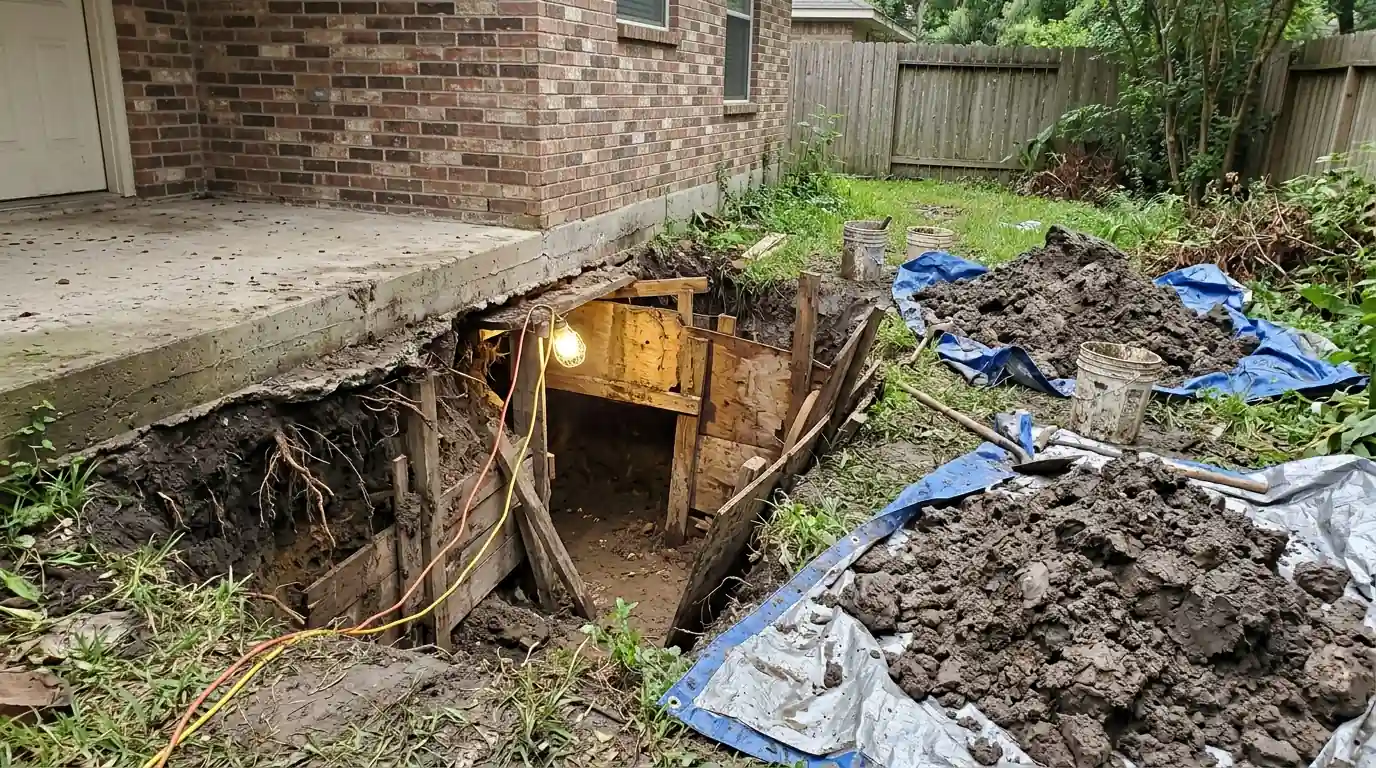
Tunneling means digging a pit beside the foundation and working under the slab to reach the broken drain, without touching the floor inside. It is the choice when the break sits under finished flooring, cabinets or a room you need to keep using. The tunnel is hand dug to the pipe, the damaged section is replaced, and the tunnel is backfilled and compacted so the soil supports the slab again. It takes longer than a floor cut and moves a lot of soil, but the inside of the house stays intact and nobody has to move furniture.
Cast iron drain replacement
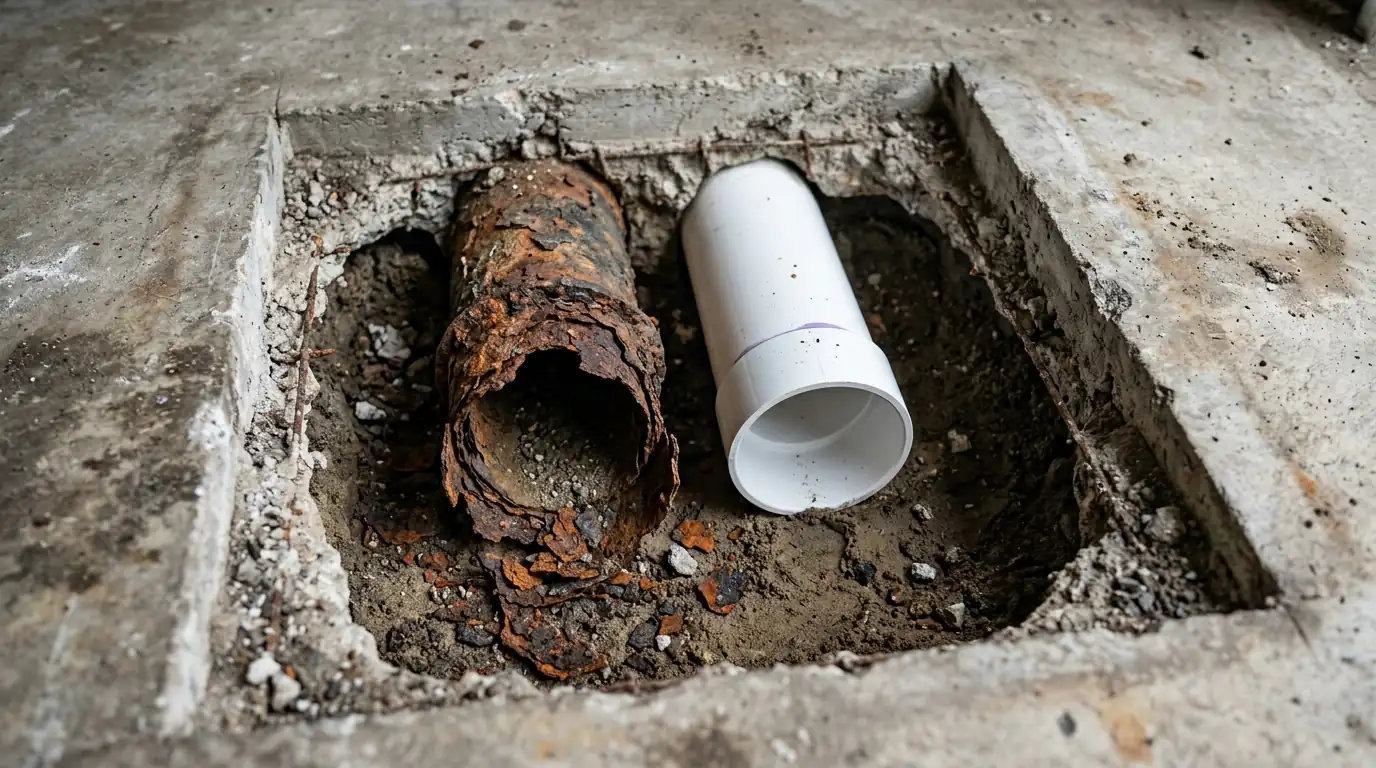
Cast iron under a slab corrodes from the inside, and the bottom of the pipe usually goes first. The camera shows it as a channel worn along the floor of the pipe, scale ridges, or holes where soil shows through. Once the bottom has rotted out, waste leaks into the ground every time a fixture drains. We cut out the failed run and replace it with PVC, joined to the remaining iron with shielded couplings. Where several branches show the same wear, replacing the main drain under the house in one job beats chasing breaks one at a time.
Repairs after a failed hydrostatic test
Foundation repair companies and buyers often ask for a hydrostatic test, and a failed result can put a sale or a foundation job on hold. The test tells you the drain system is losing water, not where. We follow up with a camera to pinpoint the break, repair it by tunnel or floor cut, and then retest so you have a passing result to show. If the drains also clog often, we'll check whether they need jetting to clear scale before the final test so the result reflects the repaired line.
Local to southeast Houston
Older slabs and expansive clay in southeast Houston
Two things work against under-slab drains here. First, the soil: local reporting notes that anyone south of Interstate 10 basically sits on expansive clay, and a slab that moves with drought and rain stresses the rigid pipe beneath it. Second, the age: in South Belt/Ellington, close to 5,930 homes were built between 1960 and 1979, and HAR lists average build years of 1967 for Sagemont and 1970 for Kirkwood. Houses from that era drained through cast iron, which can begin to deteriorate around 40 years in.
Talk to a plumber now
Any hour, any day. Tell us what you see.
Step by step
How we reach and repair a drain under the foundation
Confirm and locate
Camera footage and, when needed, a hydrostatic test find and mark the break.
Pick the access
You see the tunnel and floor cut options with the tradeoffs and price of each.
Open the access
A tunnel is dug from outside, or a small section of slab is cut over the break.
Replace the pipe
The failed drain comes out and new PVC goes in with proper fittings.
Retest and close
A retest confirms the repair before the tunnel is backfilled or the slab is patched.
Timing
How long an under-slab drain repair takes
A single break reached by a floor cut is often a one to two day job, including the concrete patch. Tunneling usually runs two to five days, depending on how far the tunnel has to go and how much pipe is replaced. Retesting and backfill add time at the end.
The drains on the affected branch are out of service while the pipe is open. We can often keep a toilet and sink on another branch working so the house stays usable.
Common questions
Under-Slab Drain Repair questions from Houston homeowners
No. A slab leak usually means a pressurized water line. A drain leak is in the waste pipes, which are not under pressure, so it shows up on a camera or a hydrostatic test, not on the water meter.
Done properly, no. The tunnel is backfilled and compacted when the work is finished so the soil supports the slab again. Large tunnels may involve an engineer's input.
It checks the drain system under the slab for leaks before closing, since those pipes can't be seen and are costly to repair.
Sometimes. If the pipe is cracked but still round, lining from inside can avoid digging. Pipe with the bottom rotted out usually needs to be replaced.
Water leaking into clay under a slab can soften or swell the soil and add to movement. That is a reason not to leave a known drain break unrepaired.
Same system, different job
Related plumbing services
- Hydrostatic Plumbing TestUnder-slab drain testing for foundation repair, home sales and suspected drain leaks.
- Slab Leak RepairHot spots in the floor and a meter that never stops, located and repaired.
- Sewer Camera InspectionA recorded camera run that shows breaks, bellies and roots before anyone digs.
- Sewer Line RepairOne cracked, offset or root-broken section dug and replaced, not the whole run.
Planning the work?
Phone any hour and we will set a time to look at it.