Plumbing Library
Hard water and chloramine in southeast Houston homes
White crust on the shower head, a water heater that pops and rumbles, a faint pool smell from the tap. Here is what is actually in the water and which treatment fixes which problem.
By Greta Wilburn, Plumbing Library EditorUpdated October 2026
Short answer
Houston city water is hard on average and is disinfected with chloramine. Hardness leaves scale in water heaters, tankless units and faucets; chloramine is what gives tap water its chemical taste. A softener handles hardness, a catalytic carbon filter handles chloramine, and reverse osmosis cleans drinking water at one sink. Many homes need one of the three, not all of them.
What the city's water report says about hardness
Houston Public Works publishes a water quality report every year, and the hardness numbers are the part that matters most for your plumbing. In the 2025 report, total hardness in the Main system ranged from 43.5 to 229 ppm, with an average of 135.5 ppm measured as calcium carbonate.
To put that in context, the USGS calls water between 121 and 180 mg/L hard and anything above 180 very hard (ppm and mg/L are the same thing here). So the citywide average lands in the hard band, and the top of the range is very hard. The spread is wide because the system blends surface water from lakes and rivers with water from deep wells, and what reaches your tap on a given week depends on the mix. A home test strip or a hardness reading on a sample tells you where your house actually sits before you buy anything.
Where southeast Houston's water comes from
Much of this side of town is served by the Southeast Water Purification Plant, one of three city surface water plants. It takes Trinity River water through the Lynchburg Pumping Station and sends out about 200 million gallons a day. League City and Pearland are listed among the plant's sub-partners, so homes there drink some of the same treated water.
That matters for one practical reason: the hardness and disinfectant you deal with in Ellington are not very different from what a neighbor deals with a few cities over. Treatment that works in one house usually works in the next one down the road.
Chloramine: why the tap smells like a pool
The 2025 report lists chloramines as the disinfectant in the distribution system. Chloramine is chlorine combined with ammonia. It lasts longer in miles of city pipe than plain chlorine, which is why utilities use it, but it also hangs on in your glass and your shower.
Two things follow from that. First, chloramine is harder to remove than chlorine. A basic carbon pitcher or fridge filter knocks some of it down, but a whole-house system needs catalytic carbon and enough contact time to do the job. Second, it does not boil off or settle out quickly if you leave a jug on the counter, the way some people do with chlorinated water.
The city uses chloramine to keep water disinfected on its way through the pipes. Most people who filter it do so for taste, smell or dry skin complaints, and fish keepers and anyone running medical equipment that uses tap water need it removed entirely.
What scale does to water heaters, tankless units and fixtures
The USGS notes that hard water moving through pipe for years leaves scale behind. In a house, the worst of it collects wherever water gets hot, because heat drives the minerals out of solution. That is why the damage shows up in the water heater first.
In a tank heater, scale settles to the bottom as a gritty layer. On a gas unit you hear it as popping or rumbling while the burner runs, and the layer sits between the flame and the water, so the heater burns longer for the same shower. On an electric unit, scale coats the lower element until it fails. A tankless heater suffers faster because its heat exchanger has narrow passages, and many units throw a scale code when flow drops. Regular water heater flushing is the simplest way to slow all three down.
Out at the fixtures, scale looks like white crust on shower heads, slow aerators, toilet fill valves that stick, and spotty glasses from the dishwasher.
- Popping or rumbling from a gas tank heater
- Lower element failures on an electric heater
- Scale or low-flow error codes on a tankless unit
- Crusted shower heads and aerators that lose pressure
- Cloudy glassware and white rings around drains
Seeing this at home right now?
Phone us day or night and describe it; we will say what it sounds like.
Softener, carbon filter or reverse osmosis: what each one fixes
These three get sold as if they do the same job. They don't, and buying the wrong one is the most common mistake we see.
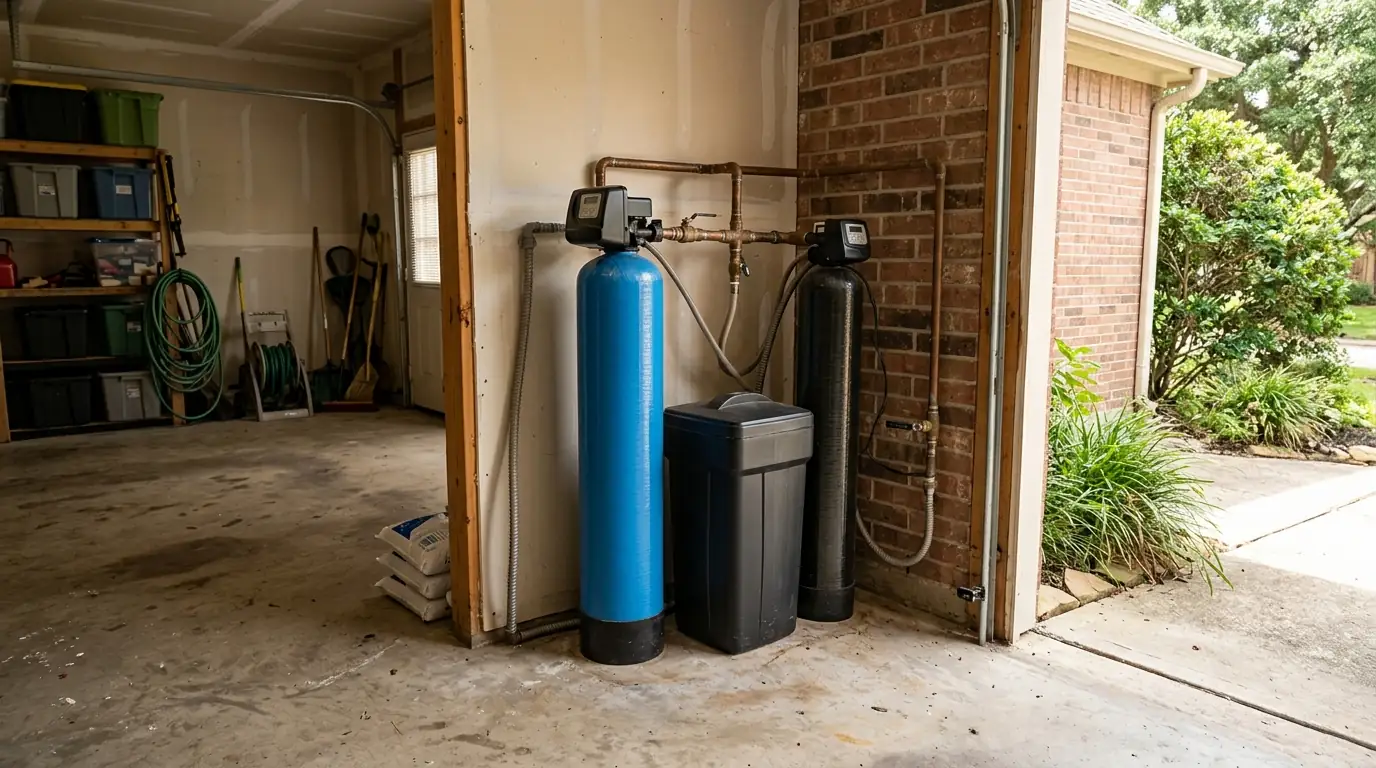
- A water softener trades calcium and magnesium for sodium in a resin tank. It stops scale. It does nothing for chloramine taste. A softener install usually goes at the main line where it enters the house, often in the garage, with a bypass valve and a drain for the regeneration water.
- A whole-house catalytic carbon filter removes chloramine and the taste that comes with it. It does not soften. A whole-house filter is sized to your flow so showers do not lose pressure.
- Reverse osmosis forces water through a membrane at one tap, usually the kitchen sink. It takes out most dissolved minerals and what is left of the disinfectant, giving you drinking and cooking water. A reverse osmosis system fits under the sink with a small storage tank and its own faucet.
Picking the right setup for your house
Start with the complaint. If the problem is crust, short heater life and spots, you have a hardness problem and a softener is the answer. If the problem is taste, smell or itchy skin after showers, carbon is the answer. If you just want good drinking water and buy bottled now, RO at the kitchen sink may be all you need.
Plenty of houses end up with a pair: a carbon filter ahead of a softener protects the resin from chloramine, and an RO unit at the sink trims the sodium a softener adds. If you are about to put in a tankless heater, softening first is worth a hard look, since that heat exchanger is the most scale-sensitive part in the house. We can test your water, look at where the main line enters, and tell you what fits before anything gets installed.
Keeping the equipment working
Every one of these systems needs some upkeep, and a neglected one can be worse than none. A softener needs salt in the brine tank, and the brine tank needs a clean-out now and then if salt bridges into a hard crust. Carbon media gets used up over time and has to be replaced on the maker's schedule. RO systems have prefilters that go first and a membrane that lasts longer.
Keep flushing the water heater even with a softener, because sediment still builds slowly. Tankless units need a descaling flush with a pump and solution through the service valves. If the heater is already loud with scale, our page on repairing or replacing a water heater helps with the next call.
Questions
Follow-up questions readers ask
The city adds it on purpose to keep the water disinfected in the pipes, so filtering is mostly about taste and smell. Fish tanks and some home medical equipment do need it removed, so check with your provider or pet store.
No. A softener removes hardness minerals and leaves chloramine in the water. For taste and smell you need catalytic carbon, either whole-house or at the kitchen sink, or an RO unit for drinking water.
The city report gives a range and an average, but your tap can sit above or below it. A test strip from a hardware store gives a quick reading, and we test hardness on site before sizing a softener.
Softened water does not harm copper or PEX, and it slows scale in the heater. The heater still needs its anode rod checked, since soft water can wear anodes faster than hard water does.
Often yes. We find a spot where the main can be looped, usually in the garage or at an exterior wall, and add a bypass valve so the system can be taken offline for service.
Once a year is a reasonable habit for a tank heater on hard water, and tankless units usually want descaling on a similar schedule. If you hear popping, it is overdue.
When you need the work done
Services this guide covers
- Water Softener InstallationA softener plumbed with a bypass and drain so hard water stops scaling fixtures.
- Whole-House Water FiltrationCarbon filtration at the main to take the chloramine taste out of every tap.
- Reverse Osmosis SystemUnder-sink drinking water filtration with its own faucet and ice maker line.
- Water Heater Flush & MaintenanceSediment flushed, anode checked and the relief valve tested before trouble starts.
Keep reading
More from the Plumbing Library
- Protecting Houston pipes from a hard freezeMost winters bring a cold night or two and nothing breaks.
- Sewer backing up? What to do firstDirty water rising in the shower when someone flushes is one of the worst things a house can do.
- Repiping a Houston home: what to expectA third leak in two years, rusty water in the morning, or gray plastic pipe in the attic.
Need the work done?
Phone us day or night and we will take it from here.