Plumbing Library
What to do first when your sewer backs up
Dirty water rising in the shower when someone flushes is one of the worst things a house can do. A few minutes of the right moves limits the mess, and the pattern of the backup tells you a lot about the cause.
By Greta Wilburn, Plumbing Library EditorUpdated October 2026
Short answer
When a sewer backs up, stop all water use in the house first: no flushing, no showers, no washer or dishwasher. Then notice which fixture overflows. One slow sink is a branch clog; water rising in the lowest tub or shower when other fixtures run usually means the main line. A yard cleanout lets a plumber clear the main without pulling a toilet.
Stop the water before anything else
Every gallon that goes down a drain while the main is blocked has to come back out somewhere, and it comes out at the lowest opening in the house. On a slab home that is usually a shower pan, a tub or a downstairs toilet.
Tell everyone in the house to stop using water right now. Turn off the washer and dishwasher mid-cycle if they are draining. Do not keep flushing a toilet to see if it clears; each flush adds more water to a line that cannot take it. If sewage is already on the floor, keep kids and pets away, and shut off power to any outlets or appliances the water reaches.
Do not pour chemical drain cleaner into a backed-up main. It rarely reaches the blockage, and it leaves caustic water sitting in the tub where the plumber has to work.
Which fixture backs up tells you where the clog is
Drains in a house are a tree. Each fixture feeds a branch, branches join, and everything leaves through one main line to the city sewer. Where the water shows up points to how far down the tree the blockage sits.
- One sink or one tub slow, everything else fine: a clog in that fixture's trap or branch line
- Both bathroom sinks and the tub in one bathroom slow: a blockage in the branch serving that bathroom
- Toilet gurgles or the tub fills when the washing machine drains: the main line is likely restricted
- Water rises in the lowest shower or tub when any toilet flushes: a main line blockage downstream of every fixture
- Sewage smell and wet ground over the yard line: possible break, not just a clog
Find the cleanout and take a careful look
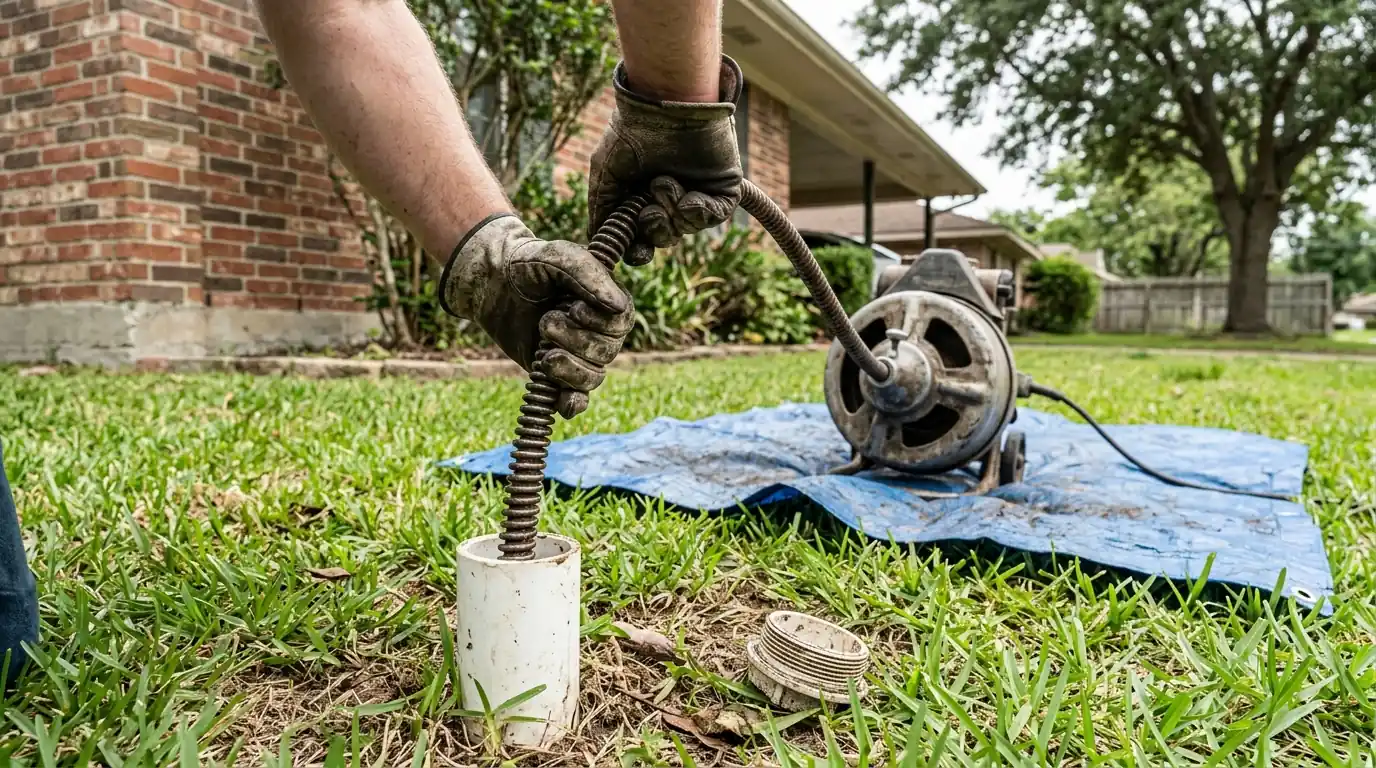
A cleanout is a capped pipe that gives direct access to the sewer line. On many Houston slab homes there is one in the yard between the house and the street, sometimes near the foundation where the drain leaves the slab. It is usually a 3 or 4 inch white PVC or black ABS pipe with a threaded cap, sometimes hidden in a flower bed.
If you find it, you can tell a lot by loosening the cap slowly. Stand to the side, because a full line will push water out. If the cleanout is full of sewage, the blockage is between that point and the street. If it is dry while the house is backing up, the problem is between the house and the cleanout, often under or just outside the slab.
Older homes sometimes have no outside cleanout at all, or a broken cap filled with dirt. That makes every future clog harder to reach, and adding one is a sensible fix once the line is clear.
Roots, grease and old pipe: the usual causes
In this part of Texas, the common causes come down to a short list. Tree roots find their way into joints in older lines and grow into a mat that catches paper and grease. Kitchen grease cools and coats the pipe wall until the opening narrows. Wipes sold as flushable do not break down the way paper does and snag on anything rough inside the pipe.
Pipe age matters too. Cast iron disappeared from new house construction by the mid-1980s, and estimates put its life at roughly 50 to 65 years, with deterioration that can begin about 40 years in. Inside an old cast iron line, scale and rust build ridges that catch debris, and cracks let roots in. If your house dates from before the mid-1980s and backups keep coming back, the pipe itself may be part of the problem.
Not a do-it-yourself job?
Call any hour. A plumber can test it and show you the result.
Cable, jetting or camera: how the line gets cleared
Most main line backups start with a cable machine run through the cleanout. A cutting head on a spinning steel cable punches through the blockage and chews up roots so water flows again. That is what main sewer line cleaning usually means, and it often gets the house working within the visit.
Cabling opens a path but leaves some buildup on the pipe wall. When grease or heavy scale is the cause, or roots grow back fast, high-pressure water jetting scours the wall closer to bare pipe. Jetting needs a line in sound enough shape to handle it, which is one reason to look before you jet.
A sewer camera inspection after the line is clear shows what caused the backup: a root mass at a joint, a belly where water sits, an offset joint, or broken pipe. That recording is what turns a guess into a plan. For a single slow sink or tub, standard drain cleaning at the fixture is usually enough and no camera is needed.
When the problem is a broken line, not a clog
Some signs say the pipe has failed rather than clogged. The backup returns within weeks of a cleaning. The cable comes back with soil or chunks of pipe on it. The camera shows a collapsed section, a joint pulled apart, or a dip that stays full of water. Outside, you may see a soggy, sunken strip of lawn over the line or smell sewage in the yard.
At that point more cleaning only buys time. The usual next step is a sewer line repair that digs and replaces the damaged section, or a lining or replacement if the problems run the length of the line. If the broken drain sits under the slab instead of the yard, the job changes, and our guide on what a hydrostatic test tells you explains how those leaks get confirmed.
Cleaning up and keeping it from happening again
Sewage is not ordinary water. Wear gloves and boots, throw away soaked rugs and porous items that cannot be washed hot, and disinfect hard surfaces. If it reached drywall or carpet pad, those materials usually need to come out and dry properly. Take photos for your insurer before you clean.
To cut the odds of a repeat: keep grease out of the sink, put wipes in the trash, and if roots were the cause, plan on cleaning at a set interval until the line is repaired. A camera check every so often on an older line lets you see trouble growing instead of finding it in the tub.
Questions
Follow-up questions readers ask
No. If the tub fills when other fixtures drain, the main line is blocked and every flush pushes more sewage into the tub. Hold off on all water use until the line is cleared.
The line from your house to the city tap is usually the owner's to maintain. If the cleanout near the property line is dry and the city main is backing up, that is the city's issue. A camera run shows which side the blockage is on.
The washer dumps a lot of water fast. If the main is partly blocked, that surge pushes air back up through the nearest fixture, often a toilet. Treat it as an early warning of a main line clog.
Recurring backups every few months, slow drains across the house, and trees growing near the yard line all point to roots. A camera inspection confirms it and shows how deep into the line they go.
Not for a one-time clog that clears easily. If the main has backed up more than once, the house has older pipe, or the cable brought back roots or debris, a camera run is worth it.
When you need the work done
Services this guide covers
- Main Sewer Line CleaningBackups in more than one fixture cleared at the cleanout, roots included.
- Drain CleaningKitchen, bathroom and laundry drains cleared with the right cable for the pipe.
- Sewer Camera InspectionA recorded camera run that shows breaks, bellies and roots before anyone digs.
- Sewer Line RepairOne cracked, offset or root-broken section dug and replaced, not the whole run.
Keep reading
More from the Plumbing Library
- Repiping a Houston home: what to expectA third leak in two years, rusty water in the morning, or gray plastic pipe in the attic.
- Gas leak or red tag: getting gas back onMaybe you smelled gas and the utility shut it off, or a tag showed up on the meter after an outage.
- Slab leak signs in a Houston house: what to checkMost slab leaks announce themselves quietly: a patch of floor that feels warm, a bill that makes no sense, a faint hiss at night.
Plumbing problem right now?
We answer 24/7. Call and talk to someone who can send a plumber.