Plumbing Library
Gas leak or red-tagged meter: how to get your gas back on
Maybe you smelled gas and the utility shut it off, or a tag showed up on the meter after an outage. Either way the stove and water heater are dead until the piping is cleared. Here is the order things happen in.
By Greta Wilburn, Plumbing Library EditorUpdated October 2026
Short answer
If you smell gas in a Houston home, leave right away, don't flip switches or start a car in the garage, and call the gas utility or 911 from outside. After a leak or an outage, CenterPoint needs your plumber to inspect and repair the house piping and appliances before it fully restores service, which usually includes a pressure test.
If you smell gas, leave first and call from outside
Natural gas has an added odor that most people describe as rotten eggs or sulfur. If you notice it inside, especially strongly or near an appliance, treat it as a leak until someone proves otherwise. The goal of the first few minutes is simple: get people out without creating a spark.
Do these things, in this order:
- Get everyone, pets included, out of the house and away from it
- Do not turn lights or anything electrical on or off, and do not unplug anything
- Do not use a phone, doorbell or garage door opener inside the house
- Do not start a car parked in an attached garage
- Leave doors open behind you if it is quick and safe, but do not stay to open windows
- Once you are well away from the house, call the gas utility emergency number or 911
- Do not go back in until the utility or fire department says it is safe
Why the meter gets shut off and tagged
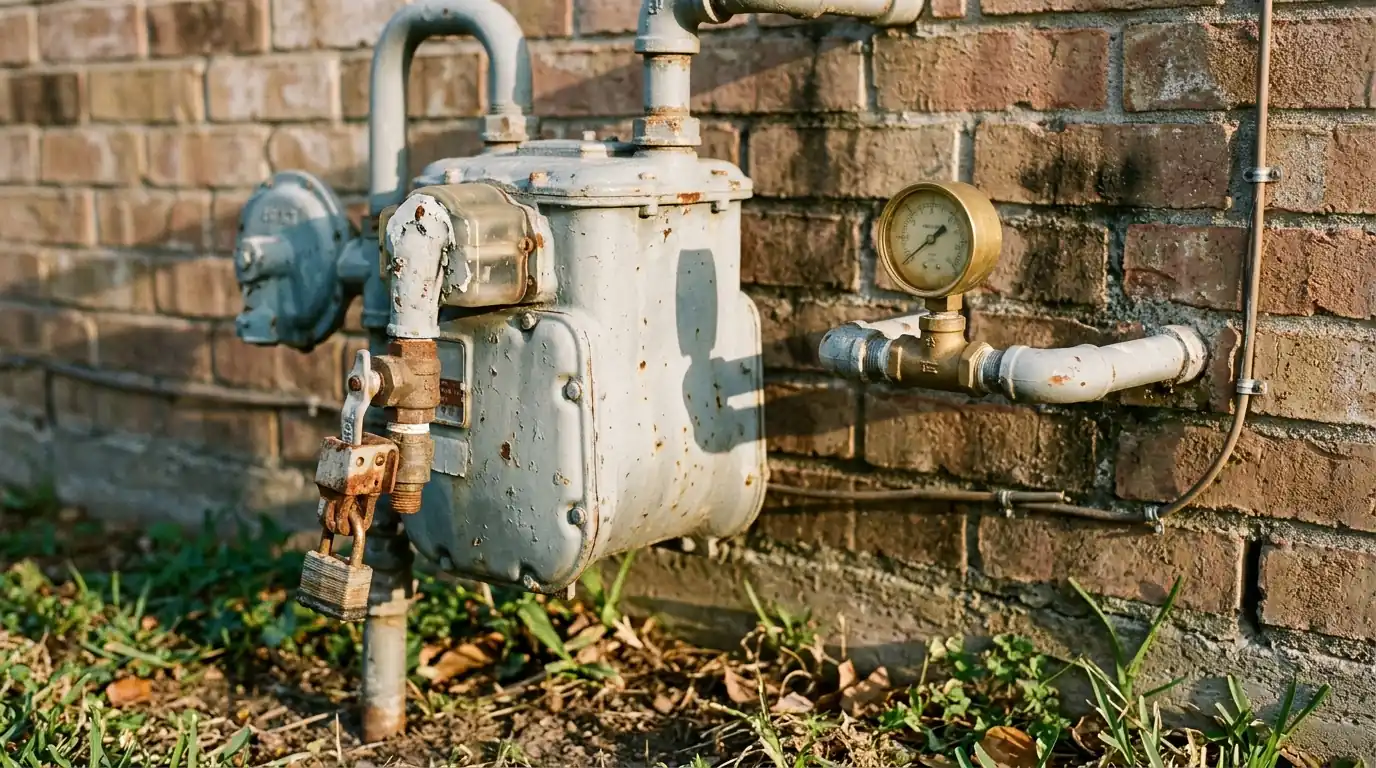
When the gas utility or fire department responds to a leak, they find the source if they can and make the house safe. If the leak is on the house side of the meter, in your piping or an appliance, the usual answer is to shut the gas off at the meter and lock or tag it. The tag is a notice that gas is off for a safety reason and should not simply be turned back on.
Homeowners sometimes see a tag after something other than a leak. After an outage in the gas system, CenterPoint Energy says customer-owned piping and appliances have to be inspected and repaired by the customer's plumber before it can fully restore service. So a shut-off for a neighborhood outage can lead to the same step as a leak: someone has to check the house side before the gas comes back.
Do not cut a lock or turn the meter valve yourself. Beyond the risk, it leaves the utility unable to restore service the normal way.
The utility owns the meter, you own the house piping
This split explains who does what. The gas company is responsible for its main, the service line to your meter and the meter itself. Everything downstream, the yard line to the house, the piping in the attic or walls, the shut-off valves and the flexible connectors to each appliance, belongs to the homeowner.
That is why the utility will not repair a leaking water heater connector or a corroded attic fitting, and why it needs to hear from your plumber before restoring service. Our job is the house side: find what leaked, fix it, and show that the system holds pressure. A gas leak repair covers that whole sequence.
Permits and who can pull them in Houston
Gas work inside the City of Houston is permitted work. The Houston Permitting Center says a plumbing permit is required for the point of intended connection to a fuel gas appliance or device, and that the permit has to be obtained by a master plumber registered with the City of Houston.
In practice that means a homeowner cannot pull the gas permit for a new water heater hookup or a new appliance line themselves. Surrounding cities run their own permit offices, so the exact paperwork can differ. Ask whoever does the work which permit applies to your address and whether an inspection is needed before the utility restores gas.
Want it checked instead?
Ring us 24/7 and we will get someone out to look.
What the pressure test involves
A gas pressure test shows whether the house piping is tight. The basic idea is the same everywhere, even though the required pressure and time can vary by jurisdiction and by the size of the system.
We isolate the house piping from the meter and from the appliances, then connect a test gauge and pressurize the system with air. The gauge has to hold steady for the required time. If the needle drops, there is a leak somewhere, and we track it down with soap solution on fittings and an electronic gas detector along the runs. Once it is fixed, the test runs again until it holds.
Common culprits we find: old flexible connectors behind ranges and dryers, threaded joints in the attic, valves that have weeped for years, and corrosion where pipe passes through a wall. A gas line pressure test is also what a new line or an extension gets before it goes into service.
- Isolate the meter and appliances from the house piping
- Pressurize the piping and watch a test gauge for the required time
- Find and repair any leak, then retest until the gauge holds
- Reconnect appliances and check each connection for leaks
- Coordinate with the utility and, if needed, the permit inspector
Getting the gas turned back on
Once the piping passes and any required inspection is complete, the gas utility comes out to remove the lock and turn service back on. Someone needs to be home, because every pilot light in the house has to be relit and each appliance checked for proper burner operation. Water heaters are the one that most often needs attention after a long shut-off; a pilot that will not stay lit or a burner that will not fire can mean a thermocouple or control issue, and that becomes a water heater repair.
If the leak was in an old or poorly routed line, it can make sense to replace that run rather than patch it. A new gas line to the range, dryer or water heater is permitted and tested the same way, so it fits naturally into the same visit.
How long you may be without gas
Timing depends on three things: how fast the leak is found and fixed, whether a permit inspection is required before restoration, and when the utility can schedule the turn-on. A small connector leak that passes on the retest can move quickly. A leak inside a wall, a failed test that takes several rounds, or a permit inspection adds days.
In the meantime, a gas water heater and range are off, so plan for cold water and a microwave. We answer 24/7, so you can call the night the meter gets locked and get the house side moving while you wait on the utility.
Questions
Follow-up questions readers ask
No. A locked or tagged meter means the house side has to be checked first. Cutting the lock or turning the valve yourself is dangerous and can delay the normal restoration process with the utility.
A small smell at the meter can come from a tiny leak at a fitting, but you cannot judge the size by smell. Call the gas utility and let them check it. Do not tighten fittings at the meter yourself.
The utility is responsible for its side of the meter. CenterPoint says customer-owned piping and appliances must be inspected and repaired by the customer's plumber before full restoration after an outage, so someone has to confirm the house side is safe.
In the City of Houston, connecting a fuel gas appliance requires a plumbing permit obtained by a master plumber registered with the city. Nearby cities have their own rules, so check for your address.
Not reliably. A CO detector senses carbon monoxide from incomplete burning, not natural gas itself. A separate natural gas alarm is available, and both are worth having in a home with gas appliances.
It means the piping lost pressure during the test, so there is a leak somewhere in the system. The fix is finding it with soap solution or a detector, repairing it, and retesting until the gauge holds.
When you need the work done
Services this guide covers
- Gas Leak RepairGas smell, hissing fittings or a red-tagged meter handled the right way.
- Gas Line Pressure TestPressure testing that gets gas service restored after a leak or a shut-off.
- Gas Line InstallationNew gas runs for ranges, dryers, tankless heaters, generators and outdoor kitchens.
- Water Heater RepairNo hot water, pilot trouble or a leaking valve fixed on tank heaters, gas or electric.
Keep reading
More from the Plumbing Library
- Slab leak signs in a Houston house: what to checkMost slab leaks announce themselves quietly: a patch of floor that feels warm, a bill that makes no sense, a faint hiss at night.
- Repair or replace a water heater in Houston?A cold shower does not automatically mean a new heater.
- Tankless vs tank water heaters in Houston homesTankless heaters get a lot of attention, and for some homes they are the right call.
Need the work done?
Phone us day or night and we will take it from here.